
Reading Rowling the Hard, Right Way versus Enjoying the Surface Story
Last week on the Feast of the Transfiguration and a friend’s 25th wedding anniversary, I wrote a Substack post with the title above and the subtitle, ‘Images of the Transfiguration, Story as Non Liturgical Sacred Art, What We Do at Hogwarts Professor, and How We’ll Be Reading Hallmarked Man.’ In it, I shared my experience in 1981 at the University of Chicago ‘Smart Gallery’s exhibit of Raphael’s ‘Transfiguration of Christ’ and consequent conversion to a more traditional and less superficial understanding of art and story.
The post was taken in large part from my PhD thesis notes about story as a ‘non-liturgical sacred art’ and the difference between sacred art of all kinds and profane art with religious content. Believe it or not, it’s relevant not only with respect to how we read and appreciate the work of J. K. Rowling — to include of course the soon to be published Hallmarked Man— but also how we understand what it means to be human and how we properly align our lives and entertainments.
I understand that it’s hard sledding at points and not for those who are completely at home with conventional thinking (or who are predisposed to dismiss the idea that there are good, better, and best ways to do anything, to include reading, because that is somehow “exclusive”); I hope you will give it an honest reading when you have a minute and an open mind. ‘Reading Rowling the Hard, Right Way.’
Today is the Feast of the Dormition of the Mother of God, what Roman Catholic believers call the ‘Assumption.’ For an art historian and Catholic perspective on the sacred vs profane art distinction, I recommend Hilary White’s explanation of the difference between Catholic and Orthodox depictions of the Dormition of the Mother of God and especially White’s ‘Lies the Renaissance Told You,’ for her overview of when and how, in her terminology, sacred art became secular. It is an excellent overview of the gulf separating art that imitates nature, “illusionism,” versus the Creator’s “method of operation” aka Medieval “realism.”
If you want a short cut to one point of relevance to these ideas and how to read J. K. Rowling, just note that the ring around Christ in the Transfiguration and the Dormition icons, the so-called mandorla or almond, is traditionally the same shape as the Ichthys fish, the intersection of two circles, albeit on its side. The symbolism of this intersection of heaven and earth, the God-Man, plays an important part in understanding Rowling’s favorite painting, Caravaggio’s Supper at Emmaus, and Rowling’s use of it as the mother-of-pearl fish pendant in Running Grave.
Nick Jeffery and I discuss many of these ideas in our most recent conversation, also at the HogwartsProfessor Substack site, ‘Is Rowling a Romance Writer or What?‘ Rowling’s book review of Nikola Sturgeon’s memoir and the New York Times article, ‘The Wizard’s Everlasting Spell,’ about the vitality of Harry Potter fan fiction also provide a lot of food for thought germane to our plans for reading Hallmarked Man, believe it or not. Have a look or listen.
Today, though, is the Feast of the Dormition, which in addition to being one of the great Feasts of the traditional Christian Church that merits a two week fast in preparation, is my wife’s Name Day and my youngest son’s birthday. She shared with me after reading my post about Raphael’s heroic ‘Transfiguration’ her parallel experiences as an American going to high school in Italy on first seeing Titian’s ‘Assumption of the Virgin‘ while on a tour of Venice.
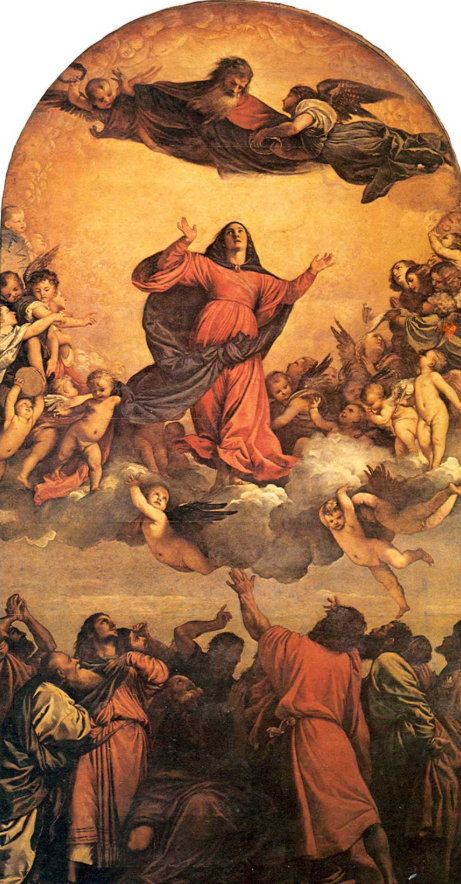
Please do read Hilary White’s essays (here and here) for an accessible explanation of why Titian and Raphael’s work, though beautiful, are profane art with a secular subject rather than sacred art per se. She is especially helpful, too, if you’ve ever wondered about those signature-for-the-period baby-with-wings representation of angels.
My wife’s experience of this painting as a jaded teen in the 70s with a crowd of her peers? Profane as it may be, as Raphael’s ‘Transfiguration’ had done to me, so Titian’s ‘Assumption,’ even larger than Raphael’s last painting, shocked her into reflection about her de facto atheism and vibrant skepticism about all things holy or ‘churchy.’ She marveled at and envied the faith of Christians that could produce a marvel like this. Read More “Reading Rowling the Hard, Right Way versus Enjoying the Surface Story”

 Dr John Granger and Nick Jeffery continue with their Lake and Shed readings into the fourth generation of Rowling scholarship. Join us for our celebration of Mrs Murray’s 60th birthday, and her
  Dr John Granger and Nick Jeffery continue with their Lake and Shed readings into the fourth generation of Rowling scholarship. Join us for our celebration of Mrs Murray’s 60th birthday, and her
  Dr John Granger and Nick Jeffery continue with our Lake and Shed reviews of the twenty-one stories written at least in part by J. K. Rowling. Join us for our celebration of Mrs Murray’s 60th birthday, and her