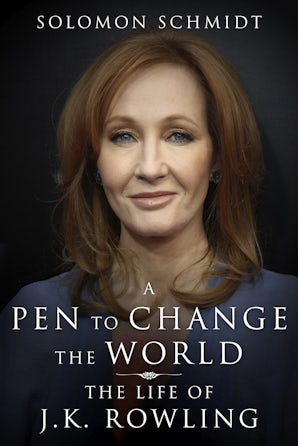
A Pen to Change the World – the Biography of J. K. Rowling by Solomon Schmidt.

A Pen to Change the WorldA new biography of J. K. Rowling is badly needed. J.K. Rowling: A Biography by Sean Smith provides an accessible, heavily detailed, but structurally simplistic look at the author’s meteorological rise. First published in 2001, Sean Smith’s unauthorized account focuses deeply on the trials and tribulations Rowling faced before finding global success with Harry Potter. Because his work functions as a time capsule from the very beginning of her career, it misses more than two decades of monumental shifts in her professional and personal life.

My copy of Smith’s book bears the dents and battle scars of being hurled across the room when the reference I’m looking for proves to be missing or inaccurate. There are some howlers such as the lower second class honours that Rowling gained at Exeter are translated into an incomprehensible (for British readers) 2.2 Grade Point Average, and Rowling’s parents being posted to a Commando base at Arbroath (as it is now), not the Royal Naval Air Station technical training base (as it was then).

As John Granger pointed out when the new biography by Solomon Schmidt was announced, he is very young, and his publisher seems to specialise in controversial books by, among others, Woody Allen, Robert F. Kennedy Jr., Ted Cruz and Rand Paul. This lefty socialist was not filled with confidence. Although Mr Schmidt sent me a very polite mail, I didn’t engage with him.

My reticence seemed to be confirmed when stories were placed in the gutter press to drum up publicity for the new book:

National Enquirer: J. K. Rowling’s Dad Sold Signed ‘Harry Potter’ Copy After She ‘Told Him to Go Pound Sand’

New York Post: JK Rowling’s father ‘ran illegal cannabis operation’ from secret cellar in house

In the later article Rowling’s cousin Ben is quoted as saying “When Pete was visiting me at one point in 1997, he told me that over the previous few years, he had been one of the largest growers of marijuana in South West England and Wales”. As someone who was a young man in Wales in 1997, I can confirm you would need a fair size farm to be one of the largest growers in the South West, not a few square feet of cold store designed to keep milk cool, when Church Cottage was a schoolhouse.

My worst fears seemingly confirmed, I was surprised when Solomon offered me a copy to review ahead of the publication at the end of June. The copy was electronic so I couldn’t even have the satisfaction of hurling it across the room…

In order to give A Pen to Change the World a fair review, I gave myself the following criteria, any one of which would be a valuable addition to the Rowling literature. If it fails all three tests, then save your money:

  1. A synthesis of all the available information we have about Rowling’s life brought up to the present date. This needs to be impartial, its okay to be sceptical and even critical, as long as the sources are presented fairly. This doesn’t need to be absolutely complete (impossible in a single volume), but should at least give a fair representation of what we know.
  2. Present new information, impeccably sourced, to known (not anonymous) people who’s lives have intersected with J.K. Rowling.
  3. Work as a piece of literature. The life of J. K. Rowling is extraordinary. If that life can be presented in an engaging way, and be a joy to read, without ‘fictionalising’ her life, this would still be a valuable book even if the above goals can’t be met.

A Synthesis of all the Available Information

A Pen to Change the World is wonderfully comprehensive, with material that has been made available after the Smith biography, woven cleverly into the narrative both pre and post Potter. All of the sources are included in an appendix of some 91 pages and referenced to each line and page of the biography. Solomon did not need to do this; most writers would have been happy with the five-page bibliography and links to extensive article and AV citations. What this does provide is an invaluable tool for researchers. A source list presented in a chronology of J. K. Rowling’s life, that will save very much time for anyone interested in looking for biographical reflections in Rowling’s works.

There are some surprising omissions. The astrological duo Starsky and Cox, that J. K. met and befriended during her year in Paris do not get a mention. But these are very few and far between, and I do bear in mind that the Hogwarts Professor interest in Rowling’s astrology might be somewhat niche.

It is Solomon’s credit that I could tell from the text what his politics biases might be. As a social minded liberal, what in the UK is called a centrist, in the later chapters there are parts of the biography I found troubling. I feel confident that would be true for everyone, no matter their political persuasion, because wherever a conflict is discussed, the author has presented both sides neutrally, and in the protagonist’s own voice.

***** Neutral, comprehensive and excellently sourced.

Present New Information

Although the biography is unauthorised by J. K. Rowling herself, Solomon Schmidt has gained access to some well-known names in Rowling’s life: Jorge Arantes, Barry Cunningham (the publisher who signed J. K. Rowling to Bloomsbury), Steve Eddy (Rowling’s English teacher), Ben Rowling and Bryony Rowling.

The revelations published in the press, at the time of writing, have come from the last two. Ben and Bryony are her American cousins, and their stories seem to be presented honestly. Where there are discrepancies with the possible (I’m wording this delicately) this could be due to the fanciful reminiscences of childhood or the hyperbole of Peter over a few drinks. I find it likely that Peter did grow marijuana, but it would only be enough for home consumption (perhaps initially to alleviate Anne’s symptoms of MS) and perhaps for a few friends in the Pub.

For students of J. K. Rowling’s lake there are a few more revelations that I have agreed not to mention prior to publication, but I eagerly look forward to discussing after that time.

**** New information has been published, and while I don’t think there is anything there to set the world on fire, Solomon is to be congratulated for finding what he has.

Work as a piece of literature.

This book is beautifully written. For the first few chapters I tried to keep track of the source material by keeping the book open to the appendix on one table while reading the text with another but abandoned this to concentrate on the story. The prose complements the shades of light and dark without being overly intrusive. A few times Solomon inserts some sentences to evoke the time and place without it appearing padded. In fact, the straightforward style can appear sparse at times but helps what is a very complex life clip along at pace. Uniquely, this biography has made it to my to-be-re-read list and not just as a reference volume.

***** A wonderfully written story, that works as a very immersive read.

Conclusion *****

I have no hesitation in recommending this book to any Rowling fans and scholars. In fact, I would recommend this book to anyone who enjoys a good story well told. The importance of A Pen to Change the World to future scholars is thanks to its voluminous citations, new references to never before documented interviews and scrupulous impartiality. The reason for it to likely enjoy widespread popularity will be down to J. K. Rowling being one of the centuries great lives. It is a life that deserves a biography of the standard of Solomon Schmidt. 5/5 Stars

MuggleNet Drops Staff, Gets Sued, Disapparates, Reappears Brand New

MuggleNet.com is, with The Leaky Cauldron and The Harry Potter Lexicon, one of the few Harry Potter fandom websites with an international following and more than a quarter century of reporting, commenting on, and celebrating everything to do with the Wizarding World. These sites were daily stops from Generation Hex during Potter Mania, 1999 – 2012, the years the books and first film film adaptations appeared.

In July 2020 with the advent of the Trans Wars, however, MuggleNet broke with Rowling, Inc., with which entity they had previously served as an unpaid marketing extension, in fidelity to their beliefs that human beings can become the other sex by believing they are. MuggleNet made this move, all but declaring the author of the Harry Potter series ‘She Who Must Not Be Named’ on their site’s posts and podcasts, by linking arms in a brotherly boycott with every other fandom site (except this one and The Rowling Library).

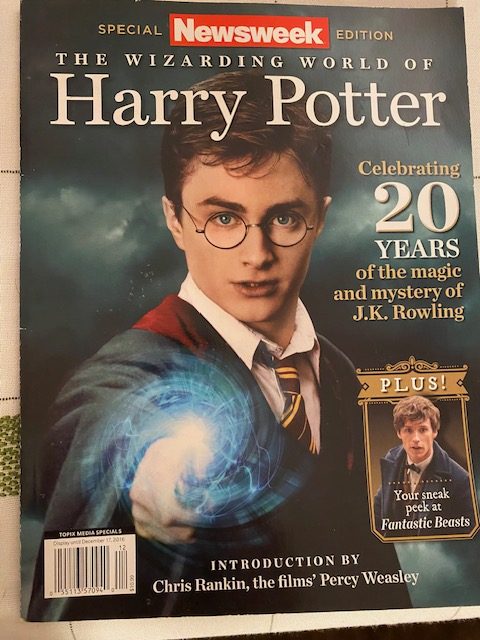
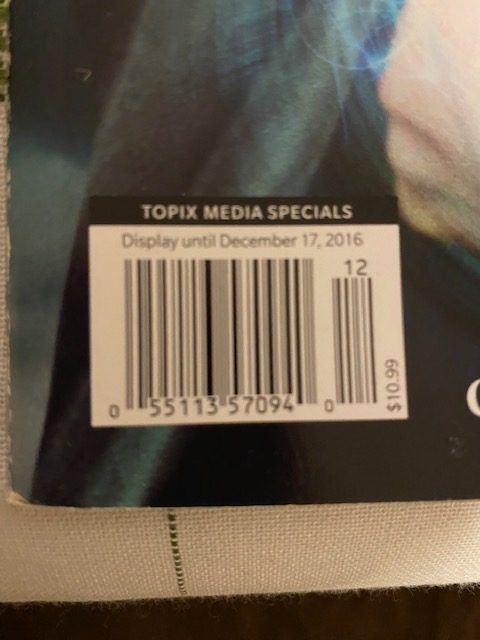
The difference in those closed ranks, though, was that the founder of MuggleNet, Emerson Spartz, had sold his website in 2020 to Topix Media Lab, a magazine and paperback book publisher that had already been printing Potter titles with MNet cooperation for years. The new owners oversaw a reformatting of the site and published a wave of new book titles but for the most part retained its staff of many years, most of which were technically volunteers, and its large archive of posts and podcasts.

In September 2025, though, Topix decided to clean house and start over. They fired everybody and in April 2026 wiped the site clean of its past. As The Leaky Cauldron’s ‘Amanda Kirk’ wrote last week in a piece titled ‘MuggleNet Has Become a Horcrux:’

In 2020, the site changed ownership to a company, Topix Media Lab, that had been in partnership with MN for its print publications. For some years after the sale, operations at the site appeared similar from the outside, albeit with a seemingly bigger push for ad revenue by Topix. In September 2025, Topix emailed MN staff to inform them that their services were no longer required. Staff numbers had fluctuated but some had remained dedicated to MN for nearly 20 years. Unless the owners planned to shut down MN, why abruptly dismiss all that institutional knowledge and devotion? The mystery deepened when Topix posted an ad on LinkedIn looking for a single full-time paid staff member to run the site. Qualifications listed for the position included an MBA.

The staff decided to fight back in court — and watched Topix guard its legal flank in April by dropping all their “volunteer” labor efforts overboard of the site with a new MuggleNet in everything but name: [Read more…]

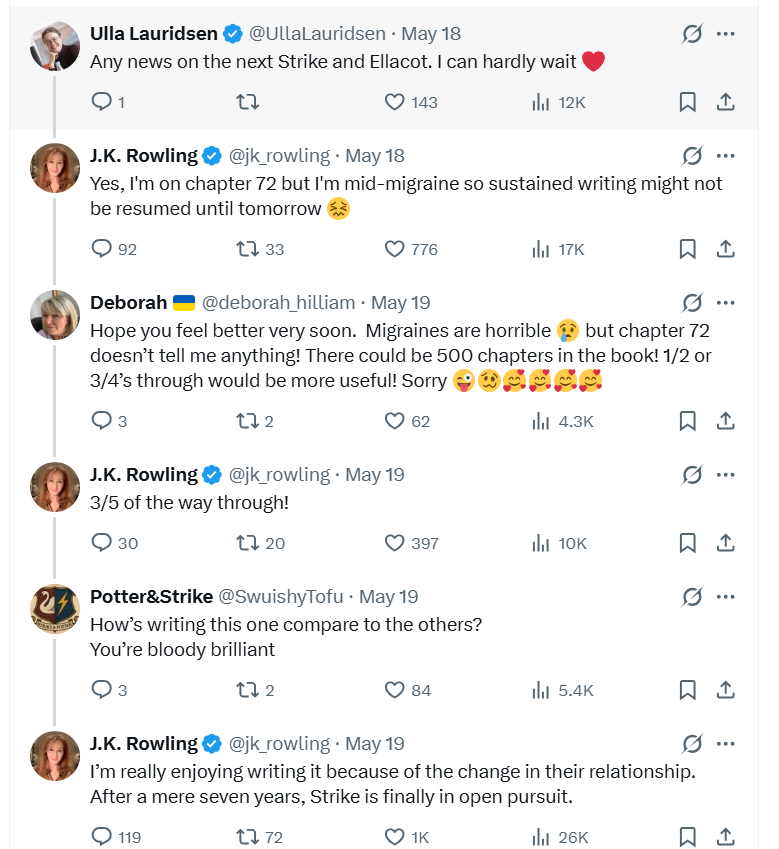
Rowling Tweets Status of ‘Sleep Tight, Evangeline:’ Sixty Percent of First Draft

Url to Thread

Three quick notes about this news!

  1. If 72 chapters is approximately 60% of Sleep Tight, Evangeline, then we’re looking at another 120 chapter book. At best, those migraines not reflecting a brain tumor or even a chronic condition, Strike 9 won’t be with us until late in 2027. That she is writing and enjoying the process, however, means the intense planning of this entry in a series of intricately structured novels is over and she is in the hard-slog of writing business. Fair winds, etc.
  2. Check out the Rowling tweet on the thread of which the Serious Striker thought it appropriate (and apparently Rowling agreed!) to ask about the fictional work in progress. Maybe her posts about government ineptitude and party politics are the secret passage to ask The Presence questions about her work? Those of you who enjoy life on social media, please ask her about the ten book series structure, the alchemical sequence, or whether the allegory of Cormoran and Robin is Cupid-Psyche mythic template, Jungian archetypal psychology, or Shakespearean romance.
  3. “After a mere seven years, Strike is finally in open pursuit.” One of the speculative ideas about Evangeline has been that Robin will be disappearing from Strike’s life for much of the novel via a kidnapping or a retreat to work with the Cursing Crone Psychologist (a la Psyche’s trip to see Persephone at Venus’ bidding). If Strike is at last “in open pursuit” of winning Robin’s hand in marriage, that suggests that, no, Robin will be center stage in Strike 9. Doesn’t it?

Let me know how you read these migraine inspired bon mots to her followers on Twixter!

Warren Farha: Memory Eternal!

Warren Farha died last night. If you’ve heard of Warren or had the pleasure to meet him, if you don’t live in Wichita, Kansas, odds are it is because of Eighth Day Books, an independently owned bookstore in a quirky private residence whose every shelf contains at least a month’s worth of challenging reading, fiction and non-fiction, that will provoke and raise up your thinking about what it means to be human.

Read the wikipedia page about Eighth Day Books or the New York Times 2015 profile (unlocked by Rod Dreher) after taking the Sorina Higgins quick guided tour of the store above. Hogwarts Professor is a weblog for Serious Readers; Eighth Day Books is a pilgrimage site for such people. Like few other places I have been and even fewer business establishments, Eighth Day Books reflects a single person with a vision of a possibility that no one else saw and which grew to include an international and local community of other faithful, intelligent people whose lives were changed by it.

I was invited by Eighth Day Books to be the featured speaker at the first Eighth Day Institute symposium sixteen years ago. I met Warren then, met him again when I spoke a few years later at the Orthodox cathedral in Wichita, and once more most recently at a St John’s College graduation in Santa Fe, New Mexico. Each time I was impressed by his quiet solidity and sobriety, a perceptible depth of character beneath kindness and a sense of humor that was much more about thoughtful smiles and the connection of eye contact than guffahs.

The topos of grief is to say, ‘The world is a better place because of Warren Farha; the world will be less a place of joy and fraternal love in his absence.’ This is true, of course, and profoundly so however cliched the sentiment may seem especially to those of us who were blessed to meet him, even incidentally as my meetings were. I trust that the thoughtful people at Eighth Day Books will continue to run the business as Warren did and that readers here, if they have not been there already, will visit the store in person or via its website.

My take-away from Warren’s life and Eighth Day Books, though,  is from the sui generis genesis point of the operation. As he explained it years ago in a talk he gave about vocation: [Read more…]

Appalachia in the ‘Hunger Games:’ The Real Life Roots of District 12

I like to think of myself as a Hunger Games fan and a real admirer of Suzanne Collins’s work in general. You can read what I have written about her Panem Trilogy here. You’ll note in that collection of urls that there are a bunch from Elizabeth Baird Hardy, our resident expert on these books and the film adaptations made of them.

Unlike Elizabeth’s other brilliant work at Hogwarts Professor, say, on the Faerie Queene epigraphs in Troubled Blood or about C. S. Lewis (e.g., here and here) when she writes about the Hunger Games she is drawing on more than her years of close reading and skills as a published scholar. District 12 is where she lives.

And she’s written a book about it that you can pre-order today and read next month: Appalachia in the Hunger Games: The Real Life Roots of District 12.

In it, Elizabeth brings together her roles as a literary maven and as a champion of Appalachian heritage. The descendant of some of the earliest settlers in Appalachia, she is a storyteller, historic interpreter, and teacher who has shared her passion for and knowledge of Appalachia and its people for over 30 years. As a writer, she has explored the literary treasures in texts ranging from the Chronicles of Narnia to Harry Potter and has been Deputy Head Mistress here at Hogwarts Professor for over fifteen years. She relies on both those roles to delve deeply into the Hunger Games books and to reveal how these fictional stories feature much that is true.

In 2011, when there were only two Hunger Games books and no films, Elizabeth started teaching the first book in her freshman composition classes in the western mountains of North Carolina. Her students responded so positively that she kept using the book for years. One reason the book worked so well was that her mountain college students understood the culture of District 12 because it was familiar. Suzanne Collins has created a world woven with elements of Appalachian culture and characters whose decisions and voices are often distinctly Appalachian.

This volume has been over a decade in the making. Elizabeth contributed a chapter on Appalachian Culture in the Hunger Games to the 2016 Critical Insights: The Hunger Games Trilogy. She quickly realized that there was enough material for an entire book. Although events like COVID and personal challenges presented obstacles along the way, those delays allowed her to draw upon the two prequels. Sunrise on the Reaping, in particular, has a wealth of connections to Appalachian culture and history. Thanks to an understanding publisher, this book will now be arriving just before the film of Sunrise on the Reaping.

Twelve chapters look at various aspects of Appalachia that directly connect to the novels: Geography and geology; Plant Life; Birds and Animals; Foodways; Stereotyping and Perception by the Larger Culture; Violence and Alcoholism: Self-Sufficiency, Isolation, and Xenophobia; Family and Independence; Faith and Fatalism; Humor and Storytelling; Music; Time: Circles and Cycles. Each chapter draws together Suzanne Collins’s fiction and the actual Appalachia and its people, history and culture. Readers who are unfamiliar with the real Appalachia are sure to learn more about the place they have visited in print, and even those who know Appalachia well will discover more about both the real mountains and the literary ones of District 12.

The book is currently available for pre-order on Amazon and from McFarland.  More information on Elizabeth, her work, and opportunities to hear her speak can be found at AppalachianInkling.com.