Plants on the Reaping: Botanical Symbols on a Sunrise First Read
With Sunrise on the Reaping being told from Haymitch Abernathy’s perspective, I had high hopes for more insights from District 12, Appalachia, my very own stomping ground.
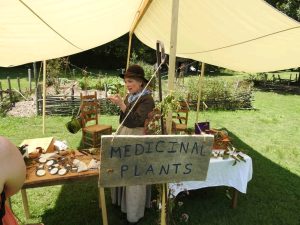
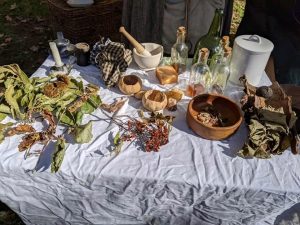 Those hopes have not been disappointed. In the coming weeks, with re-reads, I’ll be posting more thoughts from my scrappy district, home of rascals and jackasses alike. For my thoughts after a first read, I thought we’d focus on one of my favorite motifs from the original trilogy: plants, particularly those native to Appalachia, both now and in the distant dark future of Panem. Botanicals, both literal and symbolic, crop up all over the novel, and they are a particular favorite of mine, as I research and present historical programs on medicinal plants in particular. So let’s take a tiptoe through the garden. Beware: spoilers abound, so, if you haven’t finished your own first read, wait outside the gate.
Real Plants
Although Haymitch’s interest in the woods, at least early in the book, has to do more with a covert location for bootlegging than with the local flora, actual plants, both wild and domestic, appear in some interesting ways that connect to the original trilogy and to the actual terrain of Appalachia.
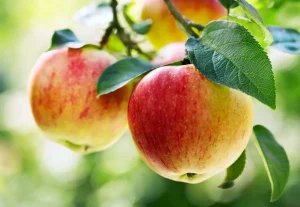 Apples and apple trees figure prominently in the original trilogy both as literal fruits and trees and as symbols, like the apple Katniss shoots out of the roast pig’s mouth in her session with the Gamemakers or the bag she unleashes to explode the Career’s supply pyramid. Haymitch first meets his beloved Lenore Dove when she is literally eating apples in an apple tree where he has gone with his friend, her cousin (more on him in a moment). Beyond their obvious use as an important food supply, especially in a world so dominated by hunger and the control of food, apples also bring to mind a host of connotations, from the traditional association with the Garden of Eden and its attendant serpent to fairy tales with enhanced apples.
When we first meet the girl who will eventually be Katniss’s mother, in her family apothecary shop, she has camomile, some of which she gives Haymitch for good luck. Camomile is a useful plant both as a pleasant tea and a sleep aid. Ironically, we already know, even before we see his Games, that Haymitch will spend his entire adult life having trouble sleeping.
Despite the fact that this book takes place long before her birth, some readers may have been hoping for an appearance by Katniss Everdeen. The first time the word “Katniss” appears, however, is near the end of the Quarter Quell when Haymitch refers to the literal plant which he uses as a landmark for where he leaves his backpack and where he and Maysilee collapse (290) after encountering the horrifying porcupine. Clearly, Collins is just throwing that in, a reminder that Katniss is an actual plant, Sagittarius latifolia, native to Appalachia and thus familiar to Haymitch, but it seems strange that the candy-coated nightmare arena should include this ordinary plant. It is also one of the few flowering arena plants that does not attempt to kill the tributes, a reminder of the role of Katniss herself and her association with this medicinal, edible plant.
Dangerous Foliage
Many of the other plants that appear, particularly in the arena, are not so innocuous. The bee balm into which imitation tribute Lou Lou falls is deadly. Actual bee balm is a wonderful plant, beloved of pollinators, excellent for tea, and possessed of many medicinal qualities. This version, however, has a poisonous pollen that, like much of the arena, is a perversion of something good or beautiful.
The butterfly bush, with its electric-sting butterflies, is also a darker version of a real plant. While some environmentalists discourage planting butterfly bushes, encouraging native plants instead, they are popular, lovely plants, very different from these, which cover the berm where Haymitch means to enter the arena and destroy the computer running the whole she-bang.
The plant Haymitch uses against the butterflies is one that already has its own defense system. Gas plant, or Dictamnus albus really is flammable. The actual plant, unsurprisingly, is far less violent than the arena version, and isn’t even very toxic, but nothing in the arena is harmless, except, perhaps, for that katniss.
We should not be surprised by the ominous use of roses, President Snow’s favorite, particularly the white rose Haymitch has to wear for his Victory Celebration, contrasting the red one worn by Snow himself. Roses, white and red, are used as symbols of Snow and tools in his mental warfare, particularly against Katniss, and The Ballad of Songbirds and Snakes shows us some of the origins of those rose elements, so it is not surprising to see them here.
Perhaps the weirdest (real) plants that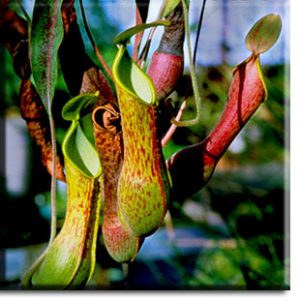 Haymitch encounters are not in the arena but in the Heavesnbees’ conservatory, Nepenthes. These odd carnivorous tropicals are very real plants, and very exotic, so nothing Haymitch would have ever met outside of their name, which he knows from memorizing “The Raven” as a gift to Lenore Dove, but he immediately recognizes that they are as dangerous as they are lovely, a hint of what is to come in the arena.
By any Other Name
As Collins has long demonstrated, with characters like Katniss and Rue, plant names in her books are intentional and powerful. That theme continues to resonate in Sunrise. While it may take readers a moment to realize that Haymitch’s best friend, Burdock, is Katniss’s father, whom we have only ever known before as “Mr. Everdeen,” his first name is an incredibly appropriate plant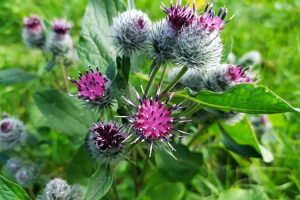 reference. In addition to the wonderful nickname, “Burdie,” which beautifully connects to his lovely singing voice so enjoyed by the mockingjays, Burdock is a suitable choice of name. Great Burdock, is a tough plant with a host of medicinal uses for nearly all of its parts and antibacterial properties. Although the leaf hairs can cause irritation, burdock is not poisonous. The most annoying but also most distinctive feature of the plant are its burrs that, each fall, stick to everything like Velcro! This is a perfect name for the resourceful father whose memory sticks with Katniss. In addition, it’s an imported plant, one that is not native to North America but which has become such a part of our landscape that it is included in one of my favorite resources for indigenous plant uses, Paul B. Hamel and Mary U. Chiltoskey’s Cherokee Plants—Their Uses, a 400-year History, a collection of plant remedies used by the Cherokee for centuries.Chickory, which lends its name to one of the District 11 Tributes, is another of those common plants that is actually not native to the continent but is familiar to nearly everyone.In its non-native origins, its host of uses, and its integration into the ecosystem, burdock is very similar to another plant used in Collins’s original trilogy, the dandelion. Katniss always identifies Peeta with dandelions, from their earliest encounters as children to her realization that he is her perfect match. Thus, Katniss’s father and her future husband are linked with very similar plants. In addition, katniss, dandelions, and burdock all have eduble roots.
Really, the man whose daughters are named for flowers, who forages to support his family, and whose knowledge saves them after his death, couldn’t have a better name than Burdock.
Asterid March, whose parents run the apothecary shop and who we quickly realize will be Katniss and Prim’s mother, has a plant name as well, as “asterid’ refers to flowers that grow in clumps. Considering that she cannot function after Burdock dies and is part of the beautiful blond trio that is destroyed by the Reaping of Maysilee Donner, her name is perfect for one who is beautiful, but not independent.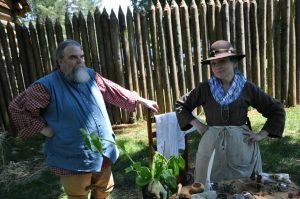
While this is just a quick look at some of the more interesting plant references woven through Sunrise of the Reaping, we certainly will continue to examine these themes and more as we continue. If you’d like to learn more about the real plants of Appalachia, I recommend the Peterson Field Guide to Eastern/Central Medicinal Plants and Herbs, by Steven Forst and James A. Duke. In my programs on eighteenth-century plant medicine, I rely heavily on this one.