Sunrise on the Reaping: The 3 Questions
 As I do my the essential re-readings to ‘get’ any Suzanne Collins novels, I find myself thinking again and again about three questions for which we have yet to have answers about Sunrise on the Reaping and The Ballad of Songbirds and Snakes.
Structure: The only comments the author has made about her story structure was with respect to standard three part sequence of story events (inciting incident, turn, reversal, climax, denouement, etc.). Her use in four of the five Hunger Games novels of a three-based system (3 Parts with 3-squared chapters in each, the first three comprising a trilogy of books), however, where her story-points occur as a rule in that structure, if it has ring or chiastic elements within it, whether there is a literary alchemy black-white-red sequence as there seemed to be in the Mockingjay novels, all those structural questions remain unanswered. Collins’ obvious structure suggests significant, signature artistry. I’m determined to explore that at last.
Symbolic Depth: The first three novels were at their anagogical depths transcending the surface political allegory the story of the soul’s apotheosis; the soul triptych being Gale as the body, Katniss the soul, and Peeta the Spirit. Read about that in these three ‘Unlocking Mockingjay’ posts:
- ‘Unlocking Mockingjay: The Spiritual Allegory’ On Katniss as a Soul Seeking Perfection and Iconological Reading
- ‘Unlocking Mockingjay: The Literary Alchemy’ On Literary Alchemy and Peeta as Postmodern Christ
- ‘Unlocking Mockingjay: Katniss’ Apotheosis’ On the Alchemical Arena and Katniss’ Perfection in the Inner Sanctuary
Collins’ achievement as a writer in the original Hunger Games trilogy was largely her use of traditional symbolism to create a story in which her readers could share in Katniss’ agonizing transformation and union with Peeta, a cathartic bonanza almost unique in YA literature.
Is there anything like this going on in the prequel novels? It is hard to believe there isn’t given Collins’ accomplishment in the first series, but one has to allow, as Elizabeth Baird Hardy suggested yesterday, that the pressure for a profit-taking and series re-introduction must be enormous.
Series Destination: Are we done? If not, where are we going? Is the prequel series to be a three book set that closes with the Plutarch Heavensbee novel, one that takes from that oligarch’s first meetings with Coriolanus Snow through the Catching Fire Quarter Quell and Mockingjay revolution? Or will it be an indefinite number of books providing more and more back story of the original books? Quo vadis? We’ll be obliged to ask that question.
What questions haunt you? Let me know and Elizabeth Baird Hardy and I will discuss it here!
 film deal is already cemented, and speculation is hot regarding casting and other decisions. But, readers and investors alike are already asking “will she or won’t she” regarding additional books. Earlier this week, our esteemed headmaster, John Granger,
 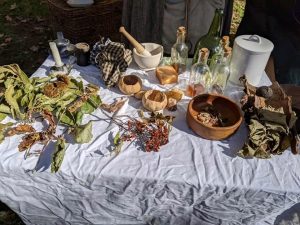 Those hopes have not been disappointed. In the coming weeks, with re-reads, I’ll be posting more thoughts from my scrappy district, home of rascals and jackasses alike. For my thoughts after a first read, I thought we’d focus on one of my favorite motifs from the original trilogy: plants, particularly those native to Appalachia, both now and in the distant dark future of Panem. Botanicals, both literal and symbolic, crop up all over the novel, and they are a particular favorite of mine, as I research and present historical programs on medicinal plants in particular. So let’s take a tiptoe through the garden. Beware: spoilers abound, so, if you haven’t finished your own first read, wait outside the gate.