
Rowling Tweets on Strike Psyche Profile
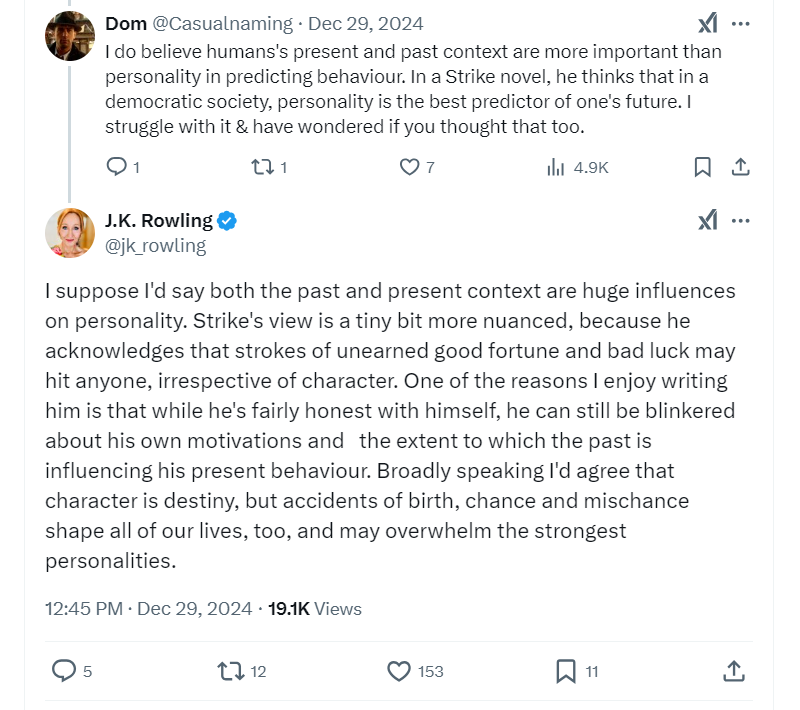
This too brief but fascinating look at Strike’s psychological make-up by Robert Galbraith herself came at the end of an equally intriguing thread about Hannah Arendt, Eichmann, and the banality of evil “transgender” fellow-travelers. That longer effort of Rowling’s deserves its own post; today let’s look at the one-off response to someone who engaged Mrs Murray about Arendt. Three thoughts?
(1) Strike Laid Bare: Rowling-Galbraith tells us point blank Strike’s strengths and weaknesses, and, in that exposure suggests strongly the direction of his transformation. “One of the reasons I enjoy writing him is that while he’s fairly honest with himself, he can still be blinkered about his own motivations and the extent to which the past is influencing his present behaviour.” Strike is about to be confronted in inescapable fashion, I think it safe to say, with “his own motivations” which will reveal to him the “extent to which the past is influencing his present behavior.” His ability to change in that crucible will be critical to his relationship with Robin.
(2) Strike and Rowling Agree: “Character is destiny” but… (Strike) “strokes of unearned good fortune and bad luck may hit anyone, irrespective of character” and (Rowling) “accidents of birth, chance and mischance shape all of our lives, too, and may overwhelm the strongest personalities.” Rowling’s artistry is depicting the morality of archetypal characters when challenged by “past and present context,” depictions of behavior for our reflection, empathetic identification, and cathartic experience. Again, Strike is about to be hit betwen the eyes with all that he has neglected in the “accidents of birth,” Strike’s being a supposedly ‘accidental birth,’ and perhaps by the “chance and mischance” of losing Robin to another man. I for one can’t wait.
(3) A Lake Point? Joanne Rowling was not born with a silver spoon for her porridge but “character” and writing genius as well as “chance and mischance” have brought her to the heights of fame, fortune, and notoriety coupled with adulation, albeit in different spheres. I think it is credible, as a reflective woman experienced in Cognitive Behavior Therapy and one who has studied psychology as an amateur, that Rowling thinks about her life, its twists and turns and tumbles and triumphs, more than most. And that this reflection on the tension between “character” and the “context” of “past and present” circumstances informs her Strike novels as something like an axis.
Hence the importance of this seeming off the cuff or throw-away look at Strike’s psychological perspective. Footnote it for reading before and after Hallmarked Man!