Rowling Rebukes Amnesty International, Highlights Important Court Case
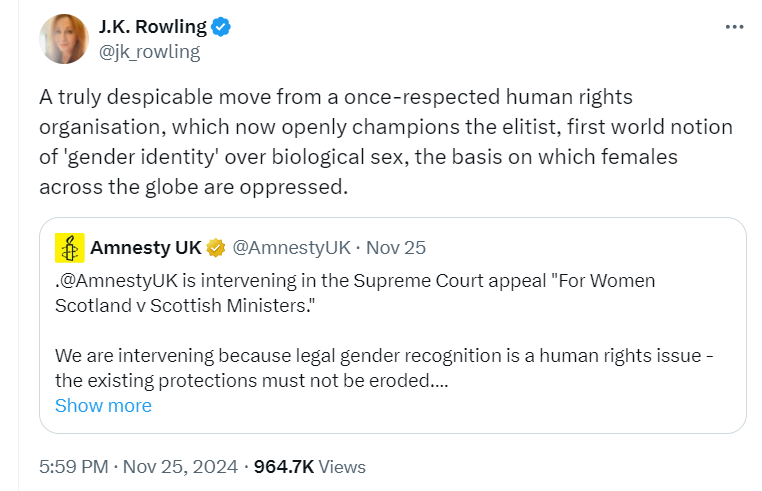
Three notes on this tweet yesterday from Rowling and the several she has made about the case before Scotland’s Supreme Court, For Women Scotland Ltd (Appellant) v The Scottish Ministers (Respondent):
(1) What the Case is About: Per the Supreme Court website page on the case:
Issues
Is a person with a full gender recognition certificate (“GRC”) which recognises that their gender is female, a “woman” for the purposes of the Equality Act 2010 (“EA 2010”)?
Facts
In this appeal, the Appellant challenges the lawfulness of statutory guidance issued by the Respondent, which has the effect that a GRC recognising that a person’s gender is female brings them within the EA 2010 definition of a “woman”.
The Gender Representation on Public Boards (Scotland) Act 2018 is an Act of the Scottish Parliament (“ASP 2018”). It sets targets for increasing the proportion of women on public boards. The original ASP 2018 definition of a “woman” included people: (i) with the protected characteristic of gender reassignment; (ii) living as a woman; and (iii) proposing to undergo / undergoing / who have undergone a gender reassignment process. In a 2022 legal challenge brought by the Appellant (“FWS1”), the Court of Session found that this statutory definition was unlawful, as it dealt with matters that fall outside the legislative competence of the Scottish Parliament.
Following FWS1, the Respondent issued new statutory guidance. This is the guidance currently under challenge. It states that, under the ASP 2018, the definition of “woman” was the same as under the EA 2010. It also stated that a person with a GRC recognising that their gender is female has the sex of a woman.
The Appellant challenged the lawfulness of the Respondent’s statutory guidance in the Court of Session. The Appellant’s arguments included that the guidance failed to respect the decision in FWS1. On 13 December 2022, the Outer House dismissed the Appellant’s petition. The Appellant appealed. On 1 November 2023, the Inner House upheld the decision of the Outer House and dismissed the Appellant’s appeal.
The Appellant now appeals to the Supreme Court.
The case was heard today and will be decided tomorrow.
(2) Importance of Case: Rowling believes this case is, per a re-tweet, “one of THE most important legal cases in the UK/world right now. It will impact women’s & girls lives EVERYWHERE.”
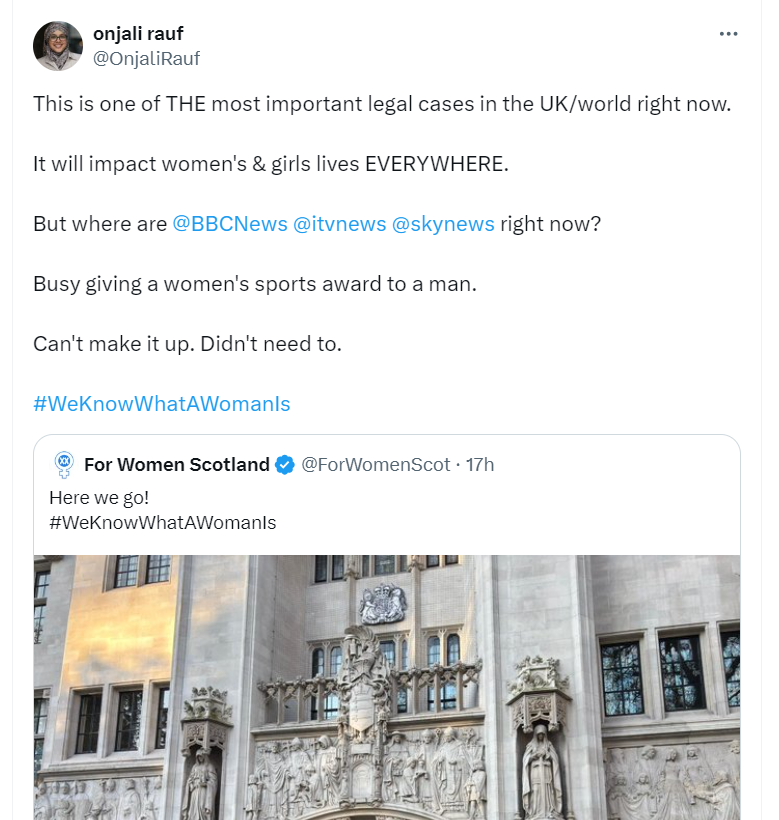
What’s at stake that makes this important?
Scotland, incredibly, has legislated that having a ‘Gender Recognition Certificate’ stating that your gender is different than your biological sex means that you are effectively — and legally — a member of the opposite biological sex.
If the Court agrees with the Appellant, a women’s rights group protesting the government’s insistence that sex can be changed by the say-so of a bureaucratic agency, this nonsense will be reversed and all legislative bodies in the UK will have this decision as a blocking precedent to passing such laws and direction in the future.
If the Court agrees with the Respondent, the “transgender” over-reach into women’s safe spaces continues with the force of law as an enforcer to this delusion. Resistance to its contra-factual basis and provable harms to women will no doubt continue but victory will be delayed indefinitely.
(3) Another Break With Her Past: One of Rowling’s only jobs as a non-writer was as a translator for Amnesty International; “While she was working temporary jobs in London, Amnesty International hired her to document human rights issues in French-speaking Africa” (Wikipedia). It was a fit for her progressive views, especially those about resisting oppressive and autocratic political regimes, and her ideas of virtue, specifically sacrificial love, empathy, and courage. Rowling has now officially broken with ‘Manesty’ over their siding with the Gender Theory Extremists about women’s safe spaces and the core issue of whether biological men and women can ever change into their opposites. File this break along with her separation of self and identity with the Labour Party.
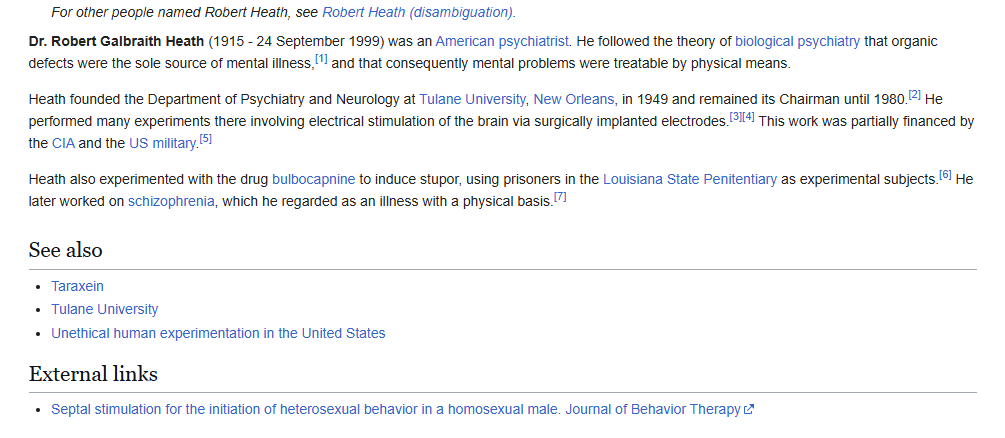
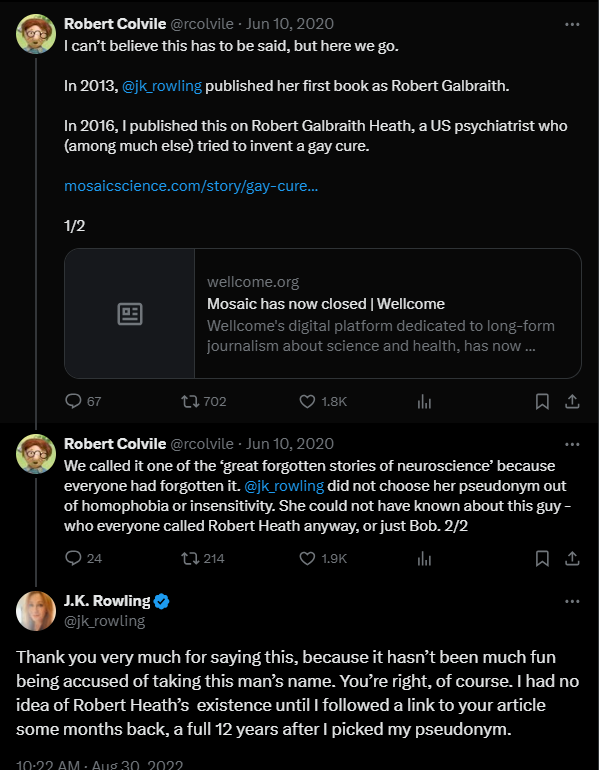
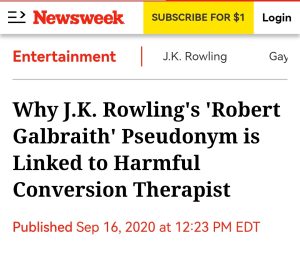 A myth has arisen on social media that J. K. Rowling chose the name Robert Galbraith in honour of
 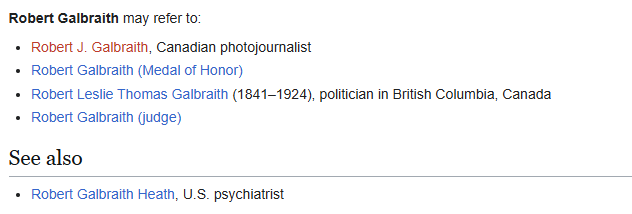 A photojournalist, a soldier a politician and a judge. Our Dr Heath is listed as “see also” because of course his name is Heath rather than Galbraith. The article on Heath at this time looks like this: