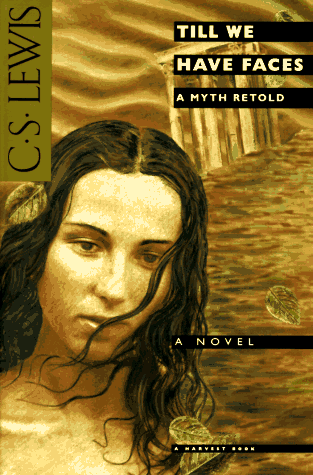
 At the Hogwarts Professor Substack page, Nick Jeffery and I both wrote pieces this month about C. S. Lewis’ Till We Have Faces and Rowling-Galbraith’s Strike-Ellacott mysteries. We then filmed our conversation about why the Serious Striker or Generic Thoughtful Rowling Reader would benefit from time with CSL in the Kingdom of Glume, Queen Orual presiding.
I began my post about the two Cupid and Psyche adaptations with several reasons reading Till We Have Faces is a very good investment of any Rowling fan’s time:
First, anything by C. S. Lewis rewards a close reading by any thoughtful person and lover of challenging modern writing (and, though Lewis is often dismissed as some kind of Christian dinosaur, he is a thoroughly modern writer). Faces was his last fiction piece, he and Tolkien thought it was his best, and it is a catharsis inducing masterpiece, frankly, that makes a more than generous return on any time invested in it.
Second, despite Rowling’s several digs at Lewis near the end of Potter Mania’s peak around the publication of Deathly Hallows, it would be hard to exaggerate the hat-tips and references to CSL’s Narniad in the Hogwarts Saga. Rowling’s efforts to diminish if not dismiss that influence have to be read in tandem with her earlier effusion of admiration for Lewis and his work. Her Christmas Pig, I think, can be read as her attempt — her wonderfully successful attempt, by the way, at least with respect to accessibility and humor — to out-do Lewis’ The Great Divorce. Reading Lewis is a good idea for the Serious Striker, then, because its a decent bet based on the postmodern writer’s track record that the bibliographical inspiration or Lake aspect of her work might be found in his writing.
Third, forget the Lake, Rowling’s Shed is filled with tools that Lewis used.
- Literary alchemy? Read his Space Trilogy.
- Ring composition? Every Chronicles of Narnia novel and Space Trilogy piece is chiastic.
- Psychomachia or Soul-Allegory? Pilgrim’s Regress, Great Divorce, Till We Have Faces.
- Genre Blend with Heavy Doses of Literary Allusion? Again, the Narniad and Space Trilogy.
- Christian symbolism? If Lewis is known for anything, loved by his fans and despised by his detractors, it is because of his “smuggling the Gospel” into his stories, not-so-subtly and supremely subtly (see Planet Narnia for exposition of the latter).
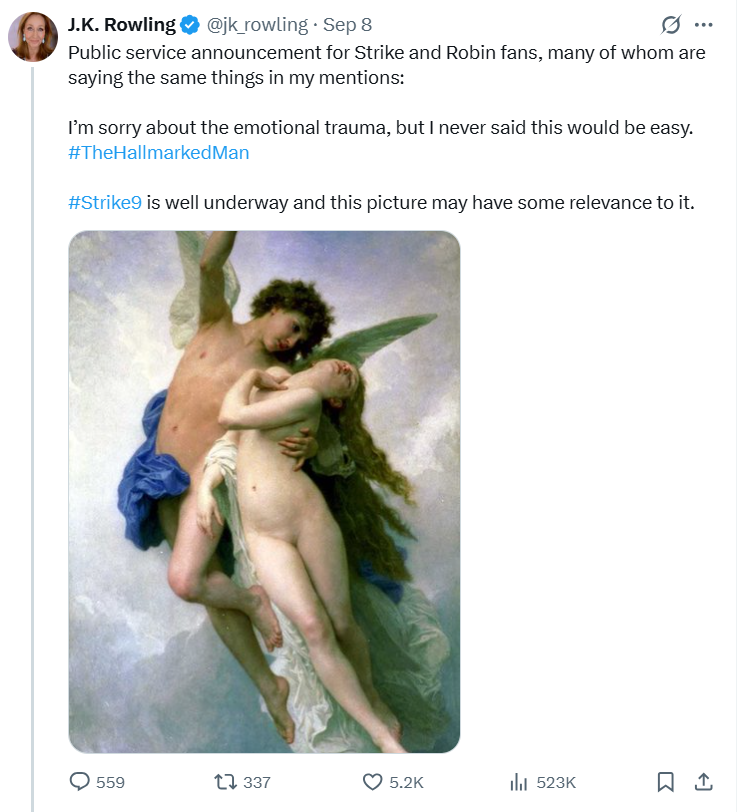
And to the point today, use of Classical myth as a story launching pad and template. Serious Strikers know that the Strike-Ellacott series is up to its eyeballs in mythic backdrops; think of Leda and the Swan, Castor and Pollux, Tisiphone and Artemis, and, the only one confirmed by the author via tweet, Cupid and Psyche. Lewis’ Till We Have Faces is a re-telling of this exact myth.
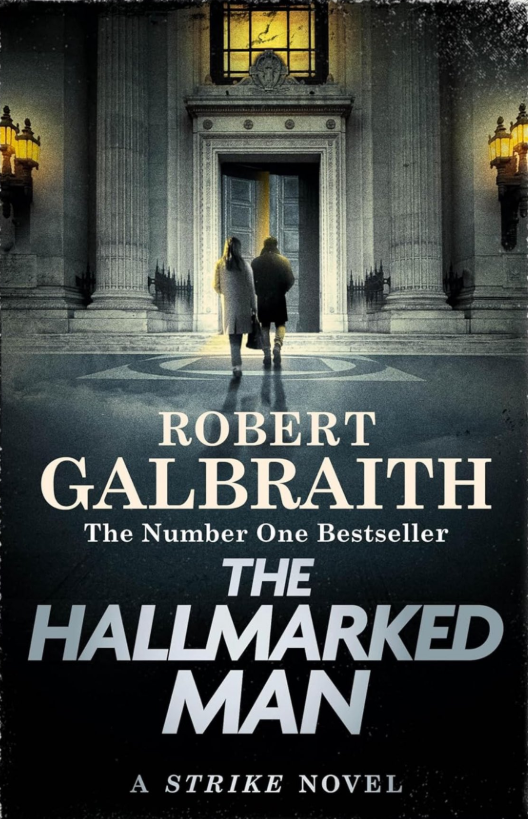
It’s not a direct match by any means. Lewis’ adaptation is fairly straight-forward (well, relative to Rowling-Galbraith’s). He re-tells the Cupid and Psyche myth from the perspective of one of Psyche’s supposedly jealous sisters. It’s still set in a mythic time and in a pagan or pre-Christian Greece (or thereabouts). Rowling uses the myth, in contrast, as a near invisible back-drop or atmosphere that informs her story, a subtle deployment that wasn’t noticed by readers until its reveal in Troubled Blood and Ink Black Heart (a revelation that wasn’t accepted by fandom until Rowling’s tweet post Hallmarked Man).
 Nick Jeffery wondered if it was possible that Rowling-Galbraith used Till We Have Faces as something of a template’s template for her adaptation of Cupid and Psyche in her Strike novels. Read his C. S. Lewis’ ‘Till We Have Faces’ and Rowling-Galbraith’s Cormoran Strike Series (Part One) for his answer to the question, ‘Is Till We Have Faces the The Thematic Template for the ‘Strike-Ellacott’ Series?’
 In my follow-up to Nick’s post, C. S. Lewis’ ‘Till We Have Faces’ and Rowling-Galbraith’s Cormoran Strike Series (Part Two), I shared the seven points of intersection I found in CSL’s 1956 adaptation and JKR’s eight Strellacott books: the underlying myth, Artemis and Aphrodite, the Pursuit of the Real, the Hidden Nature of Divinity, the Story Structure, the Meaning of ‘Faces,’ and the Eros-Anteros Distinction (what Lewis called ‘The False Cupid’ in his essays on Spenser).
In our subsequent discussion-podcast, A Spirited Conversation about Rowling-Galbraith’s Cormoran Strike Series and C. S. Lewis’ ‘Till We Have Faces,’ we reviewed our findings and played pickle-ball with the subject of what Faces might suggest about the contents of Strike 9, tentatively titled Sleep Tight, Evangeline.
Nick and I will be talking about fan theories and Rowling’s Golden Threads this week and I will be writing about the literary alchemy of the Lions in Hallmarked Man as well as more notes about the plethora of names in Strike 8. I also hope to share the introduction to and TOC for my book in progress, Harry Potter for Grown-Ups: Volume 1 Philosopher’s Stone, and a chapter of the only book to my knowledge written exclusively about the Perennialist Theory of Literature, the school of thought best suited to grasping the traditional tools used by both Lewis and Rowling in their stories.

Recent Conversation