 As announced months ago at her web site, J. K. Rowling received the Robert F. Kennedy Ripple of Hope Human Rights Award last Thursday in NYC. It is an award only given to politically liberal notables and, for Americans, it helps a lot to be a Democratic Party grandee (e.g., Speaker of the House Nancy Pelosi also received an award at the event). Two things Rowling said that night are of possible interest to serious readers of her work.
 First, she claimed that if her daughter Jessica had been a boy, she would have been named ‘Robert.’ She added that, “lo and behold she has become Mackenzie and I have become a Robert,” i.e., that she took the name ‘Robert Galbraith’ in honor of the late American politician, Robert Kennedy. While she has always claimed that Robert Kennedy was something of a hero to her, this is the first time I can recall her saying her second pseudonym was derived in part from her admiration of the third Kennedy brother. Watch the video clip here.
 Second, she said, “He was a man of both empathy and action. He helped bring about real change and he continues to inspire people. I’m not sure we can ask much more of any politician, or indeed, human being.” I’m not sure but I can guess that we can ask a whole lot more of “any politician” — because any politician today who said and did what Bobby Kennedy did with respect to gay people, Jews, and especially to women would be someone loathed by Rowling as “much worse than Voldemort.”
 Perhaps when we find out at last how Leda Strike died — was it an actual overdose and accidental death or could it have been a staged suicide to cover the murder of a woman who knew too much about powerful men? — we can re-visit all the conspiracy theories about RFK’s involvement in the seeming suicide of starlet Marilyn Monroe. Is Rowling writing a prolonged wish-fulfillment defense-in-story about her hero’s supposed role in killing Monroe before she talked?
A stretch, I know. The best part of the Rowling comments in NYC Thursday that I can find online was in this bootleg clip from a smart phone. In it, she discusses what it feels like to watch a film celebrating your life and contributions to a better world. “Well done,” indeed.
Let me know in the comment boxes if you’ve found a transcript or video recording of her remarks — and what you think of what pieces of the talk have been made public. Fun to have her back, no? And Happy St Nicholas Day, everyone!

 Friend of this blog
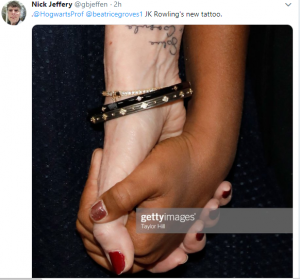
  I find myself wondering if it is a tattoo — the script akin to her handwriting suggests she wrote it there herself in pen rather than being properly inked? — but, permanent or water soluble, it is a remarkable confirmation of the centrality of alchemy in Rowling’s writing.
  J.K. Rowling made a rare appearance, attending the premiere of the HBO documentary Finding the Way Home, in New York City on Wednesday night, alongside Fantastic Beasts series star Eddie Redmayne, who narrated the doc.
 I picked up a copy of Book magazine, a super slick production of Barnes & Noble, in May 2003 because it had a picture of Rowling on the cover and two or three fun feature stories. My favorite part of the magazine, though, and the reason I still have a copy is a side-bar piece titled, ‘Will the Real Harry Potter Please Stand Up?’ It has four cameo pictures of men named ‘Harry Potter’ with brief descriptions — age, work, city of residence — and each Harry’s blurb description of what it is like to be named for the lead character in a tsunami cultural phenomenon.
 She was, of course, completely correct. The baby, a young wizard called Harry Potter, would soon possess one of the most celebrated names on the planet. It was a name that became emblazoned across JK Rowling’s novels, which went on to sell 500 million copies worldwide in 74 languages. Four syllables that would garner their own registered trademark and font.
 I share a name with a Harry Potter character, fortunately “the smartest witch of her generation,” and, because the connection is only the relatively common surname not the signature ‘Hermione’ first name, I am never bothered about it in my Walter Mitty existence. As the Dean of Harry Potter Scholars, though, I get comments, invariably a tease or in good humor.
Recent Conversation