The Casting Genius of ‘Black Severus:’ Paapa Essiedu Chosen as New Snape

Paapa Essiedu has been cast, according to several reports (see here and here) to play Severus Snape in the Bronte Studio adaptation of the HarryPotter novels for HBO+ television. The accomplished Shakespearean actor has played some of the most demanding roles in theatre repertoire to critical acclaim and successfully worked in films and television as well.

But there’s a hitch in this casting decision. Essiedu is black. Unlike the casting of a black actress to play Hermione Granger, which was defended as being canonical because the character was not described explicitly as being white [correction in comments!], Severus Snape is famously “sallow skinned,” a yellowish, unhealthy condition almost exclusively of Caucasians.

I woke up to this announcement as a virtual parliament of owls with messages from Potter Pundits flew through my chimney grate bemoaning the casting choice. “Another ‘Black Hermione’,” “The series is doomed,” “Every character that hates Snape will seem like a racist,” “What are they thinking? Isn’t Rowling being a transphobe bad enough — does she have to make the sadist Death Eater a black man, too?” etc.

I get all that (except for the ‘Rowling is a transphobe’ bit) and I’m not a fan of color-casting as a rule, especially when it is obviously more than just a little bit about generating clicks and fandom interest in the new shows.

But —

If Black Severus proves to be a reality — and I have to think it will — then it is not a poorly thought through choice, it won’t necessarily make the heroes into racists for hating Snape, and it solves several problems the Bronte Studios rebooters face. It’s also much more in the traditions of American filmmaking than, say, Black Hermione was, which Cursed Child casting was pure tokenism and click-bait.

The Rebooted Harry Potter adaptation for television has quite the uphill battle to win the hearts of global fandom. Three obstacles that come immediately to mind are

  • the continued popularity of the Warner Brothers big screen adaptations (everyone in the world except JKR now ‘sees’ the characters as the movie stars who played them),
  • the need to do something different from canon and prior adaptations that will not require re-writing the stories (there has to be a reason to watch the new shows, something that makes them ‘new’ in a way that isn’t just currency), and
  • the Everest the marketing team must summit, the Trans War association of the Author with ‘Far Right’ or ‘Anti-Progressive’ ideas, stigmata really.

‘Black Severus’ lifts the teevee adaptations over all these hurdles that have to be cleared for the show to excite fans around the world.

First, there’s the Rickman legacy. The actor who played Severus in the first films was much beloved and is now dead, which is to say, bereaved and sacrosanct, above criticism and irreplaceable. This is true for all the characters whose screen versions were played by people now departed, I think immediately of McGonagall and Hagrid, but especially for the Potions Master because of the anti-hero role he plays in the series. Minerva and Rubeus were always good guys; Severus was until the very end a great mystery.

How can any actor win the hearts and sympathy of fandom with the legacy of Alan Rickman hanging over him? Cf., fandom feelings for Michael Gambon who replaced Richard Harris, which caused many to cheer at his death in the Half-Blood Prince film finale.

The solution to the Rickman Hurdle, beyond choosing an actor with the chops and credentials that Essiedu has, is to make HBO+ Severus a ‘Magical Negro,,’ a real commonplace in American fiction and movie history.

In a single stroke of color-casting, the new Snape becomes an outcast whom the viewing audience will see as both unfairly oppressed and worthy of their sympathies, however odious his behaviors. Those behaviors become somehow understandable rather than just psychopathic sadism. The actor cannot be compared to Rickman (well, he will be, of course, but he cannot be hated qua usurper as he would otherwise be), the played race-card gives the series a signature new dynamic because of the whiff of racism any dislike of the character generates, and it is such a PC move, again of tokenism, one though that will win Woke hearts. It will rally the progressive fan base to his defense as Black Hermione did in the Cursed Child stage play, which to a degree deflates the ‘Rowling as Transphobe Bigot’ bugaboo balloon.

Rather than being another reason to think the Bronte/HBO+ adaptation will fail, Black Severus is the first sign I’ve seen that the producers and director understand the uphill fight they’re in. Black Severus, frankly, much as I’d prefer a straight forward adaptation of the books without considerations of marketing and previous versions, is casting genius for reasons beyond the acting ability and experience that Essiedu will bring to the most nuanced and complicated character in the Hogwarts Saga.

For one thing, Rowling’s most fervent critics, the Potter fandom elite, are wrong-footed by this choice. If they decry the casting decision as tokenism or not true to canon or even as the shameless attempt to distract us from Rowling’s horrific crimes against cross-dressing men, they immediately become subject to criticism as canon-purists, even racists. If they embrace the casting decision — “Hurrah, diversity!” — then they involuntarily mute or diminish their depiction of Rowling as a troglodyte Nazi.

In summary, then:

  • Black Severus, by defanging Rowling’s critics (or at least giving fans reason to think of her once again as a PC Queen) clears the major marketing hurdle for this adaptation.
  • Black Severus, as noted, clears the Rickman Effect obstacle; the Bronte Studio version transforms the character so significantly that fond memories and comparisons are eclipsed and Essiedu no doubt will bring out more of the Snape mystery than the pedestrian Warner Brothers films allowed.
  • Black Severus, too, generates a huge Buzz and twixter discussion point for fans of the books and Warner Brothers films. Screen Media addicts will be impatient to see this new Snape and especially those scenes where Harry and James come off as segregationists or worse. Imagine the irony, too, of Black Severus embracing the Dark Lord and the separatist ideology of the Death Eaters. Black Severus calling Lily Evans a “Mudblood” will be delicious, frankly, for the defamiliarization involved.

So, three cheers for the decision to cast Paapa Essiedu as Severus Snape. The series reboot gets a world-class actor playing a key and very difficult role and Black Severus helps the marketing folks generate interest in and minimize resistance to Rowling’s revival of her most famous work. Hats off to Team Rowling for this choice!

 

Rowling’s Pregnancy Traps: Last Strikes

This, again, is not a proper ‘Pregnancy Trap’ post with a long-form focus on one or two traps that define a particular work. Here is another hurried catalogue of all the “coercive love” relationships in the Strike-Ellacott mysteries: it follows the ‘Rowling Pregnancy Traps: First Four Strikes‘ post in which I reviewed the several traps encountered from Cuckoo to Lethal White. This post covers the most recent three novels in the series, Troubled Blood to Running Grave. I have written longish posts about the ‘Big Four’ Pregnancy Traps that play defining roles in the Harry Potter novels (Merope and Tom, Sr.), in Casual Vacancy (Krystal and Fats), in Cursed Child (Bellatrix and Tom, Jr.), and in the Strike series (Leda and Jonny); with this post and one other that surveys The Ickabog, Christmas Pig, and Beedle the Bard, I’ll wrap up this Pregnancy Trap Golden Thread in an article on the Substack page and a ‘Rowling Studies’ podcast for subscribers before moving on to the next Golden Thread ‘common denominator’ in her work.

Book-by-book, then, the Pregnancy Traps to be found in Troubled Blood, Ink-Black Heart, and Running Grace!

Troubled Blood

[See the first comment beneath this post for the Pregnancy Trap in Strike5 that I left out of the first version of this piece, the most important Trap of this specific book, of the Strike-Ellacott series, and perhaps of everything Rowling has written.]

  • Sarah Shadlock’s Trapping Matt Cunliffe

Readers learn in Lethal White with Robin’s discovery of the diamond earring in the Cunliffe conjugal bed that Matt and Sarah have been sleeping together. It comes as little surprise because since Career of Evil Matt’s old friend from University has been “shit stirring,” i.e., implying when she and the engaged and then married couple are together that Robin must be attracted to Cormoran and sexually tempted by him. This is not to mention, of course, Rowling having revealed in Strike3 that Robin’s fiancée had slept with Sarah while at Uni after Ms Ellacott was raped at her school and been unavailable to him at home due to her year-long agoraphobia.

The slow-release of Sarah’s long-term plan to hook herself the husband she wants, Matt Cunliffe not Tom Turvey, though, comes at last in Troubled Blood, Rowling’s wondrous fifth Strike-Ellacott mystery and perhaps the best single novel she has written. She has Robin learn via a phone call with Shadlock’s furious fiancée Turvey in a crowded Christmas season department store that Sarah has moved on to (moved in with?) Matt; she inwardly reviewed that conversation in her head while sitting with Strike in the store’s cafe:

A waiter had arrived at the table. When both had ordered coffee, and Robin some toast, each relapsed into silence. Robin was looking away from the window toward the shoppers stocking up on fancy groceries for Christmas down on the shop floor and re-running Tom Turvey’s outburst in her head. The aftershocks were still hitting her. Four weeks before my fucking wedding. It must have been called off. Sarah had left Tom for Matthew, the man she’d wanted all along, and Robin was sure she wouldn’t have left Tom unless Matthew had shown himself ready to offer her what Tom had: diamonds and a change of name. I’m the only one of us who hasn’t been fucking around. Everyone had been unfaithful, in Tom’s opinion, except poor Tom… so Matthew must have told his old friend that she, Robin, had been sleeping with someone else (which meant Strike, of course, of whom Matthew had been perennially jealous and suspicious from the moment Robin had gone to work for him). And even now that Tom knew about Matthew and Sarah, after his old friend’s duplicity and treachery had been revealed, Tom still believed the lie about Robin and Strike. Doubtless he thought his current misery was all Robin’s fault, that if she hadn’t succumbed to Strike, the domino effect of infidelity would never have been started. (Part Three, Chapter 24)

Rowling rolls out the Pregnancy Trap that Shadlock had been compelled to set only after the final divorce mediation between the long-separated Cunliffes. Ellacott deduces that Sarah had deliberately become ‘preggers’ to secure the vacillating Matt:

“Yeah.” He hesitated. “It was an accident.”

Was it hell, thought Robin. Sarah had always known how to get what she wanted. Robin realized at last how long a game Sarah had played: always present, giggling, flirting, prepared to settle for Matthew’s best friend to keep him close. Then, as her clutch tightened, but Matthew threatened to slip through it, there’d been the diamond earring she’d left in Robin’s bed and now, still more valuable, a pregnancy to make sure of him, before he could enter a dangerous state of singledom. Robin had a strong suspicion that this was what had lain behind the two postponements of mediation. Had a newly hormonal and insecure Sarah made scenes, frightened of Matthew coming face to face with Robin while he hadn’t yet decided whether he wanted either the baby or its mother?

“And she wants to be married before she has it?”

“Yeah,” said Matthew. “Well, so do I.” (Part Five, Chapter 55)

“A pregnancy to make sure of him”… Once again, Rowling uses “coercive love,” a pregnancy trap in a key story relationship. The successful trap that secures clueless Matt to Sarah, effectively closes the Cunliffe story-line in the Strike novels (if hope springs eternal that the man Louise Freeman refers to as the “flubberworm” will make a cameo of some kind in the last three books; he has to harbor thoughts of revenge against Strike, no?).

  • Janice Beattie’s Failed Trap of Her Son’s Father

During Strike’s end of novel confrontation with the “Poisoner Granny” in her flat’s Red Room, Rowling reveals that the serial killer had years before tried to win an engagement ring from her beaux by becoming pregnant with his child. Strike has asked Beattie why she killed people after sharing with her that her son Kevin will be testifying against her, that he will be sharing in court the times his mother tried to poison his father, himself, and his child, her grand-daughter. Rowling lets her readers know only then that Janice’s wedding band was a front and that she had tried to win her husband by becoming pregnant: [Read more…]

Rowling Tweets Response to NYTimes’ “Rewriting” of Trans War History, Minimizing “True Cost of Speaking Out”

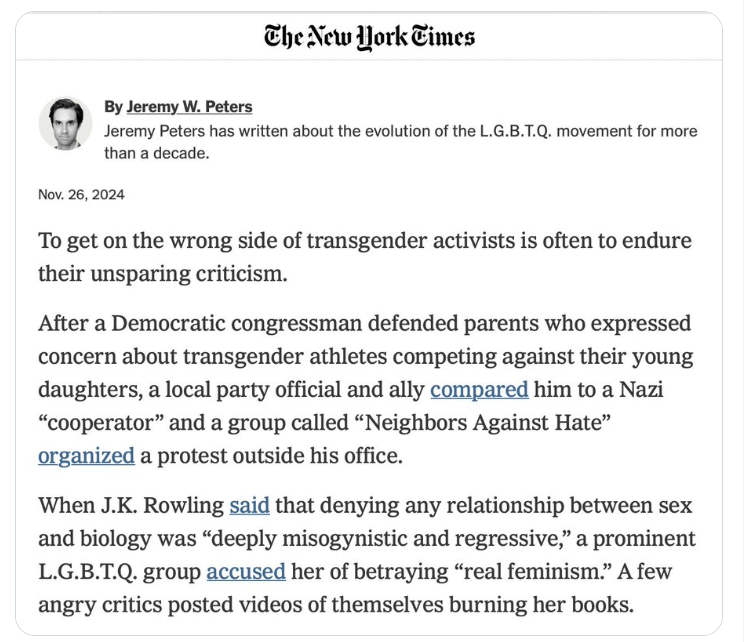
Jeremy Peters wrote an Op-Ed piece for The New York Times late last month. The title suggests that Peters ‘gets’ just how out of line the Gender Theory Extremists have been in the ongoing Trans War about “transgender” rights versus the rights of biological women and of children.

Transgender Activists Question the Movement’s Confrontational Approach‘ points to some kind of reflection on just how bad the threats and cancellations were during the darkest days of the madness, when every influencer and twitter celebrity proclaimed “Transgender women are women” in Orwellian surety. The sub-title of Peters’ piece, though, points to it being a story focused on the ‘news’ that the activists are realizing that their attacks on the sane percentage of the population isn’t working: ‘Facing diminishing public support, some activists say all-or-nothing tactics are not working. “We have to make it OK for someone to change their minds”.’

J. K. Rowling, however, is having none of this “rewriting of history.” Over a screen shot of Peters’ lede paragraphs in which she is mentioned, she wrote a long form response on her twitter account to stop the “mealy mouthed retconning” and minimization of the crimes committed by “trans activists” against those unwilling to chant in obedient conformity that “Men can be Women — and have to be allowed access to their safe spaces and sporting events (and children must be allowed to be surgically mutilated or chemically castrated).” She wrote: [Read more…]

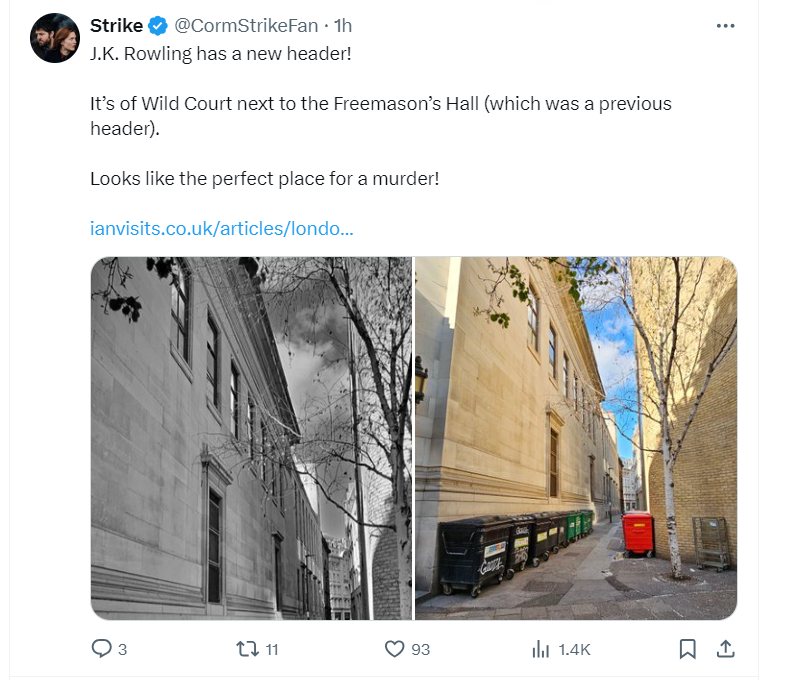
Rowling’s Latest Twixter Header Pic: Wild Court, Freemason’s Hall, London

Like every other Serious Striker, when I see a new Rowling twixter header, I think ‘Nick Jeffery’ but he was not online on a Sunday, so I searched for what the @CormStrikeFan twixter feed had to offer. Bingo!

The link at this tweet takes the reader leads to a fascinating page about the Wild Court alley and its history through the centuries. Well worth the visit — thank you, @CormStrikeFan!

I’ve spoken to Nick Jeffery since starting this post and he’s pledged an update to his massive index of Rowling’s twitter page headers to include the Hallmarked Man materials as early as Wednesday. Stay tuned!

Harry Potter as “The Last British Myth”

Robert Terry, long time friend and serious reader, wrote me today to say he’d found two interesting articles about the Hogwarts Saga on Johann Kurtz’ ‘Becoming Noble’ Substack page. The first is ‘The Last British Myth’ and the second is the conclusion of that essay, ‘Freedom.

Here is the introduction to give you a taste:

Ours is a windswept island. Time has carried many peoples and gods from our shores.

Peoples fade, and yet they linger, ever-present in an unspoken British folk communion. At the edges of our psyche, they’re all still there, dim but alive: the druidism of the ancients, the power of the Romans, the folklore of the Anglo-Saxons, the evangelism of the Christians. All live on as layers of psychic sediment which shift, flow, and resurface.

Our greatest king – Arthur – is to be found nowhere in the pages of earthly history. He lives in a different plane; yet it is one to which we also belong. Whatever we need him to be, he is – both chivalric knight of Christ and devotee of the wizard Merlin. Our patron saint – George – lives somewhere between ecclesiastical history and a folklore inhabited by dragons.

Our longest reigning monarch, Elizabeth II, was both ‘Defender of the Faith’ and initiate into the Gorsedd Beirdd Ynys Prydain – the Gorsedd of the Bards of Britain – revived on the principles of Celtic druidry.

We have always known secret worship: pagan priests on foggy hills, condemned Catholics in forest glades, witches burned for their heresy. Even now, silent prayer is hunted by the authorities.

Our churches are adorned with gargoyles; our nation is one of nations; our democracy adores its kings. Contradictions live in harmony. Our identity is certain and yet unresolved. We live in both earthly and eternal time, never certain which ancestors to honor and which eternity awaits us.

It is only against this background that one can understand the paradox of Harry Potter, the wizard who celebrates Christmas, the last of the great British myths. Like Britain itself, the tale of The Boy Who Lived is a pagan vessel out of which Christian greatness emerges, in a subtle and particular form.

J.K. Rowling’s mythopoetic masterpiece is an attempt at the resolution of the dying British soul. It is a final charge in the war for who we are and always have been. It amounts to a systematic defense of British culture, finding heroism in its eccentricities and beauty in its ways.

I believe that hidden within the work is an entire spiritual history of our land. My task here is to uncover that which lies beneath the surface, from druidic allusions to hidden scriptural quotations.

To do so, we must start at the beginning.

Enjoy — and thank you, Robert, for the tip!