Second Thoughts on Gainsborough and “Early Twenties” Rowling in London

I tease my much younger co-workers about their relationship with their ‘Smart’ phones; most are using an Apple product but have become ‘android’ users nonetheless, if you catch my drift. Customers at the store who leave their phones behind inadvertently at the register or in their shopping cart call the store when they realize “I don’t have my phone!” in a panic akin to the realization they have left behind one of their children. Too frequently they exclaim on being reunited with the pocket technology, “It was like losing my brain.”

As something of Luddite with respect to phones — I have a flip phone that I rarely carry with me except when traveling — I shake my head with wonder and judgmental disapproval at this dependence.

I was confronted yesterday with the risible hypocrisy of that posture when my laptop failed. I have had to purchase a new personal computer and face the fact that I have been at least as dependent on this technology as my young cohorts are with their phones. I just don’t carry the PC around with me and consult it every few minutes. Uploading software and regaining access to accounts online will be the better of my day today which drives that point home.

Yesterday I wrote what I thought would be a simple filler piece about Rowling’s “passion” for Thomas Gainsborough’s paintings in her “early twenties,” something she discussed briefly with Frazer in the 2001 Q&A, Conversations with J. K. Rowling. I pledged in that post to write a promised piece today about her love for the Caravaggio painting Supper at Emmaus that she mentioned both in Frazer and in last Sunday’s London Times Q&A. I will be working on bringing my new computer up to speed (and putting my working life here back on track) instead.

Today, though, after the jump, I share three more notes about Thomas Gainsborough and Rowling’s “passion” for his paintings during her formative “early twenties” in London, discoveries I didn’t include in yesterday’s post for lack of time.This morning, I’m wondering if these neglected thoughts are not the more important points about Rowling, the National Gallery, and what the young author saw in the eighteenth century painter. [Read more…]
Rowling’s Passion For Gainsborough

My personal computer failed today so I am writing this on a spare Dell laptop with Windows 7 and its own issues. I’ll keep it short, consequently, while I try to bring the new computer online.

Sunday’s London Times ‘Culture’ insert had a celebration of the top 100 bestsellers on The Times’ bestseller list of the last 50 years. I wrote about the deceit involved on that list here; Rowling’s Philosopher’s Stone was the only one of her books to make this anniversary party and at only #23 when her seven Harry Potter novels, a heavy finger not being on the opposing scale, would have been in the top ten.

Regardless of that dishonesty on the part of The Times back in the day and currently, the anniversary article featured a Q&A session with Rowling that HogPro backchannel moderators think was just unused “leftovers” from the previous Times conversation with The Presence (same picture, etc.). Five of the fourteen questions were about Philosopher’s Stone, so I have my doubts about that theory.

The most interesting answers that Rowling gave were about Stephen King, trivia about Philosopher’s Stone, and her thoughts about Caravaggio’s Supper at Emmaus. I’m working on a longer post about her answer to “What’s the first piece of art you loved?” but it allows me to review an answer she gave more than twenty years ago to the question, “Do you enjoy art?” in which the Caravaggio painting is mentioned.

That was in Lyndsey Frazer’s Conversations with J. K. Rowling, a juvenile Q&A rather than a proper biography though the book cover still proclaims truthfully “The Only Authorized Biography of J. K. Rowling.” Join me after the jump for her full answer to that question — and the artist and painting she mentioned before Caravaggio. [Read more…]

Rowling Biography Slated for Early 2025

I complain too often that the world needs a critical biography of J. K. Rowling, one for which the Boswell has researched her personal history thoroughly and professionally, by which I mean “paid private investigators to find ‘Michael’ of Exeter and Manchester among other pertinent Lake facts.” I have thought, incorrectly it turns out, that there hasn’t been even an attempt at a biography worthy of note since Sean Smith’s in 2003.

Search Amazon.com’s book section for ‘J. K. Rowling Biography’ and begin scrolling; there are five pages of attempts. I’m not sure any qualify for “worthy of note” status as most seem to be Kindle exploitation pieces, but at least biographers are aware that Rowling is a hot topic whose life-story and its relation to her work has not been told. 

The surest evidence of this is the report from Kirkus Reviews of a book going to press soon:Biography of J.K. Rowling Coming in 2025.’

The good news? A real publisher has paid a professional biographer to write a 0ne volume history of Rowling’s life and its relation to her work. It’s titled A Pen to Change the World: The Life of J. K. Rowling, it weighs in at 384 pages, and the publication date is February 2025. The author, Solomon Schmidt, has written the biography of another controversial figure, Alan Dershowitz, and hosts the ‘History Bites’ Youtube channel. The publisher’s page for the book has this blurb:

The only complete biography of the most famous author in the world.

J. K. Rowling’s Harry Potter saga is the best-selling book series in history. Through her numerous books, the blockbuster films based on her work, and her ground-breaking charities, she has touched the hearts and lives of millions of people the world over. And yet, following her extremely controversial public stance on gender issues, Rowling became a pariah in circles that once welcomed her with open arms.

Rowling’s profoundly compelling life is a story of triumph over failure, defiance in the face of authoritarianism, and the redemptive power of love. Drawing on exhaustive research, wunderkind author Solomon Schmidt has told her story in full for the first time.

The bad or not especially encouraging news?

When the blurb says “wunderkind,” that’s a spin of the fact the author is twenty years old. The book is priced at $32.99, which, even factoring in inflation and the length of the book, is a stretch. And Skyhorse Publishing is not a Big Five publishing house. The openly leftist reporter for Kirkus Reviews felt obliged to throw some shade their way:

Skyhorse is one of the most controversial publishers in the U.S. It published a memoir by filmmaker Woody Allen, who has been accused of sexually abusing his daughter Dylan Farrow, after the book was dropped by Hachette. It has also published books by presidential candidate and conspiracy theorist Robert F. Kennedy Jr., and through its recently acquired imprint Regnery, has released titles by right-wing U.S. Senators Ted Cruz and Rand Paul.

I’m going to be buying a copy for three reasons: (1) maybe Solomon Schmidt found Michael!, (2) the author wrote to me as he began this journey to ask if I’d be willing to answer questions he had while writing the book and we have corresponded off and on consequently (he seems like a nice guy); and (3) I need to learn as much as possible about Rowling’s history because the Fourth Generation of ‘Rowling Studies’ is going to be ‘Lake’ heavy compared to the first three. If I start saving now, I should be able to pay for it come February!

Post: Yes, I promised a post on Supper at Emmaus today. My keyboard failed on that longish post (no joke), which piece may wind up as a Substack site mailing to subscribers. Stay tuned!

Rowling’s Q&A in The Sunday Times

Friends in Wales and Argentina wrote me yesterday with the news that there was a featured interview with J. K. Rowling in the Sunday edition of The Times (London), the ‘Culture’ magazine insert. It wasn’t until I read The Rowling Library’s Index page dedicated to it, though, that I learned what had prompted this Q&A, which, with all its Philosopher’s Stone and Potter Mania questions, seemed to apparate via Time Turner from 1997. The Times, it turns out was celebrating the 50th anniversary of its bestseller list. As TRL explains:

The Times has published a special feature today celebrating 50 years of the Sunday Times bestseller list by unveiling the 100 bestselling books of the past five decades. To mark this milestone, they interviewed a select group of prominent personalities, including several acclaimed authors, to delve into their thoughts on books and their personal literary journeys.

Among the authors featured is J.K. Rowling, whose debut novel, Harry Potter and the Philosopher’s Stone, made the list. In this interview, Rowling reflects on the creation of her first book, the literary influences that shaped her writing—citing Charles Dickens as a major inspiration—and even shares a surprising confession: she couldn’t finish a novel by Stephen King because it was just too frightening.

I share three thoughts after the jump about Rowling’s answers to The Times questions, why Team Rowling had to be delighted with the timing of this Q&A’s appearance, and the value of this compendium of “bestsellers.” [Read more…]

Rowling’s Rings Within Rings: The First?

I was invited in February to contribute an article to a Rowling Library essay anthology about the structure of her work. I was not surprised that I was invited, frankly, because I was the first to chart the ring structure of her novels and series way back in 2010 and because of my enthusiasm and admiration for just everything The Rowling Library does. My excitement about this project, though, was really about my taking a position contrary to the thesis of the anthology and the opportunity it opened to explore something I had suspected for a long time but never nailed down.

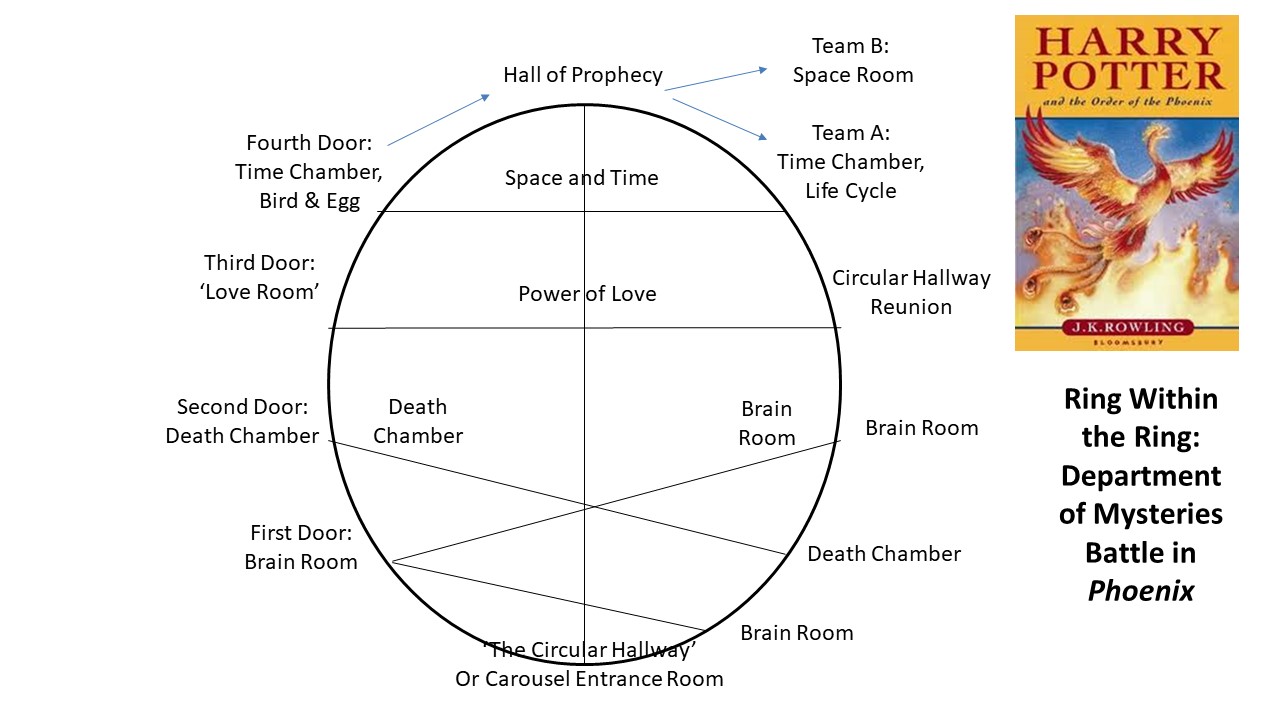
I have given I don’t know how many public talks about Rowling’s ring writing, written many more posts, and spoken on at least as many podcasts; in that history, I do not know when I first mentioned (or how often consequently I referred to the idea) that I thought the Order of the Phoenix chapters about Harry’s adventures in the Ministry’s Department of Mysteries was a ring-within-the-ring of the longest book of that series. My contribution to The Rowling Library anthology is a relatively detailed exploration of that ring and its importance to the series. I’ll be writing more about this anthology of course as TRL makes its public announcements.

What I can say here is something I don’t say explicitly in that essay. The structure and remarkable symbolism of the Department of Mysteries misadventure make it among the most meaningful single passages in the Hogwarts Saga. The only ones that come to mind as being as important for grasping what Rowling believes and was trying to communicate via her story alembic are the three parallel gauntlet runs in Stone, Goblet, and Hallows, the Chamber of Secrets confrontation with Riddle and the Basilisk, the trip to the Lake beneath the mountain with Dumbledore in Half Blood Prince, the conversation at the other-worldly King’s Cross station in Hallows, and the burial of Alastair Moody’s ‘Mad Eye’ earlier in the finale. And, writing about it today, I think the Phoenix trip into the depths of the Ministry of Magic is probably the forty page piece that should be put in future representative collections of 21st century literature to capture the essence of Rowling’s writing.

What made it interesting to me, though, when I first charted the seven books in 2010 was the possibility that this capsule of writing was a ‘for instance’ of the chiastic structure signature element Mary Douglas in her Thinking in Circles called “rings within the ring.” In brief, real chiastic writing per the great anthropologist has as a defining characteristic not only a latch, turn, and turtle-back lines, but parts that have all those elements inside the whole. It was this Douglas premise that made me chart the individual books in the series after I had confirmed Brett Kendall’s 2003 (!) theory that the septology would be chiastic in structure.

The question that came up naturally was “Are there rings inside of the book rings the way the individual novels are rings within the series ring?” My answer to that was “I don’t know — but if I were to look, I’d chart the Order of the Phoenix passage inside the Department of Mysteries.” It has so many circular elements and obvious parallelisms that I thought it was the best place to look for an embedded ring; Rowling had seemingly lit ichneutic flares around it to highlight that possibility.

Rowling’s rings-within-rings has become something of a commonplace in her Cormoran Strike novels. Though I have not charted all of the seven books in the series with an eye for this, the two I have — Troubled Blood and Running Grave — feature Parts or chapter sets that have all the ring structure elements Douglas lays out inside the ring structure of that novel which, incredibly, fits within the seven book ring of that series thus far. See my breakdown of Running Grave’s Part Eight for an example of that intricate structural artistry.

My question today for serious Rowling Readers is, “When did she start this ring-within-the-ring-within-the-ring structural work that is invisible to the conscious mind but so important to the story’s subliminal effect?” The Phoenix trip into the Department of Mysteries is on my mind and it makes a certain sense that this would be the place she started; Order of the Phoenix  was the longest book of the Potter series, it came out after a three year pause in publication, and Rowling had clearly raised her game in several regards. A jump in the dimensions of her structural artistry seems likely there.

The Sunday Times of London published a Q&A exchange with Rowling this morning to mark the publication of Running Grave in paperback (about which, more tomorrow). That exchange closed with this:

How much had you planned all seven books when you started The Philosopher’s Stone?
By the end of the first book I knew how the seventh would end and had worked out a lot of the details of the world, but I left enough leeway to enjoy creating things as I went. Although they’re such different genres, I’ve applied a lot of what I learnt about world-building on Potter to the Strike series. In my work, I like to know exactly where I’m going. In my life, not so much.

There’s quite a bit to unpack there, of course, but I don’t think she’s being honest really about the extent of her planning. The remarkable parallels with the plot points and themes of Philosopher’s Stone in Goblet of Fire and Deathly Hallows make it clear there was less “leeway” than she lets on and that she “knew exactly where she was going” from the gate.

Having noted that, might her rings-within-the-novel-ring have started as early as Philosopher’s Stone? My haunting ring-charting project has been Ink Black Heart, the Rowling novel I have written the least about due to my PhD thesis deadlines post viva voce exams (which were on the day Strike6 was published…). I think I’ll put off that project again and, as I re-read the seven parts of the Hogwarts Saga, I’ll be focusing on the there-and-home-again story parts that may be rings. The four in the books before Phoenix would be the trip to the Mirror of Erised in Stone, the descent to the Chamber of Secrets in Potter2, the time-turning trial that leads to the Shrieking Shack in Prisoner of Azkaban, and Goblet of Fire‘s Portkey powered trip to and from the Little Hangleton graveyard after arriving at the center of the Triwizard Tournament maze.

Tomorrow I’ll be writing about the Rowling Times Q&A, next week about a new Rowling biography due early next year, and in the coming months, deo volente, more about the exciting Rowling Library anthology and the hunt for Rowling’s first ring-within-the-novel-ring. Not to mention the advent of Hallmarked Man… Thank you for joining me on these adventures in Rowling Studies!