Sunday Quiz: Philosopher’s Stone ch. 1

Answers tomorrow along with an explanation of the ‘Sunday Quiz’ project! It’s not an open book test, by the way…

Harry Potter and the Philosopher’s Stone:

Chapter 1, ‘The Boy Who Lived’

  1. What “dull, gray” day of the week is it when “our story starts” at 4 Privet Drive?
  2. Leaving for work, Mr. Dursley sees a tabby cat on Privet Drive doing two things cats cannot do. What are these two things?
  3. Dursley’s office is on what floor at Grunnings, his drill company?
  4. True or False: Dursley at lunch on Tuesday is hugged by a wizard, he is called a Muggle, and he calls his wife when he overhears conversation about the Potters and their boy, Harry.
  5. What is the name of the TV weatherman who reports that the owls are acting out of the ordinary? 
  6. What are the shapes of Albus Dumbledore’s and Minerva McGonagall’s eyeglasses?
  7. How does Dumbledore put out the lights on Privet Drive?
  8. What is Dumbledore’s explanation for Harry’s surviving Voldemort’s attack?
  9. True or False: Professor McGonagall is convinced Dumbledore is wrong in leaving Harry with the Dursleys.
  10. Hagrid arrives on Sirius Black’s motorcycle and reports that there were no problems retrieving Harry. The boy fell asleep as “we was flyin’ over” what English town?

For Your Reflection:

The very first chapter of the seven book series introduces the great divide in Harry’s world, the chasm separating Wizards and Muggles. It does this by sharing the views of Vernon Dursley, archetypal Muggle, and both Minerva McGonagall and Albus Dumbledore, witch and wizard, about the other side. Infant Harry at chapter’s end crosses this canyon to live with his Aunt and Uncle. Given what we learn in the chapter about the Dursleys (not all we learn in subsequent chapters and books), is Dumbledore’s decision a good one? 


Rowling’s Ten Most Important Interviews

I was communicating on the HogwartsProfessor moderator backchannels earlier this week and the conversation thread led to a pretty serious discussion about a book each of us would like to have on our shelves, namely, a ‘Greatest Hits’ anthology of Rowling’s most important interviews. It was really an explosion as much as a ‘conversation’ because more than once of us had given this subject a lot of thought.

There were three main topics we explored: whether such a collection was possible, what constituted “important” when it came to comparing interviews between 1997 and today, and which interviews each of us would choose. I had an advantage in that last category, well, several advantages. While I will never have the encyclopedic recall of interviews that a Lisa Bunker, Beatrice Groves, or Patricio Tarantino at The Rowling Library index has, I did spend the last four or five years writing a PhD thesis on Rowling’s works and had to review as much interview canon as I could stand. I also, it turned out, had started a post on just this subject in May 2022, a draft that included a preliminary list of my own.

I compared that list of thirteen interviews with the one I threw together as a sample for the backchannel consortium last week, a list of twelve. Join me after the jump to see how much overlap there is — and where I want to go with this. [Read more…]

New Title from Rowling Library Books: ‘The Phoenix or the Flame’ Anthology

The Rowling Library (TRL) Books announced today that they will be publishing ‘A. Ibid’s edited essay-anthology, The Phoenix or the Flame: Essays on J. K. Rowling’s Original Plans for ‘Harry Potter and the order of the Phoenix, in the “fourth quarter of 2024.”

Edited by A. Ibid, who goes by the username ibid-11962, a distinguished figure in online Harry Potter communities known for his extensive knowledge of J.K. Rowling’s works and canon, The Phoenix or the Flame brings together the insights of renowned scholars including John Granger, Beatrice Groves, and Louise Freeman, among other esteemed voices. Through their expert analysis, this collection not only compares the original plans with the published novel but also explores the broader implications of these changes on the Harry Potter narrative and its legacy.

The title, The Phoenix or the Flame, which references a quote from the Harry Potter series, is a nod to the juxtaposition of Rowling’s initial vision with its final outcome. The Phoenix or the Flame is slated for release in the fourth quarter of 2024. TRL Books will soon reveal the full list of contributing authors and abstracts, the book’s synopsis, and its cover design.

I’m mentioned in that announcement so I feel I can share the story of my participation in the project — after the jump! [Read more…]

Rowling Still Writing Hallmarked Man

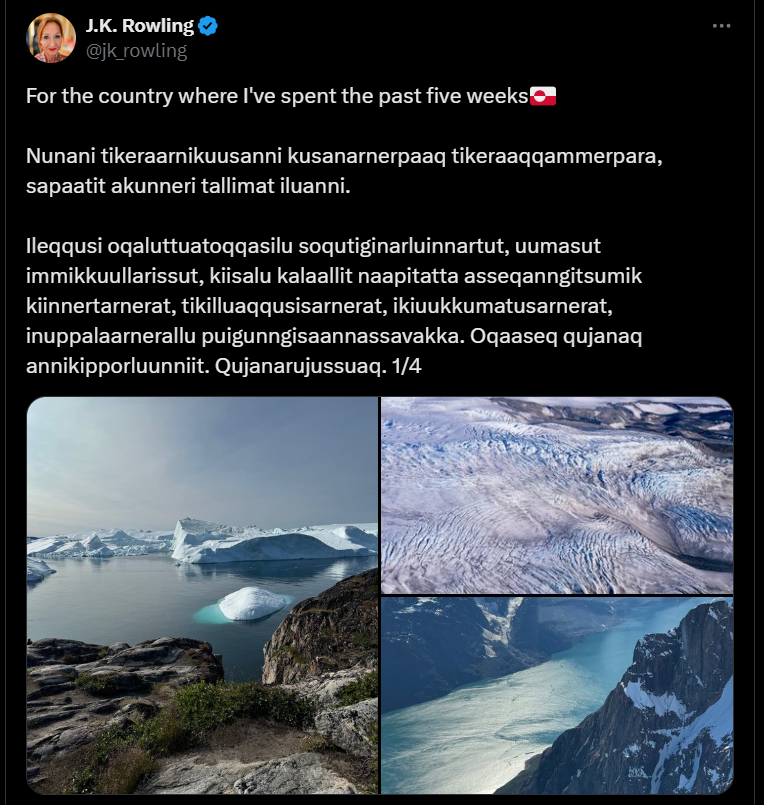
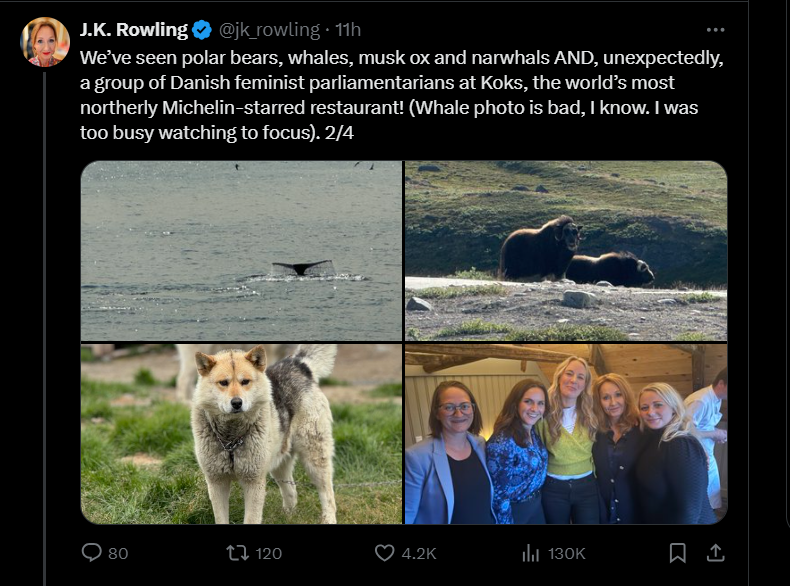
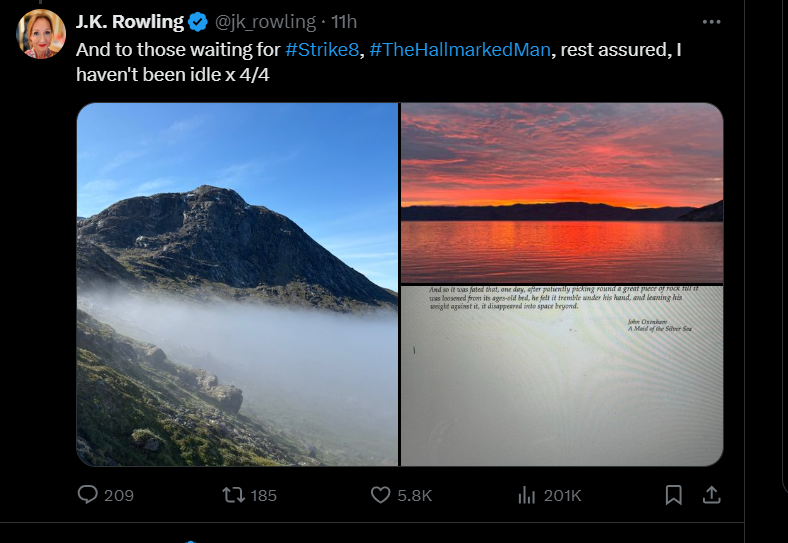
Rowling confirmed for her more than fourteen million Twixter followers what we have been reporting here for several weeks, namely, that her annual ‘Birthday Party’ cruise this year took the Murray clan to Greenland. In a four part thread, she thanked the people whom she had met, shared pictures of the natural beauty there (to include feminists near the Artic Circle), endorsed a guide to the folklore of Greenland, and assured her readers that it was a working vacation, i.e., she had not been “idle” in finishing The Hallmarked Man.

One by one, then:

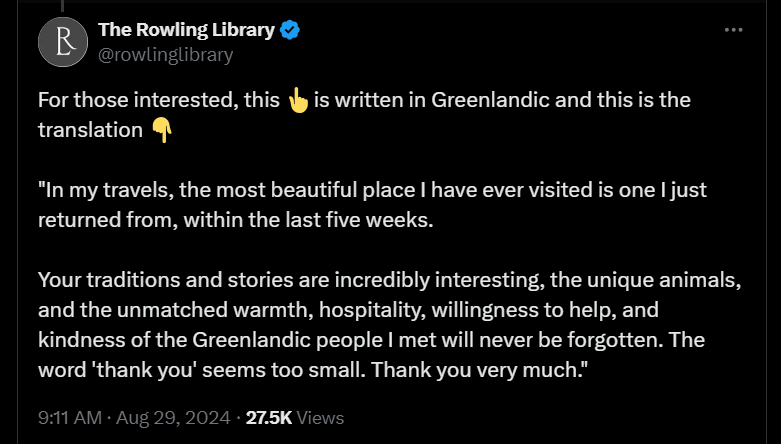
The Rowling Library helped those of us who have neglected to keep up with our Danish (Greenland dialect) by providing this helpful translation:

The natural beauty!

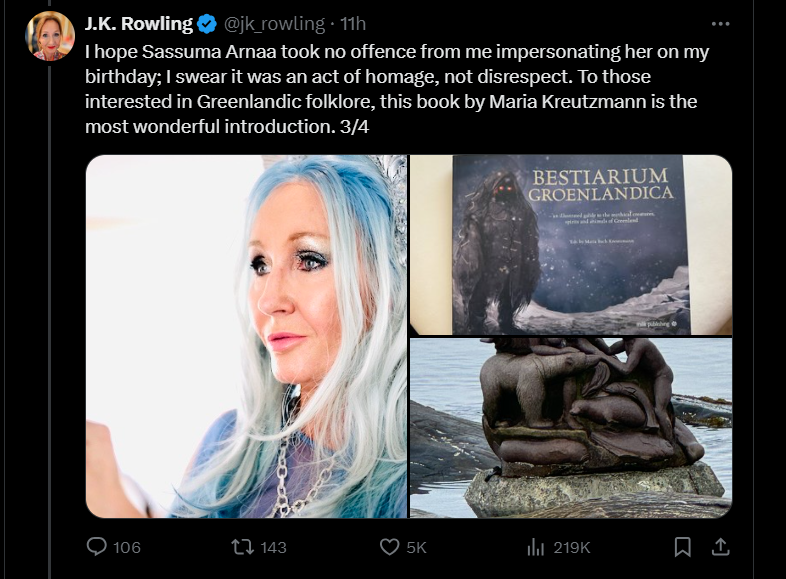
It looks like Rowling &Company had a costume ball for her birthday revel and that she dressed up as ‘The Mother of the Sea.’ Forgive me for wondering if she traveled with the necessary dress, tiara, cosmetics, and hair dyes to pull this off or they sell these things at most shops in Greenland’s port cities. 

The Maria Kreutzmann book she recommended, Bestiarium Greenlandica, can be purchased at Amazon. What’s it about?

Meet the motley crew of dangerous, cheeky, and fantastical beings of Greenland! 

The world of Greenlandic mythology is inhabited by creatures that have played a vital role in Inuit beliefs and stories throughout the ages. The Bestiarium is a collection of what is generally known about these diverse beings, spirits, and animals. Their stories are gritty, cruel, and reflect from the harsh landscape and lifestyle of ancient Greenland. Descriptions are paired with illustrations by contemporary Greenlandic illustrators that transport these mythological beings into the 21st Century. A brief history of Greenland and the shaman tradition launches the reader into the ancient world of Greenland and how myth and legend told generation after generation can mould and depict a place that was dark and grim as mischievous and lively and full of natural wonders. 

If the Fantastic Beasts franchise is ever revived (ho!), perhaps this bestiary from the great north will be part of Newt’s kit.

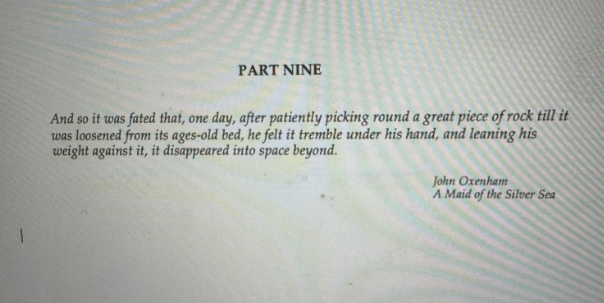
And then there was this bit of news, perhaps as much for Rowling’s editors as for her readers:

Taking a closer look at the written page, we find a quotation from Oxenham’s A Maid of the Silver Sea as the epigraph for Hallmarked Man’s Part Nine:

That passage has a note of finality to it and Running Grave only had nine chapter sets, Rowling’s ‘Parts,’ so we can hope that she is nearing the finish line. I have to doubt very much, though, that it will be available for your Serious Striker’s stocking stuffer this December. Alas!

For a in depth conversation about the Maid of the Silver Sea and Oxenham, Nick Jeffery tells all in ‘Sark, Snark and Censorship.’

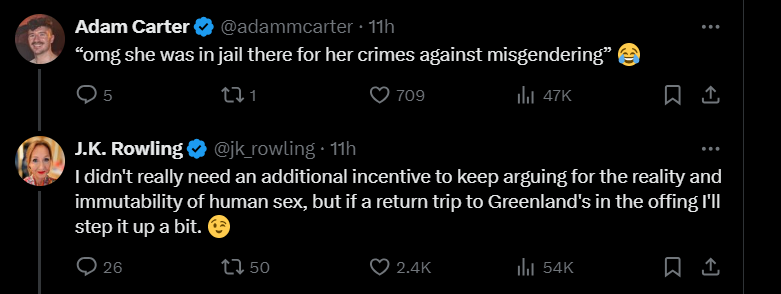
One jokester on the thread noted the hysteria that had been going on in her absence about her Olympic boxing “cyber-bullying” and how her silence for several weeks had meant to her critics that she was retreating from her war against gender theory extremists (discussed here). Her response was characteristically buoyant, appropriate for a woman sailing back across the North Atlantic in her yacht.

Tomorrow, some thoughts on the influence of P. D. James on Robert Galbraith. Stay tuned!


Rowling’s Favorite Painting and What It Suggests about Her Artistry and Meaning

Rowling’s Q&A last Sunday in The Times of London was largely forgettable, as I discussed in ‘Rowling’s Q&A in the Sunday Times.’ Her answer to an outlier question about art in that set, however, was a ‘keeper’ on several levels:

What’s the first piece of art you loved?
I visited the National Gallery on my own when I was around 19 or 20 and was absolutely mesmerised by Caravaggio’s Supper at Emmaus. I had a battered print of it on my wall for years afterwards and it featured on my first ever website.

This was not a revelation. In what remains “the only authorized J. K. Rowling biography,” Lindsey Fraser’s 2001 Conversations with J. K. Rowling, much more of a seemingly superficial Q&A than a proper critical life history, Rowling concluded her answer to “Do you enjoy art?” this way:

Perhaps my favorite painting is Caravaggio’s Supper at Emmaus when Jesus reveals himself to the disciples having risen from the dead. I love it. Jesus looks very likeable – soft and rounded – and the painting captures the exact moment when the disciples realize who this man is, blessing their bread. (Fraser, 30-31)

The chapter in Beatrice Groves’ Literary Allusion in Harry Potter that convinced me of that work’s seminal importance and the writer’s true brilliance turned on her discussion of this comment and on the painting itself. Join me after the jump for a review of Prof Groves’ exegesis, the confirmation of her points in Literary Allusion  to be found in Rowling’s comments on Sunday, and some further points about Supper at Emmaus that the “mesmerized” Rowling may be assumed to have noticed. My idea is that her use of subliminal symbols ‘tracks’ with Carravagio’s and that we are called to a Ruskin-esque posture of “deep mining” before a painting if we are to grasp the depth of her writing.

I wrote to Professor Groves earlier this week to ask her permission to quote the passage in her Literary Allusion in Harry Potter about the Caravaggio painting, Rowling’s relationship with it, and what it reveals about the remarkable Christian Everyman subtext of Harry Potter. She graciously gave me her permission so here is that remarkable passage, a key really to the Christian content of the Hogwarts Saga: [Read more…]