MuggleNet Drops Staff, Gets Sued, Disapparates, Reappears Brand New

MuggleNet.com is, with The Leaky Cauldron and The Harry Potter Lexicon, one of the few Harry Potter fandom websites with an international following and more than a quarter century of reporting, commenting on, and celebrating everything to do with the Wizarding World. These sites were daily stops from Generation Hex during Potter Mania, 1999 – 2012, the years the books and first film film adaptations appeared.
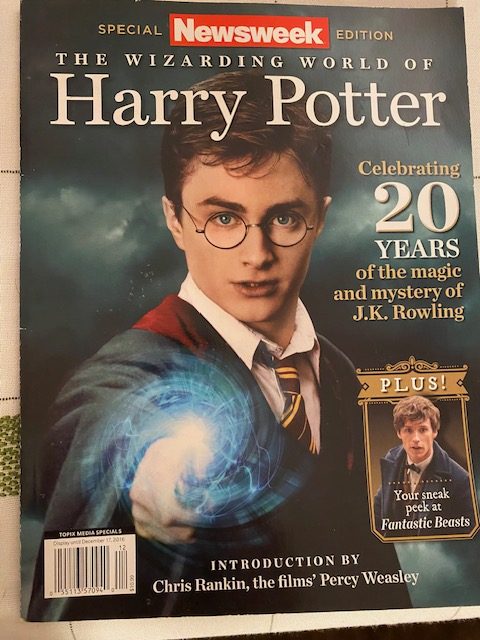
In July 2020 with the advent of the Trans Wars, however, MuggleNet broke with Rowling, Inc., with which entity they had previously served as an unpaid marketing extension, in fidelity to their beliefs that human beings can become the other sex by believing they are. MuggleNet made this move, all but declaring the author of the Harry Potter series ‘She Who Must Not Be Named’ on their site’s posts and podcasts, by linking arms in a brotherly boycott with every other fandom site (except this one and The Rowling Library).

The difference in those closed ranks, though, was that the founder of MuggleNet, Emerson Spartz, had sold his website in 2020 to Topix Media Lab, a magazine and paperback book publisher that had already been printing Potter titles with MNet cooperation for years. The new owners oversaw a reformatting of the site and published a wave of new book titles but for the most part retained its staff of many years, most of which were technically volunteers, and its large archive of posts and podcasts.

In September 2025, though, Topix decided to clean house and start over. They fired everybody and in April 2026 wiped the site clean of its past. As The Leaky Cauldron’s ‘Amanda Kirk’ wrote last week in a piece titled ‘MuggleNet Has Become a Horcrux:’

In 2020, the site changed ownership to a company, Topix Media Lab, that had been in partnership with MN for its print publications. For some years after the sale, operations at the site appeared similar from the outside, albeit with a seemingly bigger push for ad revenue by Topix. In September 2025, Topix emailed MN staff to inform them that their services were no longer required. Staff numbers had fluctuated but some had remained dedicated to MN for nearly 20 years. Unless the owners planned to shut down MN, why abruptly dismiss all that institutional knowledge and devotion? The mystery deepened when Topix posted an ad on LinkedIn looking for a single full-time paid staff member to run the site. Qualifications listed for the position included an MBA.
The staff decided to fight back in court — and watched Topix guard its legal flank in April by dropping all their “volunteer” labor efforts overboard of the site with a new MuggleNet in everything but name: [Read more…]

Rowling A-List Poet Discovery: Keats!

Dr Beatrice Groves, Research Fellow and Lecturer at Trinity College, Oxford, and author of Literary Allusion in Harry Potter, has discovered clues that strongly suggest that Rowling (as well as her friend Sean Harris) had John Keats on her A-Level reading list as the featured poet.

In a Bathilda’s Notebook post, ‘Keats, “The Eve of St. Agnes,” and “Harry Potter”,’ Groves shares, in addition to a host of fascinating possible allusions to Keats in Rowling’s work, visible evidence that Rowling is a serious reader of John Keats, namely, a 2017 tweet from the Keats-Shelley House of their July 2015 Visitor’s Log page:

Groves deciphers in her post what Rowling, Neil Murray, and Sean Harris wrote and explains its significance of this discovery, a gem, as she notes, that “has not previously been noticed by anyone in the Harry Potter fandom.” She ends her exegesis with a pointed plea to readers that I wish to amplify here for readers who might not see it on Groves’ Notebook page at MuggleNet:

Rowling has never made an explicit reference to Keats in either her writing or interviews (nothing like the hat-tip to Jane Austen in the naming of Mrs. Norris, for example). This has made it more difficult to argue for Keats allusions than those of her acknowledged influences such as Shakespeare, Collette, or Dickens. But Keats is an absolute stalwart of the English literature curriculum in the UK: I have long suspected that Rowling studied him as part of her English A-level course – and, recently, I finally found the proof [in the 2017 tweet above]! Rowling has indeed long read and loved Keats; she studied him at A-Level, and hence he has been part of her literary consciousness for all her writing life….

I suspect that if we were to track down Rowling’s A-level syllabus, we’d find that “La Belle Dame sans Merci,” Lamia, and The Eve of St. Agnes were all part of the course. (Tracking this down, incidentally, is one of my long-term aims – and it is proving surprisingly difficult! If you or someone you know took English A-level in the 1980s and studied The Winter’s TaleKing Lear, and Keats – the three texts we now know she studied – I’d be very interested to hear from you – especially if you remember what your exam board was or the rest of the syllabus you studied!).

Do read the whole St Agnes post for Groves’ explanation of the importance of this discovery — and, if you have the information about Rowling-era A-Lists in the UK she asks for, please contact her via the email address at her Oxford University home page.

Congratulations to Dr Groves on this important find and an oversized thank you to her for sharing the allusions to Keats embedded in Rowling’s work that only a true Keat-ophile could have spotted! I love the suggestion in the 2017 tweet from the Keats-Shelley house that Rowling chose the phantom ‘K’ initial in her first pseudonym, ‘J. K. Rowling’ (she has no given middle name) as a tribute to the original J. K., John Keats.

Links to all of Dr Groves’ online writings can be found at this HogwartsProfessor.com ‘Beatrice Groves Pillar Post‘ page.

P. D. James: Rowling Names Goldmine?

I was scrolling the almost 400 drafts of posts for Hogwarts Professor that I have started over the last twenty years and never finished and found this one from early in my PhD researches. It’s about P. D. James, a writer much admired by Rowling, perhaps admired and studied even more than Agatha Christie (if there is a fascinating overlap in those influences concerning The Duchess of Malfi). I confess to being surprised that I never put this up; I can think of no single post I have written that required reading an author’s complete works — unless I’ve written somewhere about the inimitable Boris Akunin. [Quick search of site for ‘Akunin’ — no, but I did only get one post out of the Shardlake series.] It’s long overdue, as I hope you’ll agree, because of the several important names found in the James novels and the fascinating plot point parallels with Potter and Strike series. Enjoy!

Beatrice Groves, author of Literary Allusion in Harry Potter and a great lover of detective fiction from her youth, urged me as part of my dissertation reading year to do a deep dive into P. D. James, the Queen of the genre post Christie. The prompt was because of a connection between the Cordelia Gray character in P. D. James’ Unsuitable Job for a Woman and Robin Ellacott in the Cormoran Strike novels.

I’ve been reading P. D. James now for several months and this morning I went through the 14 books I have read to list the names, events, and allusions I thought worthy of dog-earing pages as I flew through to the great reveal of each mystery. I’m reading chronologically and am up to A Certain Justice (1997), dedicated to the five grandchildren.

Perhaps the most interesting piece is the one you would guess, ‘namely,’ the names connection.

  • Felix, Cover Her Face
  • Arabella (cat who is murdered in a fashion suggestive of the petrification in Chamber),
  • Pettigrew (a solicitor “cursed with a name like that”), Unnatural Causes
  • Morag, Shroud for a Nightingale
  • Orlando (a child who died young),
  • Rose, Innocent Blood
  • McGonagall (reference to poet as “arguably Britain’s worst poet ever”),
  • Remus (dog), Devices and Desires
  • Peverell, Original Sin
  • Wardle (police surgeon), Original Sin, and
  • Venetia, A Certain Justice

I think the Arabella, Pettigrew, McGonagall, and Peverell hits rate as significant Potter links, especially the Peverell Family connection (see Original Sin for that; better than the Vanity Fair reference and the Gaunts?). Orlando, Wardle, and Venetia, too, are lifts or hat tips we find in Strike.

How about quotations in mysteries? Cover Her Face includes a put down of “psychological thrillers with highbrow quotations at the beginning of chapters.” Skull Beneath the Skin looks down on a set of quotations “all from the Penguin Dictionary of Quotations or the Oxford Dictionary,” and in Children of Men the professor notes about the four lines of Horace in Latin in a friend’s suicide note, “He probably found the Latin in the Oxford Dictionary of Quotations.” It might be worth a check of both P. D. James and JKR’s literary allusions to see how many are in the Oxford Dictionary… [2024 note: I purchased six editions of the ODQ and could find no link.]

Potter sources of some potential:

Close but not quite a mother Molly knitting sweaters for beloved child: Unsuitable Job features a birth mother who was not allowed contact with her son so she knitted him “endless sweaters” and Innocent Blood‘s murderous mom who gave up her daughter knits her a sweater as her first and last gift to her.

Children of Men has a prisoner escape from the regime’s island to which evil-doers are transported and left to be tortured (and eaten!) by the bad guys there. If that weren’t echo enough of Sirius Black and Azkaban, the passage in which Theo learns about this adventure begins with a reference to the “black dog on my shoulder.”

I think the Cordelia Gray – Hermione Granger connection Prof Groves made in 2018, with the Shakespearean first and resonant last names, is a keeper, too.

Strike sources of some potential:

It is a Dalgleish truism that motive is not the key to solving mysteries: “Motive is the last thing you look for” (Cover Her Face), “Where, when, and how would eventually have why revealed to him” (Unnatural Causes), etc.

Unnatural Cause‘s first paragraph turns out to be the opening of a mystery inside the book while being a perfectly apt paragraph on its own. Dalgleish and a publisher discuss the possibility of a writer plotting his own murder to be akin to his book’s death scene as a publicity stunt to sell more books, which author, Maurice Seton, shares several characteristics with Owen Quine.

Cordelia Gray arrives at the detective agency as a temporary secretary and works her way up to partner in the office and then becomes owner. Hat tip to Beatrice Groves who used that Cordelia-Robin path as her Ace Allusion parallel to convince me to read P. D. James.

Does Rowling quote Plutarch’s “Boys throw stones at frogs in sport. But the frogs do not die in sport; they die in earnest” somewhere in Strike? It seems familiar. James quotes it in Death of an Expert Witness. [2024 note: No, she doesn’t.]

Deborah Miscoe and Adam Dalgleish, their slowly advancing romance, may have been a model for Strike/Ellacott, in terms of slow narrative release emmeshed in stand-alone mysteries. But that was something of a bust for the James characters until Emma Lavenham comes into Adam’s life.

In Taste for Death, James quotes without naming Graham Greene’s bon mot about writers: “If he had a splinter of ice in his heart, then so have I.” Rowling has used this quotation several times through the years.

The idea of the physically attractive being advantaged in life, as per Charlotte, Cuckoo, and other Strike characters, is explored in Original Sin (cf. p 325).

The embedded Christian content suffuses every book but the only attempt at parable or allegory I found was Children of Men which is, relative to James’ light hand with symbolism in her mysteries at least, pretty much “in your face.”

I think there is enough here, alongside the Groves MuggleNet posts about the Gray/Strike echoes, to justify a serious look at the debts Rowling-Murray owes James-White beyond the name she created pre-publication and has kept for herself. They’re more significant than those to any other writer I know of, with the possible exceptions of Lewis, Tolkien, Christie, and Nabokov.

[2024 Note: I still think that is true and hope that Serious Strikers will take this post as a challenge to read P. D. James (or re-read, I suspect, favorite books in many readers’ libraries) to make more profound connections than the very superficial and equally suggestive correspondences between the detective fiction of these two writers. Cheers!]

Rowling’s Favorite Painting and What It Suggests about Her Artistry and Meaning

Rowling’s Q&A last Sunday in The Times of London was largely forgettable, as I discussed in ‘Rowling’s Q&A in the Sunday Times.’ Her answer to an outlier question about art in that set, however, was a ‘keeper’ on several levels:

What’s the first piece of art you loved?
I visited the National Gallery on my own when I was around 19 or 20 and was absolutely mesmerised by Caravaggio’s Supper at Emmaus. I had a battered print of it on my wall for years afterwards and it featured on my first ever website.

This was not a revelation. In what remains “the only authorized J. K. Rowling biography,” Lindsey Fraser’s 2001 Conversations with J. K. Rowling, much more of a seemingly superficial Q&A than a proper critical life history, Rowling concluded her answer to “Do you enjoy art?” this way:

Perhaps my favorite painting is Caravaggio’s Supper at Emmaus when Jesus reveals himself to the disciples having risen from the dead. I love it. Jesus looks very likeable – soft and rounded – and the painting captures the exact moment when the disciples realize who this man is, blessing their bread. (Fraser, 30-31)

The chapter in Beatrice Groves’ Literary Allusion in Harry Potter that convinced me of that work’s seminal importance and the writer’s true brilliance turned on her discussion of this comment and on the painting itself. Join me after the jump for a review of Prof Groves’ exegesis, the confirmation of her points in Literary Allusion  to be found in Rowling’s comments on Sunday, and some further points about Supper at Emmaus that the “mesmerized” Rowling may be assumed to have noticed. My idea is that her use of subliminal symbols ‘tracks’ with Carravagio’s and that we are called to a Ruskin-esque posture of “deep mining” before a painting if we are to grasp the depth of her writing.

I wrote to Professor Groves earlier this week to ask her permission to quote the passage in her Literary Allusion in Harry Potter about the Caravaggio painting, Rowling’s relationship with it, and what it reveals about the remarkable Christian Everyman subtext of Harry Potter. She graciously gave me her permission so here is that remarkable passage, a key really to the Christian content of the Hogwarts Saga: [Read more…]

Mailbag: Alchemy of Hallmarked Man?

I received a comment on my post ‘Rowling Q&A in The Sunday Times’ that included an off-topic question. I have elected to answer it here rather than on that thread. It’s a subject in which I think a lot of HogwartsProfessor readers are interested, for one thing, and none of them would be going to a post on the Times Q&A to learn more about it.

Hi. I agree. Her recent interview [with The Times] was meant to sell newspapers rather than give real information. Whatever you’ve got to say about The Supper At Emmaus, I’d like to hear it. It’s an interesting Christian painting.

Besides that, I’ve got a question about Strike #8, The Hallmarked Man. All the clues she’s given us are about metals.  Metals say “Nigredo” to me, but the predominance of silver says #8 might be the  “Albedo” book? If so, was The Running Grave the “Nigredo” book?  Thanks for reading. Looking forward to your answer.

There are actually three questions in those two paragraphs. Here are my answers for this Serious Striker:

(1) “What do you think of Caravaggio’s Supper at Emmaus?”

If you are a HogwartsProfessor subscriber over at Substack, you’ve already received my long-form essay on this subject. I hope you’ll read it and let me know what you think.

(2) “Was Running Grave the ‘Nigredo’ novel in the Cormoran Strike series?”

Great question! We will not know until we have all ten books in the Strike Saga but it certainly was a break-down piece for both Robin and Cormoran.

If I had to wager on the subject (and, being broke, the betting would have to be for amusement rather than remuneration), I’d go with Evan Willis’ idea on the Tetrachtys structure of the ten book set, which, if memory serves, has a three book nigredo ‘triad,’ a two book albedo and one book rubedo ‘monad,’ that last in parallel with Christmas Pig. See ‘Why the Cormoran Strike Novels are a Ten Book Series‘ for the math and the alchemy.

Of course, Rowling-Galbraith might be doing in the ten book series what Bronte Studios is said to be doing in the ten year adaptation of the Hogwarts Saga, i.e., one year for each of the first four and two for each of the last three. Alchemically, that would give us two books for each of the ‘back-side’ reverse alchemy turtle-shell lines. See William Sprague and Louise Freeman for the ‘reverse alchemy’ idea in Potter and Strike.

(3) “Will The Hallmarked Man be the ‘Albedo’ novel in the Cormoran Strike series?”

No idea! I can point you to a Serious Striker, though, who has given this a lot of thought (and written cogently about it, too). Which is to say, “Someone in addition to Evan Willis and the piece linked to in the answer to the second question.”

That would be Beatrice Groves, Research Fellow and tutor at Trinity College, Oxford, and author of  Literary Allusion in Harry Potter, who in her post at the HogwartsProfessor Substack about Rowling’s latest twixter picture ‘The Golden Journey to The Hallmarked Man‘ provides links to other articles she has written that explore the alchemy possibilities in Strike8. Here is the paragraph with those links to save you the search:

The second thing that struck me was, of course, the alchemical possibilities of the title of Flecker’s poem – some gold to add to all that silver! I’ve written about the possible influence of alchemy and precious metals on Strike 8 before and had predicted the keyword ‘silver’ in the title of all the epigraph texts of The Hallmarked Man – maybe instead they will all have a precious metal in the title? The ‘sound of silver bells’ in the wider poem was also a line that stood out given that we know Silver Bells, by Dean Martin is going to play some kind of role. Most striking in this regard is the ‘glimmering sea’ of Rowling’s header quotation, as it is so close the silver sea of the previous epigraph text we have been given. That sea turned silver by the sun glinting from it: ‘“A silver sea! A silver sea!” he cried aloud, and into his mind there flashed an incongruous comparison of the bountifulness of Nature’s silver with the pitiful grains they hacked out of her rocks with such toil and hardship’ (A Maid of the Silver Sea).

To answer your question, “Evan Willis and Beatrice Groves think that Hallmarked Man will be an albedo novel.” They come at the subject from remarkably different angles and they seem to have arrived at the same conclusion.

If you’re wondering why I’m not entering this fray, the answer I think is in this ‘Rowling Studies’ podcast that Nick Jeffery and I posted, you guessed it, over at the HogwartsProfessor Substack site. Check out Memorial Day’sOn Reading, “On Writing:” A Four Generational Approach to J. K. Rowling’s New Q&A.’ In that conversation, Nick and I discuss the rut that Rowling Studies is in, one, incidentally, that I helped dig and sustain over more than two decades.

The rut, in brief, is interpreting Rowling novels as they come out, exegesis largely independent of her work as a whole and devoid of discussion of its inspiration in psychological ‘Lake,’ labor that continues until Team Rowling begins to drop cookie crumb clues — Twixter contests, cameos, and scene shots! — about the nest book, at which time all energy shifts to predictions about that novel (scorecards about bullseyes and misses to be scored post publication).

Forgive me, but, having done that book sales-fandom excitement pro bono work for Rowling, Inc., for as long as I have, I think it’s time to re-think what we’re doing, kick back on the guess-work, and do the “slow mining” reflection that Ruskin recommended in Queen of the Air to get a better appreciation of Rowling’s artistry and meaning. I helped pioneer the ‘Let’s Guess!’ speculative game during the inter librum years of Potter Mania to help introduce readers waiting on the next book to ideas like literary alchemy and psychomachia.

That’s just not necessary anymore, I think. What we need now is a critical biography approach as well as an oeuvre wide perspective, frankly, a less frenetic and breathless enthusiasm for an anticipated or just published work and more Larger View take on what The Presence is writing. That’s still lot’s of fun, trust me, and has all the advantages of being new ground.

So, count me out on this year’s guesswork about Hallmarked Man. I think the Checklist I wrote before Ink Black Heart is still a good guide if you want to go there. I’m simultaneously in rut-recovery and excited about exploring a new methodology.

Love to Father Nicholas and Kansas friends from Oklahoma!