Dame Maggie Smith: Requiescat in Pace

Dame Maggie Smith died yesterday, age 89.

I do not envy the actor and actress chosen to play Severus Snape and Minerva McGonagall for the upcoming television adaptations of the seven Harry Potter novels. The ghosts of Alan Rickman and Maggie Smith will haunt them. The love felt by fandom for this actor and actress, compounded or cemented by grief at their deaths, will make the new Hogwarts professors seem like unworthy usurpers.

Dame Maggie Smith once said about the two roles that made her globally famous well into her dotage, “I am deeply grateful for the work in Potter and indeed Downton but it wasn’t what you’d call satisfying. I didn’t really feel I was acting in those things.”

Smith also added that she and Alan Rickman, may he rest in peace, used to joke around about how their roles in the franchise almost entirely consisted of reaction shots. The actress stated that theatre was her favorite medium and the only reason she hopped onto screen roles was because the work she wanted to do in theatre was just not happening.

The Potter film franchise was blessed with many great character actors and actresses. My favorites were Richard Harris, Alan Rickman, Kenneth Branagh, Jason Isaacs, Ralph Fiennes, and Maggie Smith. Not a one of them, I think, “was acting in those things” but wearing a mask and costume in order to animate a character already very much alive in the audience’s imagination. Most of the necessary acting was superfluous consequent to Rowling’s success in bringing these characters to life on the codex page.

That being said, however wasted the talents of the Potter franchise’s ensemble cast was, Dame Maggie Smith’s Professor McGonagall and Rickman’s Snape managed to forever erase my imagination’s image of their characters and replace it with their own. This is true of the child-actors who played Harry, Ron, and Hermione as well, but I am glad rather than annoyed that my ‘head canon’ McGonagall and Snape are the gifted actress and actor who played those roles.

If you have not seen Dame Maggie Smith in anything but the Harry Potter film adaptations or Downton Abbey, I hope you will watch The Prime of Miss Jean Brodie, playing the title role of which film won Smith her first Academy Award (Best Actress, 1969). She went on to win the ‘Triple Crown of Acting‘ with more than one Emmy and Tony Award. I top this post with the climactic scene of that film as a haunting tribute to this genius of stage and screen. She deserves to be remembered for more than a “reaction shot” role in which her talents were rarely deployed and which she only took on because she had no offers to work in theater, her great love.

Dame Maggie Smith, requiescat in pace, memory eternal.
 

Is Rowling ‘Spiritual Not Religious’?

Rowling has told one interviewer that she leads “an intensely spiritual life” but confessed to another that the Christian church did not offer her much solace at the time of her mother’s death and that she struggled with the “rules” and “institutional” aspects of ecclesial living.

This is a difficult subject for even serious readers to track because it requires that I argue on the one hand, as I hope I have demonstrated both in Deathly Hallows Lectures and How Harry Cast His Spell, that Rowling’s Hogwarts Saga finale was profoundly sacramental, laden with Christian symbolism and content,  and about a Christ-like sacrificial love resulting in a victory over death, while at the same time being an allegory of a believer’s struggle between embracing skepticism or faith as his life orientation. Rowling has said that her faith is very important to her, that she is more than a “weddings and funeral” church-goer, but that her belief in God is a very tenuous thing.

Her core beliefs, as she has shared more than once, turn around the immortality of the soul and the importance of imagination. Religion, which is to say, the communal, exoteric, and liturgical practice of a living faith? Not so much.

I recently have been corresponding with a challenging new voice in Potter Punditry and Rowling Studies who has pledged to push back on my arguments that Rowling is more invested in her feminist rituals and public testimony than she is in any kind of church life. This thoughtful reader seems to be arguing (or preparing an argument) that I misunderstand Rowling’s Anglican faith despite my having grown up in the Episcopal Church. I very much look forward to reading that counter to my “spiritual not religious” position, especially as I have not given the state of the Anglican communion any thought since my departure from it soon after my marriage in 1987.

I hope this isn’t necessary to repeat, but I hope, if you’re thinking that I am contradicting myself here with respect to what I’ve written previously about the Christian content “baked into the cake” of almost everything Rowling writes, that you will review the “triple play” post I wrote last week in which I explained how this author’s interwoven literary alchemy, psychomachia, and chiastic structure combine to deliver a soul-transformative experience to readers via their imaginations. Rowling may not be a practicing Christian in any conventional sense, but she wields the most powerful tools of the English literary tradition, uniformly Christian until about fifteen minutes ago, to great effect.

My pre-emptive skepticism about my friend’s claim that Rowling is religious beyond weaving a Christian world view, allegories of the soul, and images of the sacraments into her fiction — between the Goblet of Fire grail image and the Bond of Blood, I trust few are disputing that today — springs from three sources, which I’ll discuss after the jump! [Read more…]

Rowling’s Soul Triptych Psychomachia: Is It From Shakespeare’s ‘Macbeth’?

I began writing about Rowling’s psychomachia, the allegory of the soul’s journey to perfection, in 2002 with the publication of The Hidden Key to Harry Potter, the book that eventually became How Harry Cast His Spell. In brief, I explained then that the three principal student characters in the Hogwarts books, Harry, Hermione, and Ron, were Rowling’s version of the allegory of the soul in Plato’s Phaedrus, a conceit that stretched across imaginative fiction to include among many others The Brothers Karamazov, the three hobbits on Mount Doom, and Kirk, Spock, and Bones.

The characters were the respective authors’ depiction of the spiritual heart, the mind or will, and the body with its desires and passions, usually reduced to the formulaic “body, mind, and spirit.” Hermione was the brains of the Hogwarts set, Ron was the body stand-in, and Harry, the scion of sacrificial love and doing the hard, right thing, was the heart or spirit to which the others deferred, at least when things were going well. Together, the three faculties of soul mature through seven alchemical cycles until they vanquish their respective failings and defeat the Dark Lord.

Rowling has worked in other types of psychomachian allegory in different books, most notably the Shakespearean romance model in the Strike series and the transference love of a child and its toy in Christmas Pig. Depicting the perfection of the soul in spirit is what she does, whichever tools she chooses to create the cathartic imaginative effect within her readers. I have argued, again since 2002, that this is what makes Rowling’s work singularly popular; readers come to fiction, per the Eliade thesis, for the oxygen it provides their transpersonal faculty — and Rowling’s allegories of the soul meet that need much more successfully than the other fare on offer in bookstores, the cinema, or in online games.

But where did she first encounter this idea in a book or play? Did she come up with it on her own or did she read about soul triptychs and the like in critical literature about a favorite story? And what inspired her to make the leap from Dostoevsky’s or Tolkien’s triptychs to making the genre formula trio of schoolboy novels with hero, egghead, and swarthy best mate, into a psychomachian drama set piece?

There’s no way of knowing the answers to that question short of Rowling agreeing to answer questions while under the power of a high octane Veritaserum draft. As that has never happened, I think it safe to assume it never will. I have a decent guess, though, namely, that she got the idea while reading about her favorite Shakespeare play, Macbeth, and then recognized it in other favorite works, especially The Lord of the Rings and even Star Wars. When inspired to write a schoolboy series of books, she elected to make the formula trio of students into her soul triptych vehicles.

A stretch? Of course it is! After the jump, I’ll share Rowling’s public statements about Macbeth, the widely available critical work on Shakespeare’s plays that discussed the soul triptych within it, and some preliminary thoughts about the likelihood that this was Rowling’s ur source for her Potter soul triptych. [Read more…]

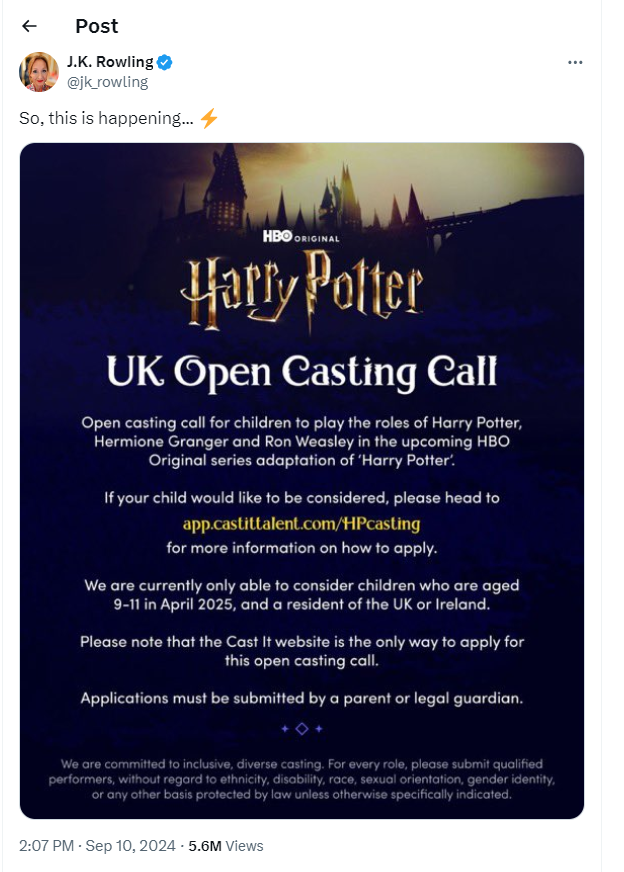
Rowling Tweets Casting Call for 2025 Harry Potter Television Adaptation

Three very quick notes:

(1) They won’t start filming (or it casting?) until April of next year. No way this thing takes off until 2026. I’d like to hear ideas about why HBO-Warner Brothers-Bronte Studios are not fast-tracking this project because I’m clueless about everything to do with teevee.

(2) This is a casting call for the three children lead roles: Harry Potter, Ron Weasley, and Hermione Granger. Those are the biggest parts to cast correctly, but when will the hundred or so other players be chosen? Again, we’re still at the starting line on this project after they cast the soul triptych.

(3) If you have a minute, check out the comment thread on this tweet. There is a remarkable diversity of reactions to the HRH casting call; even Elon Musk checks in. Quite a few responders mention a hope that the almost invisible DEI verbiage at the bottom of the casting call does not mean ‘Black Hermione’ and ‘Gay Dumbledore,’ et ceteri/ae. Quite a few more decry the bigotry, racism, homophobia, et cetera ad nauseum, of anyone not thrilled by those possibilities.

People are really engaged by this adaptation and I expect it will act as a projection screen for fans beliefs about “representation” and for all those involved in the teevee program’s production, to include Rowling herself. Should you need proof that Harry Potter is the “Shared Text” of readers globally, young and old, this imminent and inevitable ‘acting out’ online by all the partisans should be a convincing demonstration.

Rowling-Solomon Interview July 2000: Seven Possible Points of Interest in 2024

For the full four part transcript of the Evan Solomon interview with the Young Presence at the time of Goblet of Fire‘s publication, see “J.K. Rowling Interview,” CBCNewsWorld: Hot Type, July 13, 2000 over at Accio-Quotes’ Rowling interview archive.

After the jump I share the seven exchanges in this interview I think worthy of reflection in this Q&A almost a quarter century later, the best being the last, a surprise comment Rowling makes about her faith at the time of her mother’s death: [Read more…]