Rowling’s Rings Within Rings: The First?

I was invited in February to contribute an article to a Rowling Library essay anthology about the structure of her work. I was not surprised that I was invited, frankly, because I was the first to chart the ring structure of her novels and series way back in 2010 and because of my enthusiasm and admiration for just everything The Rowling Library does. My excitement about this project, though, was really about my taking a position contrary to the thesis of the anthology and the opportunity it opened to explore something I had suspected for a long time but never nailed down.

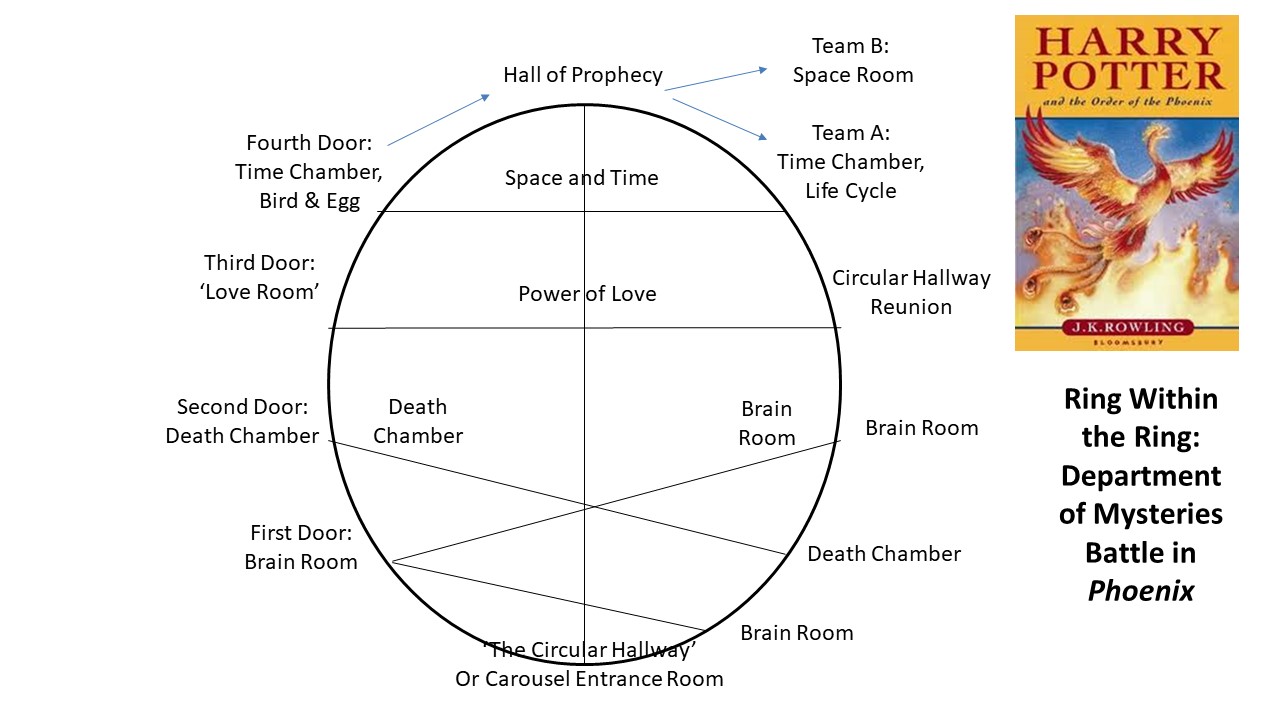
I have given I don’t know how many public talks about Rowling’s ring writing, written many more posts, and spoken on at least as many podcasts; in that history, I do not know when I first mentioned (or how often consequently I referred to the idea) that I thought the Order of the Phoenix chapters about Harry’s adventures in the Ministry’s Department of Mysteries was a ring-within-the-ring of the longest book of that series. My contribution to The Rowling Library anthology is a relatively detailed exploration of that ring and its importance to the series. I’ll be writing more about this anthology of course as TRL makes its public announcements.
What I can say here is something I don’t say explicitly in that essay. The structure and remarkable symbolism of the Department of Mysteries misadventure make it among the most meaningful single passages in the Hogwarts Saga. The only ones that come to mind as being as important for grasping what Rowling believes and was trying to communicate via her story alembic are the three parallel gauntlet runs in Stone, Goblet, and Hallows, the Chamber of Secrets confrontation with Riddle and the Basilisk, the trip to the Lake beneath the mountain with Dumbledore in Half Blood Prince, the conversation at the other-worldly King’s Cross station in Hallows, and the burial of Alastair Moody’s ‘Mad Eye’ earlier in the finale. And, writing about it today, I think the Phoenix trip into the depths of the Ministry of Magic is probably the forty page piece that should be put in future representative collections of 21st century literature to capture the essence of Rowling’s writing.

What made it interesting to me, though, when I first charted the seven books in 2010 was the possibility that this capsule of writing was a ‘for instance’ of the chiastic structure signature element Mary Douglas in her Thinking in Circles called “rings within the ring.” In brief, real chiastic writing per the great anthropologist has as a defining characteristic not only a latch, turn, and turtle-back lines, but parts that have all those elements inside the whole. It was this Douglas premise that made me chart the individual books in the series after I had confirmed Brett Kendall’s 2003 (!) theory that the septology would be chiastic in structure.

The question that came up naturally was “Are there rings inside of the book rings the way the individual novels are rings within the series ring?” My answer to that was “I don’t know — but if I were to look, I’d chart the Order of the Phoenix passage inside the Department of Mysteries.” It has so many circular elements and obvious parallelisms that I thought it was the best place to look for an embedded ring; Rowling had seemingly lit ichneutic flares around it to highlight that possibility.

Rowling’s rings-within-rings has become something of a commonplace in her Cormoran Strike novels. Though I have not charted all of the seven books in the series with an eye for this, the two I have — Troubled Blood and Running Grave — feature Parts or chapter sets that have all the ring structure elements Douglas lays out inside the ring structure of that novel which, incredibly, fits within the seven book ring of that series thus far. See my breakdown of Running Grave’s Part Eight for an example of that intricate structural artistry.

My question today for serious Rowling Readers is, “When did she start this ring-within-the-ring-within-the-ring structural work that is invisible to the conscious mind but so important to the story’s subliminal effect?” The Phoenix trip into the Department of Mysteries is on my mind and it makes a certain sense that this would be the place she started; Order of the Phoenix  was the longest book of the Potter series, it came out after a three year pause in publication, and Rowling had clearly raised her game in several regards. A jump in the dimensions of her structural artistry seems likely there.

The Sunday Times of London published a Q&A exchange with Rowling this morning to mark the publication of Running Grave in paperback (about which, more tomorrow). That exchange closed with this:

How much had you planned all seven books when you started The Philosopher’s Stone?
By the end of the first book I knew how the seventh would end and had worked out a lot of the details of the world, but I left enough leeway to enjoy creating things as I went. Although they’re such different genres, I’ve applied a lot of what I learnt about world-building on Potter to the Strike series. In my work, I like to know exactly where I’m going. In my life, not so much.

There’s quite a bit to unpack there, of course, but I don’t think she’s being honest really about the extent of her planning. The remarkable parallels with the plot points and themes of Philosopher’s Stone in Goblet of Fire and Deathly Hallows make it clear there was less “leeway” than she lets on and that she “knew exactly where she was going” from the gate.

Having noted that, might her rings-within-the-novel-ring have started as early as Philosopher’s Stone? My haunting ring-charting project has been Ink Black Heart, the Rowling novel I have written the least about due to my PhD thesis deadlines post viva voce exams (which were on the day Strike6 was published…). I think I’ll put off that project again and, as I re-read the seven parts of the Hogwarts Saga, I’ll be focusing on the there-and-home-again story parts that may be rings. The four in the books before Phoenix would be the trip to the Mirror of Erised in Stone, the descent to the Chamber of Secrets in Potter2, the time-turning trial that leads to the Shrieking Shack in Prisoner of Azkaban, and Goblet of Fire‘s Portkey powered trip to and from the Little Hangleton graveyard after arriving at the center of the Triwizard Tournament maze.

Tomorrow I’ll be writing about the Rowling Times Q&A, next week about a new Rowling biography due early next year, and in the coming months, deo volente, more about the exciting Rowling Library anthology and the hunt for Rowling’s first ring-within-the-novel-ring. Not to mention the advent of Hallmarked Man… Thank you for joining me on these adventures in Rowling Studies!
Rowling to Turn 60 on 31 July 2025; Where was She at 10, 20, 30, 40, 50?

If you number years of age as some traditional people do — considering the first year not as “zero years old” but as “one,” turning “two” at the beginning of the second year of life on what we celebrate as the first birthday — Joanne Rowling Murray entered her sixtieth year on 31 July, sailing on her yacht somewhere between Greenland and eastern Canada. She’ll turn 60 in conventional counting on 31 July 2025.

Turning 60 is not a very big deal in the US or UK but it is in the Far East for astrological reasons. Chinese astrology qualifies a year using both a ten year and twelve year cycle, which, taken together, mean that the quality of the birth year reappears only at the end of 60 year combined cycle:

Also named the sexagenary cycle or  the stem-branch cycle, the Chinese 60-year calendar cycle is based on the combinations of a cycle of ten heavenly stems and twelve earthly branches. Each year is named by a pair of one stem and one branch. The Year of Jia Zi (Jia from the heavenly stems and Zi from the earthly branches) is the beginning of the sexagenary cycle. The next Jia Zi Year will come 60 years later.

In Japan the 60th birthday is celebrated with special ceremonies, clothing, and food; the word for it, Kanreki, literally means “rebirth” because the celebrant is beginning again at his or her point of origin. I was living with a very successful Japanese man’s family in Massachusetts in May 1986 and the party on his birthday was something like what in the military is known as a “command call;” his students, business associates, publishers, family, and friends traveled from Japan, North and South America, and all of Europe to salute him. It’s a big deal.

Joanne Rowling was born in July 1965, a year qualified in Oriental astrology as ‘Yin Wood Si Ni Snake.’ The year beginning in February 2025 will have the same qualities. I suppose there are jokes about being a ‘wooden snake’ but as I was born in the year of the Yin Metal Ox, I’ll pass on throwing the first stone at her glass house.

I assume Rowling and the Murray clan will spend her birthday on their yacht floating off a beautiful beach or fjord as has become the family tradition. I thought today to review where Rowling was on her decade birthday celebrations to launch her Kanreki observances near the start of her sixtieth year. Thanks to the anonymous aggregator at The Rowling Library who put together their biographical timeline for The Presence; your efforts made this birthday compilation relatively easy.

Tenth Birthday — July 1975

Rowling’s family moved in 1974 to “Church Cottage, Tutshill, Gloucestershire, England. Rowling attends secondary school at Wyedean School and College” (TRL). Rowling at ten was living in an unhappy home. Casual Vacancy‘s Andrew Price and his painful relationships with his father Simon and mother Ruth is easily read as a transparency of the Rowling family as it was in Joanne’s teen years. [Read more…]

MinaLima Out as Potter Book Designers

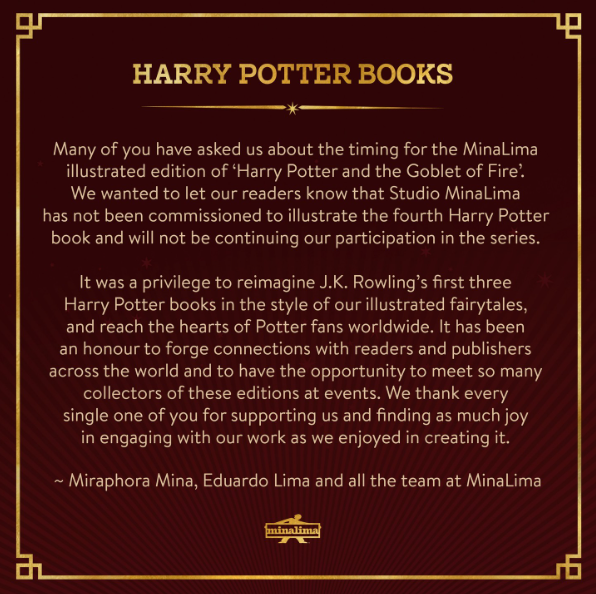
If there is a Harry Potter ‘look,’ it is the one created by MinaLima, the design and illustration team responsible for the Warner Brothers movie-adaptations’ graphic work (the Marauders’ Map!), the first two of the three Fantastic Beasts screenplays, as well as the first three volumes of the illustrated edition set of the seven Hogwarts Saga novels. Studio MinaLima announced via Instagram on 5 August that they would not be designing or illustrating the Goblet of Fire volume in this series.

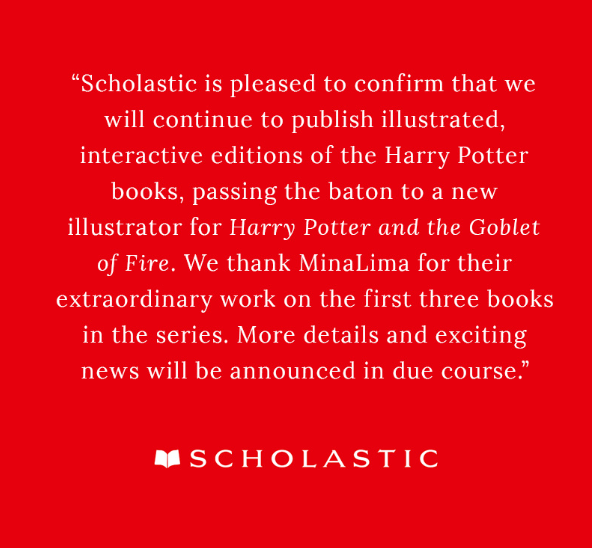
Scholastic confirmed this via The Rowling Library’s Instagram platform soon thereafter:

Judging from the responses to this news on Instagram, collectors and fans of the series as well as of MinaLima’s artistry are not at all happy with this decision. I scrolled down the first responses to The Rowling Library posting of this news and the reactions were uniformly expressions of disappointment, even disgust with Scholastic.

Why the change? The answer is almost certainly “money.” Either MinaLima asked for more than Scholastic was willing to pay or the books they designed were becoming too expensive to produce, which is to say, “too close to the ceiling price point readers will pay thereby reducing the profit made on each sale” or Scholastic just decided to go with a much less costly partner in this venture. As they have already done in another series — [Read more…]

Rowling Impersonator, Doppelganger — and the Mysterious Michael at Exeter?

This is a grab-bag post with only the weakest of a connecting thread, namely, all three pieces have something to do with J. K. Rowling.

The first is the evidence Andy Ngo uncovered in April 2023 that radical leftist Talia Lavin had decided to impersonate J. K. Rowling on the Twitter social media platform in order to put “trans-phobic” words in the author’s mouth. If you check out the Lavin wikipedia page, you’ll see this wasn’t her first offense with respect to irresponsible behavior online.

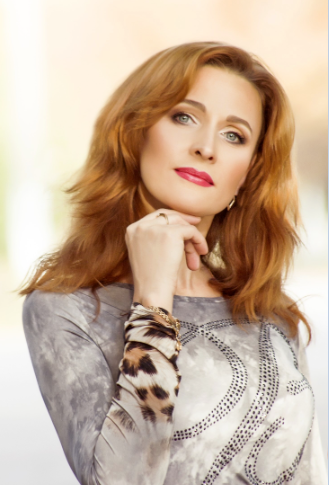
The second is a Ukrainian woman living in the Donbass region who appears to be Rowling’s body-double or doppelganger. As you can see from the picture, she’s a dead ringer for The Presence, say, in 2005, and, at 5’2,” not far off in height, even allowing that it is a much younger Rowling that she resembles. Life in Ukraine, especially in the Donbass, is unimaginably difficult today because of the proxy war being fought between the United States and the Russian Federation there; perhaps Rowling, Inc., could find a job for ‘Oksana, Age 43‘ as a Rowling stand-in for engagements she is obliged to show her face and do little else? I think she belongs on these lists of ‘Nine Regular People Who Look Like Celebrities‘ or ‘Twenty-Two Celebrity Doppelgangers.’

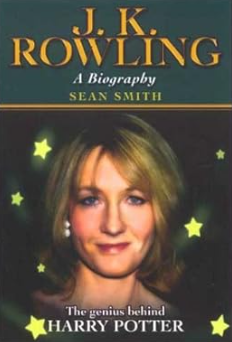
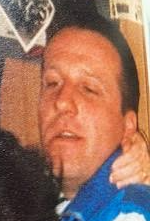
And, third and last, I searched and searched online for digital versions of the photographs of Rowling as a college student at the University of Exeter that are in Sean Smith’s J. K. Rowling: A Biography. I had no luck with that and, sadly, the book has no photo credits or exact dates so the pictures cannot be searched in that fashion. This is a real shame, because two of the pictures are of Rowling out on the town with three friends, two young women and one man. These are the only pictures we have of Rowling at UExeter outside of graduation — and they feature a guy, perhaps even the mysterious boyfriend?

I’m fairly confident that this man is either the “Michael” boyfriend of seven years, the break-up with whom after she lived with him in Manchester 1990-1991, inspired her decision to leave the UK for Portugal, or, much more likely, that he knows the real “Michael’s” surname. He looks like an accountant, rugby player, and, alas, not especially bright, which is to say, he could be the inspiration for Matt Cunliffe.  To be fair, of course, who looks their best in candid pictures taken in a bar, frat, or club?

Regardless, if you’ve seen this man or recognize him, please write to me at john at HogwartsProfessor dot com. I have tried for matches with him at TinEye.com (zero matches) and SocialCatfish.com (twenty-seven matches for $6.87 I don’t have); why not unleash the power of our readership to find the man? Happy Surfing!

Oliver Anthony: Is He a Member of Generation Hex?

Rowling was asked on her 2007 Open Book Tour of North America if she had any advice for her readers, young and old. She responded promptly and in the affirmative: “Don’t trust the press or the government.”

The years since have only confirmed the wisdom of that pointed advice, especially during the Covid, Trans, and Ukraine hysterias.

If postmodernity as a historical period per the angry Algerians of literary criticism is characterized by its collective “incredulity toward the metanarrative,” that is as true for those who grew up reading Harry Potter. This is true, I think, even though almost all of that fandom’s leadership were sucked into the Orwellian nightmares from the political left of the last fifteen years.

I thought of the skepticism about everything we are told by the media and government that is prevalent and growing today — “How many times can we be duped into changing our status flags on Facebook before we catch on?” seems a commonplace feeling — when I read that Anthony Oliver’s ‘Rich Men North of Richmond’ marked its first anniversary in the public square.

Here is that unforgettable song of raging against the machine as sung by its remarkable writer:

And here are Oliver’s reflections on the year that has passed by, his gratitude to his supporters, his determination not to be pigeon-holed by media or political partisans, and his commitment to working to help others have a life with roots in the land, not their ‘Smart’ phones.

No, I have no idea if Oliver Anthony read Harry Potter as a boy. He seems to be a cross between Wendell Berry, the free-wheelin’ Bob Dylan, and abolitionist John Brown (it’s the beard).

I wouldn’t be surprised, though, if he did read it all. There’s a magical touch and Gryffindor quality to him.

What if her were a character in the Saga? Where would he be sorted? Whom does he resemble?

The Sorting Hat might put him in Hufflepuff to be guided by Professor Sprout but he shows shades of Ravenclaw insight; I think, though, if you gave the young Albus Dumbledore some time in the mountains with a pick and a banjo, that he might have been singing songs like ‘Rich Men North of Richmond.’

Tomorrow, ‘Rowling, Jimi Hendrix, and the Defining Decision of Her Life.’ Stay tuned!