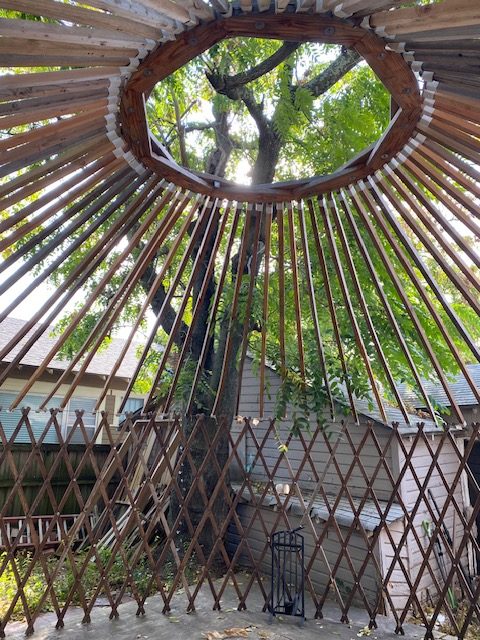
Backyard Ring Composition: Ger Cover

Yesterday Troy Honeycutt, his assistant Ashley, and I put the canvas ger cover from Mongolia over the ‘yurt’ rafters, ring, and pantograph walls. It was too late to take pictures when we were done, but I snapped a few today.
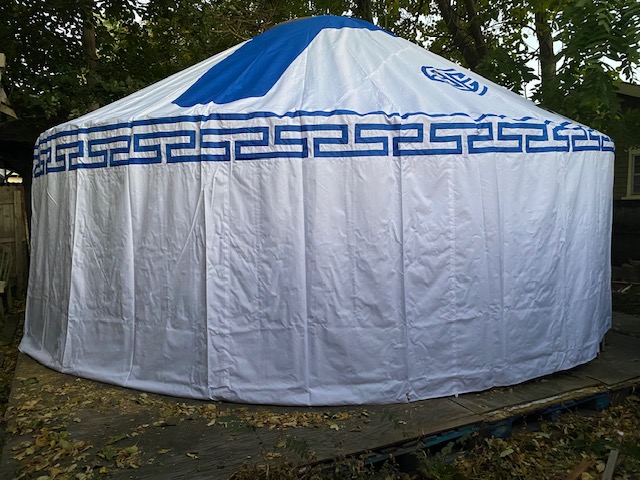
Incredibly, as small as the cover’s package was, it unfolded to fit the home-made scaffolding like a glove on a hand.

The problem we had was consequent to not laying it out before pulling the cover over the ring and rafters. That haste meant that the door cut was on the opposite sing of the ring from the doorway. It took us much longer to spin the cover around than it did to pull it over.

But when it was done, the anything-but-waterproof tent was ‘up’!
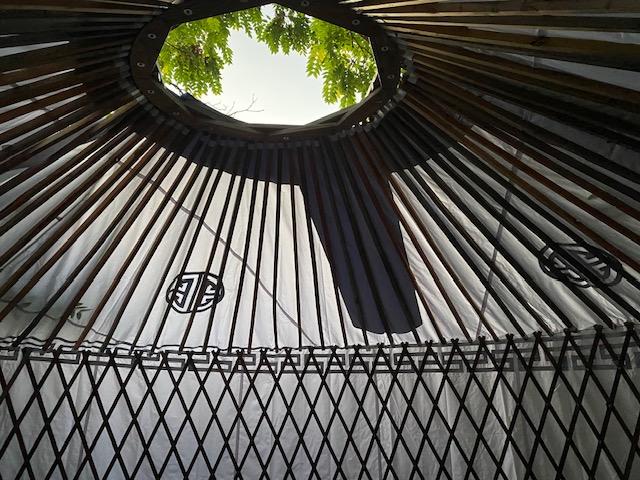
I still have to tie and pull tight the seam strings and tweak quite a few of the rafter connections to the baby-gate wall and to the ring, not to mention cutting the tree branches that are visible through the canvas cover.
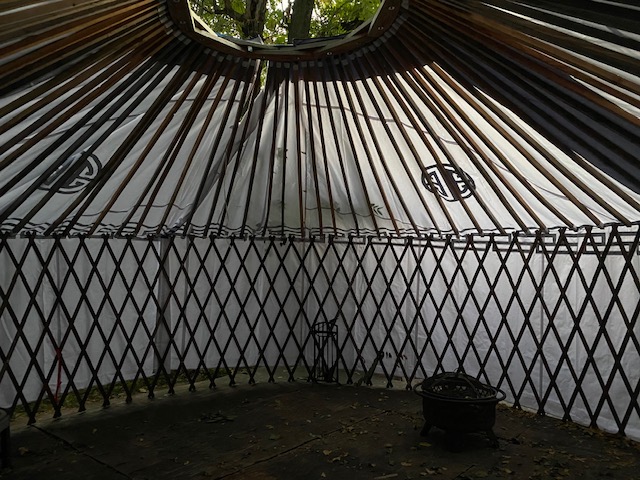
Tomorrow night the family hopes to have our first fire inside the building in order to see if the center hole works as chimney or if the smoke quickly chases us out of the ger. More anon!
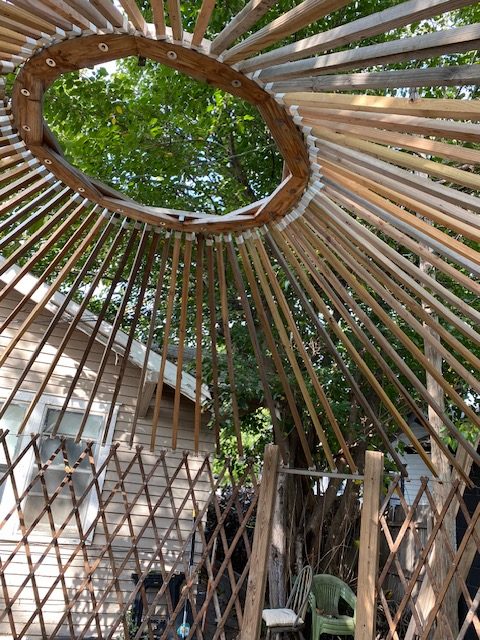
It’s A Ring Composition! In the Backyard!

I spent yesterday and the day before re-reading Casual Vacancy for the Pregnancy Trap 2 post I promised last week. Troy Honeycutt and his assistant Ashley came over to put up the final rafters on my 20′ Mongolian ger (Americans call them yurts but that is the Soviet word for “shack” that they used to dismiss traditional Mongolian tents and, with them, Mongolian nomadic life). Today we struggled to put on the cover (from believe it or don’t MongolianStore.com) and succeeded but it was too dark for pictures.

Tomorrow, Deo volente, I will finish my notes and charting of Casual Vacancy and share my findings in a post — along with pictures of my wife’s new Tai Chi studio. Thanks to my brother-in-law Craig Jahr for the carpentry work he did on the ring, to the Honeycutt team for assembling the pantograph walls and rafters, to Benedict Ovel for the ad hoc door he put together in January, and to my family and friends for the five years of Christmas Parties we celebrated inside the incomplete ger extended baby-gate sans ring and rafters.

J. K. Rowling’s ‘G-Spot’ and ‘Triple Play:’ The Lake & Shed Secret of Her Success

I want to try tonight to explain as succinctly — and as provocatively — as possible why I think Rowling’s ‘Lake and Shed’ metaphorical explanation of how she writes offers a compelling reason for both why she writes and why readers around the world love her novels the way they do. I call this her ‘G-Spot’ and ‘Triple Play’ because it is her point of singular genius, the defining quality that separates her from contemporary story-tellers, which involves ‘Shed’ artistry of three particular literary tools, all subliminal, which work together to achieve her aims.

First, then, a brief review of Rowling’s ‘Lake and Shed’ description of how she writes, her method, inspiration to publication, then my hypothesis of why this method reflects why she writes, and finally, a very brief discussion of Rowling’s three ‘Shed’ power-tools that all have a shared aim and effect on readers. All after the jump! [Read more…]

Rowling’s Rings Within Rings: The First?

I was invited in February to contribute an article to a Rowling Library essay anthology about the structure of her work. I was not surprised that I was invited, frankly, because I was the first to chart the ring structure of her novels and series way back in 2010 and because of my enthusiasm and admiration for just everything The Rowling Library does. My excitement about this project, though, was really about my taking a position contrary to the thesis of the anthology and the opportunity it opened to explore something I had suspected for a long time but never nailed down.

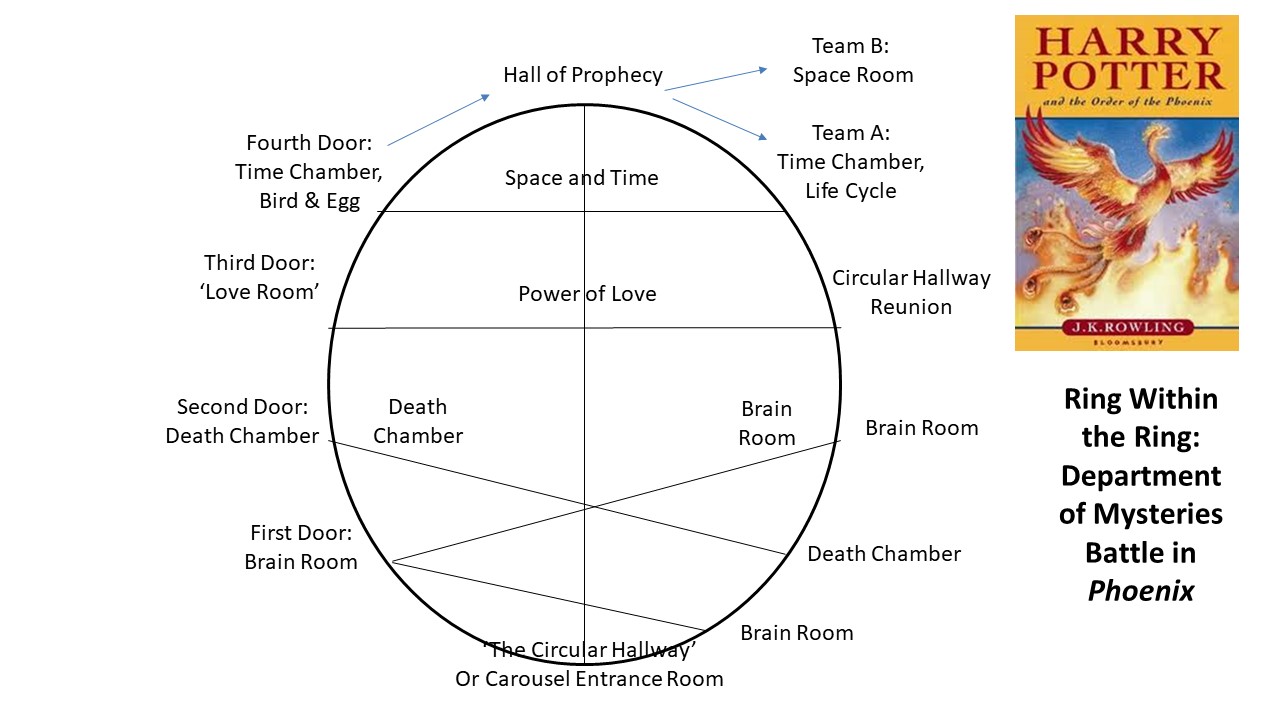
I have given I don’t know how many public talks about Rowling’s ring writing, written many more posts, and spoken on at least as many podcasts; in that history, I do not know when I first mentioned (or how often consequently I referred to the idea) that I thought the Order of the Phoenix chapters about Harry’s adventures in the Ministry’s Department of Mysteries was a ring-within-the-ring of the longest book of that series. My contribution to The Rowling Library anthology is a relatively detailed exploration of that ring and its importance to the series. I’ll be writing more about this anthology of course as TRL makes its public announcements.

What I can say here is something I don’t say explicitly in that essay. The structure and remarkable symbolism of the Department of Mysteries misadventure make it among the most meaningful single passages in the Hogwarts Saga. The only ones that come to mind as being as important for grasping what Rowling believes and was trying to communicate via her story alembic are the three parallel gauntlet runs in Stone, Goblet, and Hallows, the Chamber of Secrets confrontation with Riddle and the Basilisk, the trip to the Lake beneath the mountain with Dumbledore in Half Blood Prince, the conversation at the other-worldly King’s Cross station in Hallows, and the burial of Alastair Moody’s ‘Mad Eye’ earlier in the finale. And, writing about it today, I think the Phoenix trip into the depths of the Ministry of Magic is probably the forty page piece that should be put in future representative collections of 21st century literature to capture the essence of Rowling’s writing.

What made it interesting to me, though, when I first charted the seven books in 2010 was the possibility that this capsule of writing was a ‘for instance’ of the chiastic structure signature element Mary Douglas in her Thinking in Circles called “rings within the ring.” In brief, real chiastic writing per the great anthropologist has as a defining characteristic not only a latch, turn, and turtle-back lines, but parts that have all those elements inside the whole. It was this Douglas premise that made me chart the individual books in the series after I had confirmed Brett Kendall’s 2003 (!) theory that the septology would be chiastic in structure.

The question that came up naturally was “Are there rings inside of the book rings the way the individual novels are rings within the series ring?” My answer to that was “I don’t know — but if I were to look, I’d chart the Order of the Phoenix passage inside the Department of Mysteries.” It has so many circular elements and obvious parallelisms that I thought it was the best place to look for an embedded ring; Rowling had seemingly lit ichneutic flares around it to highlight that possibility.

Rowling’s rings-within-rings has become something of a commonplace in her Cormoran Strike novels. Though I have not charted all of the seven books in the series with an eye for this, the two I have — Troubled Blood and Running Grave — feature Parts or chapter sets that have all the ring structure elements Douglas lays out inside the ring structure of that novel which, incredibly, fits within the seven book ring of that series thus far. See my breakdown of Running Grave’s Part Eight for an example of that intricate structural artistry.

My question today for serious Rowling Readers is, “When did she start this ring-within-the-ring-within-the-ring structural work that is invisible to the conscious mind but so important to the story’s subliminal effect?” The Phoenix trip into the Department of Mysteries is on my mind and it makes a certain sense that this would be the place she started; Order of the Phoenix  was the longest book of the Potter series, it came out after a three year pause in publication, and Rowling had clearly raised her game in several regards. A jump in the dimensions of her structural artistry seems likely there.

The Sunday Times of London published a Q&A exchange with Rowling this morning to mark the publication of Running Grave in paperback (about which, more tomorrow). That exchange closed with this:

How much had you planned all seven books when you started The Philosopher’s Stone?
By the end of the first book I knew how the seventh would end and had worked out a lot of the details of the world, but I left enough leeway to enjoy creating things as I went. Although they’re such different genres, I’ve applied a lot of what I learnt about world-building on Potter to the Strike series. In my work, I like to know exactly where I’m going. In my life, not so much.

There’s quite a bit to unpack there, of course, but I don’t think she’s being honest really about the extent of her planning. The remarkable parallels with the plot points and themes of Philosopher’s Stone in Goblet of Fire and Deathly Hallows make it clear there was less “leeway” than she lets on and that she “knew exactly where she was going” from the gate.

Having noted that, might her rings-within-the-novel-ring have started as early as Philosopher’s Stone? My haunting ring-charting project has been Ink Black Heart, the Rowling novel I have written the least about due to my PhD thesis deadlines post viva voce exams (which were on the day Strike6 was published…). I think I’ll put off that project again and, as I re-read the seven parts of the Hogwarts Saga, I’ll be focusing on the there-and-home-again story parts that may be rings. The four in the books before Phoenix would be the trip to the Mirror of Erised in Stone, the descent to the Chamber of Secrets in Potter2, the time-turning trial that leads to the Shrieking Shack in Prisoner of Azkaban, and Goblet of Fire‘s Portkey powered trip to and from the Little Hangleton graveyard after arriving at the center of the Triwizard Tournament maze.

Tomorrow I’ll be writing about the Rowling Times Q&A, next week about a new Rowling biography due early next year, and in the coming months, deo volente, more about the exciting Rowling Library anthology and the hunt for Rowling’s first ring-within-the-novel-ring. Not to mention the advent of Hallmarked Man… Thank you for joining me on these adventures in Rowling Studies!

Popular Culture Catches up to Chiasmus in Harry Potter

Entertainment web magazine Screen Rant has discovered the chiastic form of the Harry Potter series, seemingly from first principles. Senior staff writer, Angel Shaw, noticed that the later novels reflected the earlier ones and wanted to know if they were the first to discover it. 

Once I noticed the Harry Potter series’ reflective nature, I went to the internet to see if anyone else had reached the same conclusion. Of course, they had, and I quickly dove into what has come to be called the ring composition” or “chiastic” theory of Harry Potter, analyzed stupendously by John Granger.

Anyone who wishes to dig deeper into ring composition can see the pillar post here, or read John Granger’s book Harry Potter as Ring Composition and Ring Cycle. John’s most recent work, the stupendously epic Running Grave: Ring Reading, can be found here.