Rowling’s Soul Triptych Psychomachia: Is It From Shakespeare’s ‘Macbeth’?

I began writing about Rowling’s psychomachia, the allegory of the soul’s journey to perfection, in 2002 with the publication of The Hidden Key to Harry Potter, the book that eventually became How Harry Cast His Spell. In brief, I explained then that the three principal student characters in the Hogwarts books, Harry, Hermione, and Ron, were Rowling’s version of the allegory of the soul in Plato’s Phaedrus, a conceit that stretched across imaginative fiction to include among many others The Brothers Karamazov, the three hobbits on Mount Doom, and Kirk, Spock, and Bones.

The characters were the respective authors’ depiction of the spiritual heart, the mind or will, and the body with its desires and passions, usually reduced to the formulaic “body, mind, and spirit.” Hermione was the brains of the Hogwarts set, Ron was the body stand-in, and Harry, the scion of sacrificial love and doing the hard, right thing, was the heart or spirit to which the others deferred, at least when things were going well. Together, the three faculties of soul mature through seven alchemical cycles until they vanquish their respective failings and defeat the Dark Lord.

Rowling has worked in other types of psychomachian allegory in different books, most notably the Shakespearean romance model in the Strike series and the transference love of a child and its toy in Christmas Pig. Depicting the perfection of the soul in spirit is what she does, whichever tools she chooses to create the cathartic imaginative effect within her readers. I have argued, again since 2002, that this is what makes Rowling’s work singularly popular; readers come to fiction, per the Eliade thesis, for the oxygen it provides their transpersonal faculty — and Rowling’s allegories of the soul meet that need much more successfully than the other fare on offer in bookstores, the cinema, or in online games.

But where did she first encounter this idea in a book or play? Did she come up with it on her own or did she read about soul triptychs and the like in critical literature about a favorite story? And what inspired her to make the leap from Dostoevsky’s or Tolkien’s triptychs to making the genre formula trio of schoolboy novels with hero, egghead, and swarthy best mate, into a psychomachian drama set piece?

There’s no way of knowing the answers to that question short of Rowling agreeing to answer questions while under the power of a high octane Veritaserum draft. As that has never happened, I think it safe to assume it never will. I have a decent guess, though, namely, that she got the idea while reading about her favorite Shakespeare play, Macbeth, and then recognized it in other favorite works, especially The Lord of the Rings and even Star Wars. When inspired to write a schoolboy series of books, she elected to make the formula trio of students into her soul triptych vehicles.

A stretch? Of course it is! After the jump, I’ll share Rowling’s public statements about Macbeth, the widely available critical work on Shakespeare’s plays that discussed the soul triptych within it, and some preliminary thoughts about the likelihood that this was Rowling’s ur source for her Potter soul triptych. [Read more…]
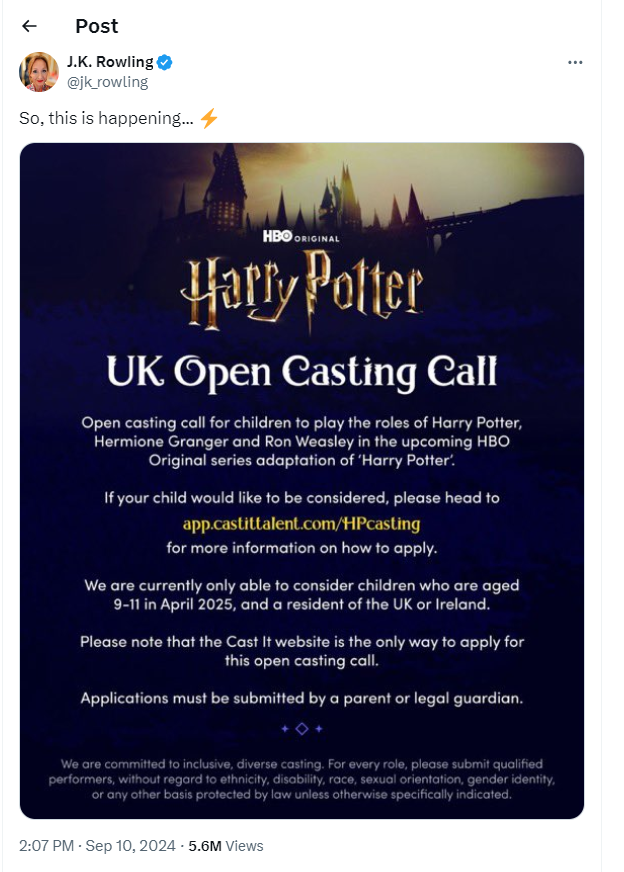
Rowling Tweets Casting Call for 2025 Harry Potter Television Adaptation

Three very quick notes:

(1) They won’t start filming (or it casting?) until April of next year. No way this thing takes off until 2026. I’d like to hear ideas about why HBO-Warner Brothers-Bronte Studios are not fast-tracking this project because I’m clueless about everything to do with teevee.

(2) This is a casting call for the three children lead roles: Harry Potter, Ron Weasley, and Hermione Granger. Those are the biggest parts to cast correctly, but when will the hundred or so other players be chosen? Again, we’re still at the starting line on this project after they cast the soul triptych.

(3) If you have a minute, check out the comment thread on this tweet. There is a remarkable diversity of reactions to the HRH casting call; even Elon Musk checks in. Quite a few responders mention a hope that the almost invisible DEI verbiage at the bottom of the casting call does not mean ‘Black Hermione’ and ‘Gay Dumbledore,’ et ceteri/ae. Quite a few more decry the bigotry, racism, homophobia, et cetera ad nauseum, of anyone not thrilled by those possibilities.

People are really engaged by this adaptation and I expect it will act as a projection screen for fans beliefs about “representation” and for all those involved in the teevee program’s production, to include Rowling herself. Should you need proof that Harry Potter is the “Shared Text” of readers globally, young and old, this imminent and inevitable ‘acting out’ online by all the partisans should be a convincing demonstration.

Sunday Potter Quiz: Wardrobe Boggart!

Harry Potter and the Prisoner of Azkaban: Chapter 7

Mark True statements with a “T” and False statements with an “F.”

  1. _____  Chapter Seven, The Boggart in the Wardrobe, begins in Potions class where Malfoy enters in bandages. He asks Professor Snape for help with his work on the Shrinking Solution – and Severus makes Harry and Ron do the hard stuff.
  2. _____ Malfoy implies Harry is a coward for not hunting down Sirius Black himself instead of being in school. “If it was me,” he says, “I’d want revenge.”
  3. _____ Professor Snape takes five points from Gryffindor because Neville’s toad becomes a lizard instead of shrinking properly.
  4. _____ Professor Lupin takes the class into the Staffroom for a lesson about changing Professors into boggarts.
  5. _____ A real boggart is in the Staffroom wardrobe and Lupin takes this opportunity to teach the class how to defeat the Shape-changer that tries to frighten its antagonist: laughter.
  6. _____ Neville’s boggart turns into Professor Snape but he finishes him off with the Riddikulus charm and turning him into a lizard wearing a dress and a funny women’s hat.
  7. _____ Ron is afraid of spiders but succeeds in defeating his boggart by using the Riddikulus charm and putting roller skates on its many legs.
  8. _____ Lupin’s boggart turns into a “silvery white orb hanging in the air” which he defeats by using the Riddikulus charm and turning it into a cockroach.
  9. _____ Harry is upset at the end of class because he wasn’t able to turn his Dementor boggart into anything; the monster scared him so much that he almost passed out before Lupin intervened.
  10. _____ The chapter ends with Ron, Harry, and Hermione agreeing that Professor Lupin’s class was the best Defense Against the Dark Arts class they’d ever had. Hermione wishes she had had a chance against a boggart.

Share your answers in the comments boxes!

Mailbag: Is Rowling Guilty of ‘Gender Appropriation’? Why ‘Robert Galbraith’?

Hi John,

A question that has been with me for a while is this: in light of Rowling’s position on transgender issues, what do we make of her use of a male-sounding pseudonym (JK Rowling) and an obviously male pseudonym (Robert Galbraith, with uber-masculine military backstory and all)? I mean, couldn’t this be considered gender appropriation? identifying as male?

Women writers have used male pseudonyms for a while to juice sales to male readers. Mary Ann Evans (George Eliot) and Emily Bronte (Ellis Bell) are just two examples.

For one as stridently feminist as Rowling, why the male persona? Of course, in 1990s her initial editor likely advised her to use the initials to attract boy readers, thereby increasing sales, and she, as a writer new to the publishing industry, naively took the advice. But 15+ years later, the wildly successful author/millionaire commander of her empire, with 7+ books, multiple films, one or two theme parks, and philanthropic organizations behind her, was surely much more confident in her abilities, ideas, and beliefs, yet still chose a male persona to check on her popularity aside from the JKR reputation.

Anyway, I’m sure she’s a complex person, so the answer won’t be simple.

Am I just being a smart aleck or is there something to this?

I think it’s a great question; thank you for asking!

I want to take this in three different directions, any one of which three ideas could be the subject of its own post. The first is to dismiss pre-emptively the rot Rowling offers about her name choices as well as the suggestion that the words ‘gender appropriation’ inspire today, the second is the alchemical resolution of contraries into an hermaphroditic ‘Rebis,’ and the third is the Shakespearean psychomachia and mythic backdrop of the Strike-Ellacott series. Join me after the jump for my introductions to reasons why Rowling-Galbraith-Murray has chosen the pseudonyms that she has. [Read more…]

Rowling-Solomon Interview July 2000: Seven Possible Points of Interest in 2024

For the full four part transcript of the Evan Solomon interview with the Young Presence at the time of Goblet of Fire‘s publication, see “J.K. Rowling Interview,” CBCNewsWorld: Hot Type, July 13, 2000 over at Accio-Quotes’ Rowling interview archive.

After the jump I share the seven exchanges in this interview I think worthy of reflection in this Q&A almost a quarter century later, the best being the last, a surprise comment Rowling makes about her faith at the time of her mother’s death: [Read more…]