Shared Text: ‘Redneck Wizard’

A good friend sent me the video below. She is not a Harry Potter fan and I suspect she marvels that the Hogwarts Saga continues to be such a big deal more than a quarter century after the original Potter Mania took off (not on a broom).

I would be incredulous, too, but, as I explained years ago — sixteen years ago! — in an article titled ‘Book Binders,’ Rowling’s Potter novels serve as the ‘Shared Text’ of at least two generations.

Expect tributes and parodies such as ‘Redneck Wizard’ to continue to be Grade A Click Bait for another twenty-five years, especially after the booster shot to the popular imagination that the WB-Bronte Studios adaptations for teevee will be.
Is J. K. Rowling a Coward? Three Topics About Which She Will Not Speak

To risk understatement, I am a J. K. Rowling fan. Bum Phillips once said about Earl Campbell that the running back may not be the only person in his class but “it doesn’t take long to say roll.” I think that can fairly be said of my contributions to Rowling Studies from 2002 to the present day. As one Serious Striker wrote to me last year, one who incidentally is not currently a fan or a friend, “No one has contributed more to the understanding of J. K. Rowling’s work than you have.”

I am the “Dean of Harry Potter Scholars” and have invested what time I have in her work only because I think Rowling is a great writer and an important one. C. S. Lewis said once that the 20th Century would be known to literary historians as the ‘Age of Charles Williams’ the way that critics talk about Shakespearean England or Byron’s Era. No sign of that coming about, alas, as prescient as Lewis was; it seems much more likely and merited in terms of reach, depth, and accomplishments, literary and philanthropic, that the 21st Century will be known as the ‘Age of Rowling.’

I lay out those credentials and views in order to introduce a subject that may disturb Rowling-philes as well as her harsher critics. That subject is Rowling’s courage, and, specifically, her lack of courage, call it cowardice, on at least three points.

Courage is important to Rowling’s self-identity so a failing with this respect to this central virtue is no small thing. Remember her comments about why she admired Robert F. Kennedy, Sr., at the Ripple of Hope Award ceremony in 2019:

Robert Kennedy embodied everything I most admire in a human being.

He was morally and physically courageous, and, like Churchill, I believe that courage is the foremost of the virtues because it  guarantees all the others. He looked beyond the invisible but powerful boundaries that can insulate people of privilege from the rest of the world and he looked into those dark corners where poverty and discrimination and injustice breed. He was a man of both empathy and action and he brought about real change and he continues to inspire people beyond the boundaries of his of his own country — and I’m not sure we can ask much more of any politician or indeed of any human being.

Read RFK, Sr’s 1965 Affirmation Day speech in South Africa, the so-called ‘Ripple of Hope’ address, for a good bolt of that moral courage and daring political boldness as well. Rowling finds that selfless spirit, something akin to fearlessness, the “foremost of the virtues.” She clearly has made that a thematic golden thread running throughout her works and in her personal life as well, from the courage it took to leave a violent husband though she had no familial safety net waiting for her and Jessica back in the UK to her stand against the “transgender” and Gender Theory Extremist mobs the last five years.

But she has her blind spots and prudence points, issues about which she has not spoken because of how it would reflect on her. Join me after the jump for a look at three of those issues.

[Read more…]

Guest Post: ‘Strikelgangers’

Strikelgangers: A Guest Post by Daniel Williams

          In How Harry Cast His Spell, our dear Hogwarts Professor wrote a chapter entitled “one person, two natures.”  In this chapter he introduces the idea of “doppelgangers” in the Harry books. He sets up this paradigm at the Macro level—Slytherin vs Gryffindor, for example, and at the micro level—i.e. Ron and Hermione. 

The Strike series shares this thematic DNA. 

Strike and Lucy’s Parental Figures.

Strike and his sister Lucy grew up together being pulled between 2 worlds.  Their mother, Leda did her best to re-write Pamela Des Barres I’m with the Band.  She was referred to as a “super-groupie.”  She was impetuous.  She was flighty.  She was anything but conventional.  She refused to have anything resembling roots.  She also died of a heroin overdose in a drug den.

Since their mother was such a chaotic figure in their lives, her diametric opposition were Stirke and Lucy’s Aunt Joan and Uncle Ted.  These staunch pillars of stability were able to overcome Leda’s flightiness to make very discernible imprints on the kids.  Lucy is every bit the mother figure that Mrs. Weasley is.  Strike himself joined the Army—no doubt causing his counter-culture mother to roll in her grave.  He is also described as being “staunchly tidy.”

The Robin Axis.

          In many ways, Robin is the spiritual cousin to Harry.  She too is caught between two worlds, even if those worlds are abstractions. Robin is in a long term relationship with the “unimaginative” Matthew.  Matthew bears more than a passing resemblance to the Percy we suffer through in Order of the Phoenix.  He is much more concerned about what his promotion prospects say about him than if he happens to actually enjoy his work.  In Silkworm, while having drink with Strike, Matthew’s “every sentence was angled, like a mirror to cast [Matthew] in the most possible light.” He is the very definition of extrinsic motivation.  Even when Robin catches her husband in infidelity, one of his initial horrors is that his work prospects might be endangered.  Strike refers to him as “a twat.” [Read more…]

Rowling Library Issue #93: Best Ever?

The Rowling Library’s September issue is now available and it has four articles that I found to be remarkable reading. I urge you to download and read it (or simply read it online) when you have a moment; it rewards all the time you may invest in it, believe me.

I wrote earlier this week about ‘Rowling’s Ten Most Important Interviews‘ and today, courtesy of TRL’s September issue, I was able to download a copy of an interview Rowling gave the Scottish Book Collector newsletter in 1998, parts of which were used for two articles by Jennie Renton in different venues years later. Was it one of the most important interviews in Rowling’s twenty-five plus years of talking to the media? I don’t think it cracks the Top Ten, but, as the TRL reporter notes, the earlier interviews in Rowling’s history are the more revealing and this talk is not an exception to that rule of thumb.

I look forward to writing a post here dedicated to what Rowling said to Renton about how she writes, what scene she loved in her favorite Chronicles of Narnia book, the importance to her of Olivander’s, her feelings of “terrific fear” “inadequacy” and “helplessness” as a child, her insistence on the one hand that she doesn’t “intend to make a point or teach a philosophy of life,” while, on the other, she allows that her books have a “moral… subtext” if not “moralistic.” Sean Harris, perhaps Rowling’s closest friend, gets a shout-out as well, perhaps his first appearance in interview canon.

This interview alone makes the September TRL issue worth a download. But there’s more. [Read more…]

Rowling Heads to the Paris Paralympics

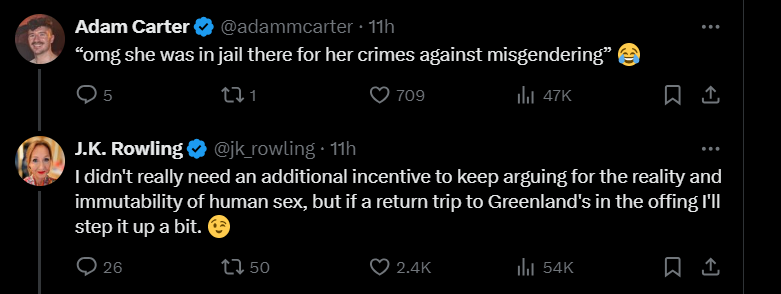
Rowling tweeted this in response to a fan who joked about her supposedly heading to Greenland to escape criticism of her stand against the gold medal winning boxers in this summer’s Paris Olympic Games.

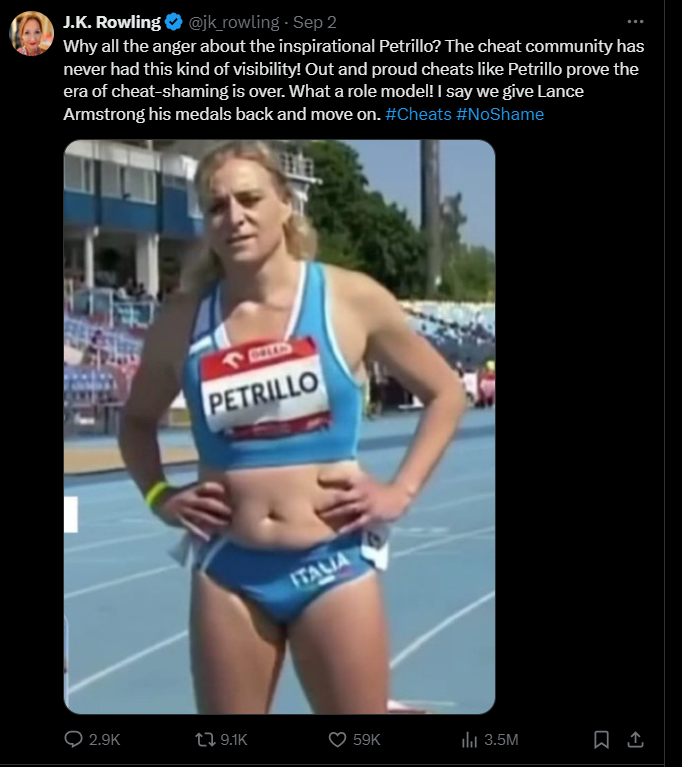
To no one’s surprise, she seems to be doing her best to sail again to the far north for her birthday next year. Yesterday she tweeted about Fabrizio ‘Valentina’ Petrillo, a 47 year old Italian “transgender woman” who satisfied the Paralympic guidelines for men-competing-as-women with respect to current testosterone levels. These guidelines are ridiculous because, once having passed through puberty, the male human body is significantly stronger and faster than the average female body, an advantage that is not off-set by lowering testosterone and elevating estrogen. Rowling sarcastically called Petrillo “inspirational” and a “role model,” if only to “the cheat community” of men-competing-as-women.

The first comments to this thread were behind Rowling and against Petrillo, not an unheard of thing now that Rowling’s 14 million twitter followers include significant numbers of Gender Critical feminists, two of whom noted that “transgender” Petrillo’s specific practices from youth forward with respect to his mother’s and wife’s clothing was understood by psychologists as “transvestic fetishism.” [Read more…]