Sunday Potter Quiz: Merope Gaunt!

I am writing a Hogwarts Professor Substack post on the ‘Pregnancy Traps’ that run through Rowling’s work from Harry Potter to Cormoran Strike. What better chapter to choose, then, for our Sunday quiz questions, Half-Blood Prince edition, than the chapter in which Harry dives into the Pensieve with Dumbledore via Bob Ogden’s memory to meet Merope Gaunt and read about her love for the muggle Tom Riddle?

It’s the ‘Pregnancy Trap’ that failed — and which gave the world the psychopathic Lord Voldemort. Enjoy!

Chapter 10: The House of Gaunt

  1. True/False? On his way to his first private lesson with Dumbledore, Harry saw and hid from Professor Trelawney.
  2. What was the password to Dumbledore’s office?
  3. What object did Dumbledore use to store his memories?
  4. True/False? After Dumbledore could not open a crystal memory-storage bottle, Harry pulled out the cork for him.
  5. In Bob Ogden’s memory, what was nailed to the Gaunts’ door?
  6. What two objects did Mr. Gaunt show Bob Ogden?
  7. What was the name of Tom Riddle Senior’s lady friend?
  8. Who was Voldemort’s mother?
  9. What object from the Gaunts’ house did Dumbledore wear?
  10. Who repaired the pot that Merope broke?

Essay Prompt/Discussion Topic: Merope’s Pregnancy Trap is actually her second move to win Tom Riddle, Sr’s love. The first thing she does, according to Dumbledore’s best guess at least, is brew a potent love potion and enchant him with it. It is only, again per Dumbledore’s speculation, when she elects to release him from the potion’s effect (in the hope that their marriage and her being ‘with child’ will win him over) that the Pregnancy Trap is sprung — and fails. How does Merope Gaunt’s love potion resemble and differ in intention and effect from the ones used by Molly Weasley and Romilda Vane?

Answers: 1. True (195) 2. Acid pops (196) 3. The Pensieve (198) 4. False: Dumbledore used his wand (199) 5. A snake (201) 6. Slytherin’s locket and the black stone ring (207) 7. Cecilia (209) 8. Merope Gaunt (112) 9. The black stone ring (215) 10. Ogden (205)

 

‘John Granger Talks About Potter-Mania’

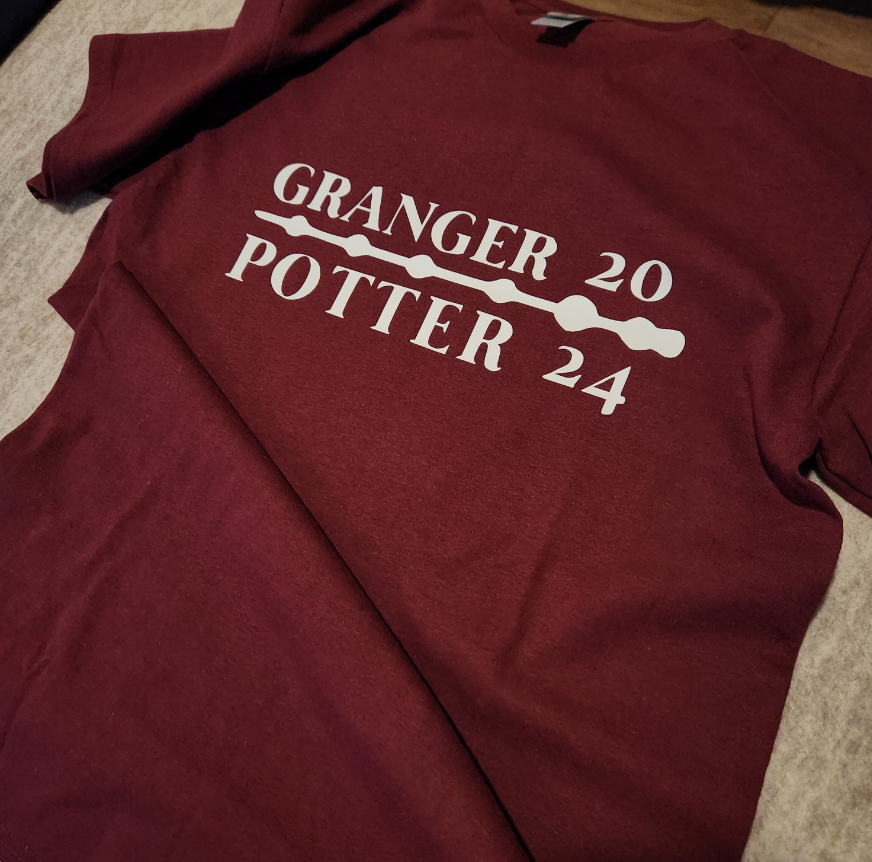
Granger-Potter 2024! Get Out the Vote!

I first saw a ‘Granger-Potter’ Presidential campaign shirt at a 2016 fantasy fan conference in Atlanta. Shirts, buttons, bumper stickers, posters, flyers — it was a big “merch” item at a remarkable meet-up of every fantasy lit, movie, and games franchise, in which Harry Potter was only one among many fan factions. I didn’t buy any because I foolishly assumed I could buy some tee-shirts and buttons anywhere.  I think I’ll order one or two of these shirts.

‘Granger-Potter’ was supplanted in 2020 after Rowling’s tweets heard ’round the world by an exclusively feminist ticket (Harry had been outed by a keynote speaker at that year’s ‘Harry Potter Conference’ as gay, black, and gender non-binary, but closeted…). You’ll note the Latin words for ‘Justice’ and ‘Equality’ in this campaign, which I guess was to suggest that, if we elected these British women — the Constitution places no restrictions on fictional characters who are not American citizens from running for higher office — that social justice and equal outcomes for all would be achieved with a flick and a swish.

I was delighted that ‘Granger-Potter’ has returned for the 2024 campaign season but I think I’ll be voting this year for the Jedi ticket.

May the Force be with us all in the coming month of electoral madness!

Tee-shirts available in all sizes and a variety of colors at Etsy.com.

Rowling Twixter Fish and Strike Update

Rowling’s latest Twixter page header is a Blue Oranda Goldfish. Two quick facts and one speculative leap about this beauty:

It grows to eight or nine inches in length, which means you need a big tank if you want it to feel at home. By ‘big,’ I mean at least 20 to 30 gallons up to a 300 gallon ‘bowl’ or a carp pond in the backyard. They can live as long as fifteen years, even twenty, so investing in the right living conditions and care has a pay off in longevity. The chief challenges in that effort are feeding them just the right amount, not too much, not too little, and keeping the tank clean. As big as the fish gets, it produces a lot of waste so the filtration system has to be carefully monitored and the water changed regularly, which, given the size of the tank, is a big deal.

They only exist in captivity and have been a status symbol for the wealthy for centuries:

Orandas, like all fancy varieties of goldfish, are not found in nature. 

According to recent genetic research, it’s thought that all modern goldfish are descended from a species of wild carp, Carassius auratus gibelio. These Prussian or Silver Prussian carp originate from Central Asia, specifically, Siberia, where the fish live in slow-moving or stagnant water bodies, such as ponds, ditches, lakes, and rivers, feeding on algae, plant matter, insect larvae, small crustaceans, and the like.

For hundreds of years, carp were raised as a food source. However, in the 1500s, the first ornamental goldfish were traded to Japan by Chinese breeders, arriving in parts of Europe in the 1600s and the US by the 1800s. 

Large, flat-bodied, brightly colored goldfish were originally kept as ornamental pond fish. However, fancy rounder-bodied varieties were later developed by Asian enthusiasts to be displayed in glass vessels as status symbols in the homes of the wealthy. 

The name ‘Oranda’ is, frankly, fascinating to anyone who took an introductory Latin course in high school. The word also has a meaning in Turkish and Asian languages that may be as relevant, but I’m useless on those scores.

Focusing on the Latin, oranda is a gerundive from oro, orare, the first conjugation Latin verb for ‘to pray, to beg,’ technically the future passive participle, almost certainly here used as a substantive adjective or noun.  Most of us know the ‘-nda’ form from two popular names for women, ‘Amanda’ and ‘Miranda.’ One of the uses or forces of a gerundive is a notion of obligation, hence the names: ‘Amanda’ is ‘a woman who must be or ought to be loved,’ and ‘Miranda’ a ‘woman about whom all must marvel or wonder.’ ‘Oranda,’ on this model, would mean ‘a woman who must be worshipped or begged.’

Oranda, though, is more famous in a slightly different form, as a gerund or verbal noun. The phrase Lex orandi which is so central to Christian teaching, means simply ‘the rule of prayer,’ better ‘the ruling principle of worship.’ [Lex is often translated as ‘law’ which naturally has a sense of force and obligation in it, but here that sense is more of a ‘natural law’ in the sense of the inherent rule or principle at work.] It is almost always used as the first of three gerund phrases, namely, Lex orandi, lex credendi, lex vivendi,’ which translates as ‘the ruling principle of worship is the ruling principle of belief which is the ruling principle of life,’ or, using the gerundive force, ‘How one must worship is how one must believe and how one must live.’

The Romans 1:20 principle evident in Orthodox Christian worship — the layout out of the church and principal place of the iconostasis, the chant, the iconography, the chiastic structure of the three primary services, and the choreography of the priest, choir, and deacons — are reflected in the neptic-hesychastic beliefs of Orthodox Christians and way of life practices of the faithful; the absence of this principle in Catholic and Protestant worship, the lex orandi, is the great and substantive divide between the ‘right believers’ or ‘Orthodox’ and the ‘other-believers’ or ‘heterodox’ in creed or thinking and way of life.

Back to the fish!

Oranda, and I’m guessing here, probably comes from the bumps on the head of the fish which resemble a crown. This is a reach, I know, but given the symbolic meaning of fish to Christians, ichthys being an acronym for ‘Jesus Christ, Son of God’ and the ‘Jesus Fish’ being a cipher for the conjunction of two spheres, the meeting of heaven and earth in the God-man, a fun interpretation of oranda is ‘the fish who must be worshipped.’ See this post for the relevance of this symbol for understanding Rowling’s favorite painting and her own artistry. Given the discipline necessary to keep such a fish in clean water, maybe making those duties part of your prayer rule would be a good idea.

I have no idea, of course, if this has any correlation with why Rowling chose to include this Blue Oranda Goldfish in her twixter homepage header.

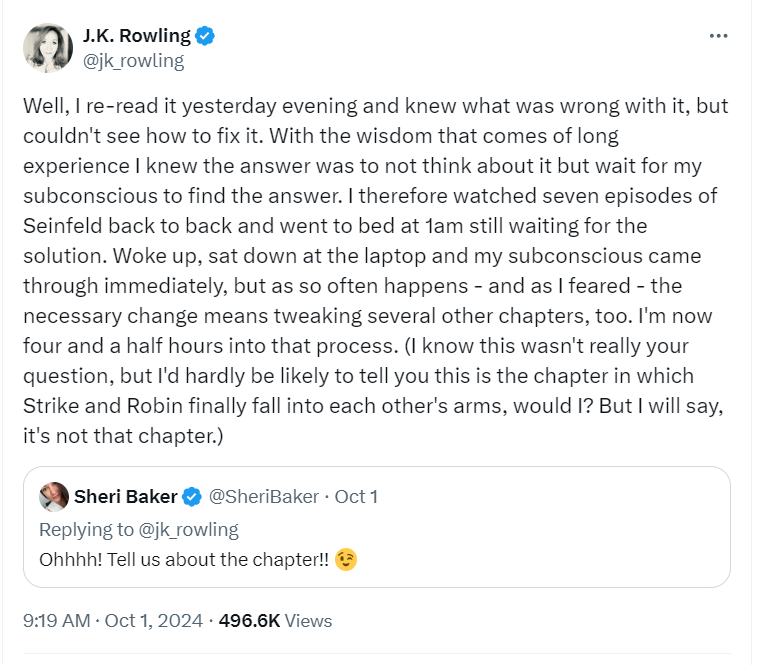
Beneath that header, Mrs Murray let her readers know that Hallmarked Man is still very much a work in progress. Even with the tease that Strike 8 will include the Strike fandom’s longed-for moment when “Strike and Robin finally fall into each other’s arms,” it looks like we won’t see the next installment in the series until well into 2025.

This time last year, we were just beginning to explore the depths (and the structure!) of Running Grave. It’s a bit unreasonable for readers to expect books of this length and quality to be produced on an annual basis. I’m going to assume, consequently, for my own mental health and in respect to the creative energy involved in writing these novels, that we will not have Hallmarked Man until next summer or even this time next year. An earlier publication date, holding to my new expectation, will only be a wonderful surprise.

Back to searching online for a 300 gallon Blue Oranda goldfish tank…

The Rowling Library Magazine #94: Esoteric Beasts, TV Potter, and More!

This month’s issue of The Rowling Library Magazine was once again worth the time it took to read every single article, each one with a surprise inside for the serious reader, fandom zealot, book collector, and video game player. You can download it here as a pdf or read it online for free — and, yes, you should subscribe to support this consistently excellent collection of international writing about all things ‘Rowling.’

The four articles I enjoyed in this month’s issue were:

Solve et Coagula, Part One — Though very difficult to read and without links or footnotes to follow up on, A. Dalla Palma’s piece about the Fantastic Beasts film franchise’s alchemical backdrop and esoteric content was a delightfully challenging introduction to the speculation happening among serious students of these movies. I dropped out of that effort after laboring to discern what was Rowling’s work from the Hollywood formula dross in the first Beasts entry, an impossible and frankly disheartening task, but I am pleased both by the hermetic quality of this article’s contents and by the idea implicit in it that Rowling was attempting to craft a remarkably sophisticated and challenging experience in this medium, something akin to the transformative experiences of her written work. That the ‘Two Davids’ succeeded in frustrating (which is to say “hijacking and destroying” that effort to dumb it all down to blockbuster pablum?) that effort brings me back to why I dropped out of reading the Beasts screenplays closely. I hope very much in Part Two of this series that the author will include references to his or her sources as well as explanations of alchemical terms that are crucial for a reader’s ability to understand the symbolism involved.

Who Will Watch It: Adults or Kids? — The first article was very much the sort of thing I enjoy reading, namely, an interpretation of Rowling’s work that goes well beneath the story surface to get at its symbolic depths, but I struggled with the prose, organization, and referencing in the piece. The feature article, in contrast, was about a subject I know very little about and care about less, the HBO Max adaptation of the Harry Potter series for television, but which captivated me by the clarity of its argument and by the information it shared. In a nutshell, the unnamed author put his or her finger on the chief challenge facing the teevee team (identifying its core audience), speculating intelligently from the players now involved and their previous work what their direction will be in this adaptation, and suggesting a likely course. This was, frankly, The Rowling Library Magazine at its best: a topic of no little importance (even I recognize that the HBO adaptation will be a landmark event and displace to some degree the unfortunate film adaptations of the stories) approached from a fresh perspective with significant insight in well crafted argument. [Read more…]