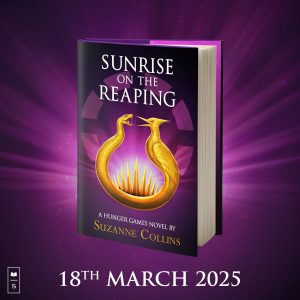
‘Sunrise on the Reaping’ Second Excerpt A Reading by Suzanne Collins: Lenore Dove, Haymitch, and Humean Logic

Two Days Until Publication of Sunrise on the Reaping! The Day After Tomorrow!

Tonight, as promised, I want to take a closer look at the second “Sneak Peek” preview excerpt from Sunrise, this one read by Suzanne Collins. Tomorrow I pledge to write up my notes about what we know about the plot of the fifth Hunger Games novels based on the revelations in the first four with citations of those passages. Looking at these notes, I have to wonder if any book published has ever had so much of its plot already in the public record before its publication. We already have much more in hand than either or both of the pre-pub “Sneak Peeks” have shared.

As with yesterday’s review of the opening pages of Sunrise, I will provide the transcript (one posted by UnHolySir) passage and then my notes behind bullet points.

A few of the geese hiss to announce my arrival. Lenore Dove’s was the first face they saw when they hatched, and they don’t love anyone but her. But since I’ve got corn, they’ll tolerate me today. I toss it a ways away to call off her bodyguards and lean in to kiss her. Then I kiss her again and again, and she kisses me right back.

  • We have another echo here of the Hunger Games opening in which Katniss shares her Buttercup the cat relationship history.
  • To anticipate tomorrow’s post, Lenore Dove’s goose-keeping and the centrality of Haymitch’s love for her with respect to how he lives the rest of his life is something we know about from one of the last paragraphs in Mockingjay: “We learn to keep busy again. Peeta bakes. I hunt. Haymitch drinks until the liquor runs out, and then raises geese until the next train arrives. Fortunately, the geese can take pretty good care of themselves” (387).
  • We’ll be talking about the symbolism of geese and their use in mythology and literature as it plays out in Sunrise.

“Happy birthday,” she says when we come up for air. “Didn’t expect to see you until after.”

She means the reaping, but I don’t want to talk about it.

“Hattie let me go early,” I tell her. “Gave me this too. A present for my big day.”

I pull out the bottle. [Read more…]

‘Sunrise on the Reaping’ First Excerpt: Haymitch, Sid, Ma, and Lenore Dove

Three Days Until Publication of Sunrise on the Reaping!

Scholastic has released two short excerpts from the opening chapter of Sunrise, the second one being in the form of a reading by the author, Suzanne Collins.

Let’s take a paragraph by paragraph look at the first excerpt from the fifth Hunger Games novel and the second prequel. We’ll have the full text on Tuesday the 18th but the two teasers we’ve been given — tomorrow I’ll go through the excerpt read by Collins — are an opportunity to begin thinking about the new book in the context of the four other Hunger Games codices before we’re overwhelmed by the undertow of the whole story.

This excerpt appeared last week at BarnesAndNoble.com. My notes are after the bullet point markers.

Happy birthday, Haymitch!”

The upside of being born on reaping day is that you can sleep late on your birthday. It’s pretty much downhill from there. A day off school hardly compensates for the terror of the name drawing. Even if you survive that, nobody feels like having cake after watching two kids being hauled off to the Capitol for slaughter. I roll over and pull the sheet over my head.

  • Sunrise opens on a Reaping Day in District 12 with our hero, Haymitch Abernathy, struggling to wake up. It is almost exactly the opening scene of Hunger Games in which Katniss is grumpy at her rising, also in a hurry to get somewhere on the morning of a Reaping Day.
  • We were told in Ballads of Songbirds and Snakes (p 13) that Reaping Day is a fixed calendar day, namely, the 4th of July. There’s some irony here because American Independence Day has morphed into Panem District Subjection Day. It also means that our man Haymitch, being born on the 4th of July just as the United States conventionally considers that day its Birthday and national holiday, the date of the signing of the Declaration of Independence, is marked by Collins as an archetypal American, for better or worse.
  • That or he’s Panem’s Ron Kovic, the Marine Corps Vietnam veteran who becomes an anti-war activist, whose autobiography is titled Born on the Fourth of July. Haymitch is a Quarter Quell Victor who becomes a driving force in the Mockingjay revolution against the Capitol.

“Happy birthday!” My ten-year-old brother, Sid, gives my shoulder a shake. “You said be your rooster. You said you wanted to get to the woods at daylight.”

  • Prim does not wake Katniss up in the Hunger Games opening; she is on her way to the woods at dawn, however. Prim like Sid, though, is the beloved younger sibling that we meet in the first paragraphs.
  • Elizabeth Baird-Hardy pointed out in her discussion of the preview-excerpt that the first bird reference is in the first one hundred words of the novel. I’ll try to track the birds as they pop up.

It’s true. I’m hoping to finish my work before the ceremony so I can devote the afternoon to the two things I love best — wasting time and being with my girl, Lenore Dove. My ma makes indulging in either of these a challenge, since she regularly announces that no job is too hard or dirty or tricky for me, and even the poorest people can scrape up a few pennies to dump their misery on somebody else. But given the dual occasions of the day, I think she’ll allow for a bit of freedom as long as my work is done. It’s the Gamemakers who might ruin my plans.

  • Lenore Dove is our second bird and that name is rich. There’s a  ballad called ‘Lenore’ that I expect Elizabeth Baird-Hardy will be telling us about soon and the more famous Edgar Allen Poe poem of the same name. As with Lucy Gray Baird in Ballads, whose given names are the title of a poem by Wordsworth, I think ‘Lenore Dove’s life and early tragic death will track with Poe’s ‘Lenore.’
  • Ballad readers will note that Haymitch’s name for his mother is “Ma,” the affectionate name Sejanus Plinth calls his fish-out-of-water mom and which Coriolanus Snow thinks is a real tag of the Plinth’s not being proper Capitol, rich as they are. It was Sejanus’ last word as he died on the gallows and I suspect if Snow hears Haymitch use this endearment he will twitch.
  • The “dual occasion” is almost certainly the coincidence of his birthday and the Reaping Day, though, as it happens every year, I’m not sure why Ma would consider it a day of special allowance. Because it’s a Quarter Quell and her boy’s twice as likely to be chosen?
  • Collins seems to be in a hurry here to let her readers know that the Abernathys are a poor working family; there are tints here of melodrama.

[Read more…]

Symbols and Sunrise on the Reaping: A Few District 12 Predictions from the Previews

We are just a few days away from the release of the second Hunger Games prequel, Sunrise on the Reaping. As we anticipate the story of the fiftieth Quarter Quell, forty years after The Ballad of Songbirds and Snakes and twenty-four years before The Hunger Games, it’s a safe bet that Suzanne Collins will once again use symbol and story woven together as powerfully as the bird, serpent, and crown that adorn the cover of this new volume. We now have a short print preview and an interview sneak preview that have given us a few hints, so join me after the jump for some predictions, based on those short sneak peeks and on some of the powerful themes and symbols we have already seen at work in the world of Panem.

[Read more…]

‘Sunrise on the Reaping’ Inspired by Hume’s “Implicit Submission:” Three Take-Aways from Her Comments

As discussed in the ‘Sunrise on the Reaping: All We Know‘ post, the second Hunger Games prequel is almost unique among Collins’ offerings in that she has spelled out which political message inspired the work and the direction she chose to take the story in light of that point of origin. Per the People magazine article:

Along with unveiling the book’s cover, Collins teased what fans can expect in the new novel which follows her latest prequel, The Ballad of Songbirds and Snakes.

“With Sunrise on the Reaping, I was inspired by David Hume’s idea of implicit submission and, in his words, ‘The easiness with which the many are governed by the few,’ ” she said, per the release. 

“The story also lent itself to a deeper dive into the use of propaganda and the power of those who control the narrative,” she continued. “The question ‘Real or not real?’ seems more pressing to me every day.”

There are three take-aways there:

  • Hume’s “idea of implicit submission” was her starting point, what “inspired” Sunrise,
  • the story she wrote “lent itself,” which is to say ‘she chose to make it,’ a  “deeper dive into the use of propaganda and the power of those who control the narrative,” and
  • she tied it into her original series’ primary theme and with the world today by concluding,  “The question ‘Real or not real?’ seems more pressing to me every day.”

Let’s go through these one at a time, starting with David Hume. [Read more…]

Haymitch and the Donner Sisters: Key to the Mockingjay Resistance Movement? Sunrise on the Reaping & the Pearl Plot

I am re-reading The Ballad of Songbirds and Snakes tonight after thinking more about David Levithan’s praise for the Sunrise cover. I reviewed Catching Fire yesterday because its Chapter 14 has the thumbnail sketch of Haymitch’s victory in the Quarter Quell that will be the subject of Sunrise. Levithan’s comments, though, I think reflect continuity between Ballad and Sunrise that is as great or greater than that between the second books of each three novel series, a continuity reflected in the Ballad and Sunrise covers.

While I do that reading, though, I want to share links to three Hogwarts Professor posts about The Hunger Games, two that I wrote fifteen years ago in the exciting months before the publication of Mockingjay and one conversation with fans immediately afterward:

(If you only have time for one, make it The Hunger Games ‘Pearl Plot,’ version 2.0.)

The ‘Pearl Plot’ was my guess that, consequent to the Quarter Quell that Haymitch wins, the surviving Donner sister (whom I designate as ‘Pearl’ because she is not given a first name but ‘Madge’ her daughter has a name via ‘Margaret’ that means ‘pearl’) recruits the conspirators and writes the Mockingjay rebellion counter-narrative that leads to the Reaping Day selection of Katniss (via Prim) and Peeta — and almost all the events of the 74th Hunger Games.

Needless to say, I hope, Mockingjay did not deliver on any of the Pearl Plot’s premises being revealed, which should have been no surprise given that District 12 is destroyed by the Capitol at the end of Catching Fire (Goodbye, Undersees!) and the third novel is crowded with Katniss’ victory over the Capitol and District 13 and her eventual apotheosis.

As more than one reader pointed out, though, in the discussion thread dedicated to the Pearl Plot after Mockingjay was published that Collins might be saving all that revelation for a Hunger Games Prequel novel. I hope you’ll read the ‘Pearl Plot’ posts and let me know if you think Sunrise on the Reaping (or the prequel series finale?) will include revelations of what really happened in Katniss’ Hunger Games before the pyrotechnics of Mockingjay!

Post (squared):

If you want to read my book-length discussion of the meaning of The Hunger Games series, it’s available in these three Hogwarts Professor posts:

Unlocking Mockingjay: The Spiritual Allegory’ On Katniss as a Soul Seeking Perfection and Iconological Reading

‘Unlocking Mockingjay: ‘The Literary Alchemy’ On Literary Alchemy and Peeta as Postmodern Christ

‘Unlocking Mockingjay: Katniss’ Apotheosis’ On the Alchemical Arena and Katniss’ Perfection in the Inner Sanctuary

All the Hogwarts Professor Hunger Games  commentary is available at ‘Unlocking Mockingjay: The Complete Set of Posts And a Round-up of the First 30 Discussion Points.‘ Enjoy!