Rowling Kicks John Oliver to the Kerb (Curb)

As part of America’s post election post mortem, liberal commentators are lining up to explain away the Republican loss. As a liberal in my later years, (a socialist in the UK, where we are less squeamish about using the word), I too am frustrated about the Harris campaign loosing the popular vote. Many have pointed to the push to eliminate sex as a category, instead of poorly defined and fluid gender, as one reason for Trump’s popularity among people less able to insulate themselves and their family from the effects of this policy. Popular comedian and commentator on Last Week Tonight, John Oliver, blamed Harris’s failure to respond to this question:

It was frustrating to see the Harris campaign fail to formulate a response, and its basically because its pretty easy to do… watch, I’ll do it for you right now…

As we have discussed before, there are vanishingly few trans girls competing in High Schools anywhere. Even if there were more, trans kids, like all kids vary in athletic ability, and there is no evidence they pose any threat to safety or fairness. It is very weird for you to be so focused on this subject, and finally if you genuinely what to address the biggest concern for most girls who play High School sport, you would be less worried about this, and more about the creepy assistant volleyball coach who keeps liking their posts from f*****g Instagram.

Mr. Oliver may believe that this is some fresh perspective, but in Britain, the – It doesn’t happen – Even if it does happen its not a problem – Even if it is a problem, its weird (and bigoted) of you to be focused on it – is depressingly familiar, and utterly unconvincing. Oliver has some history with J. K. Rowling, she was in the audience for his first appearance on US television, so it wasn’t a surprise when she responded:

Nothing about this feels good, because John Oliver generously gave his time for my charity Lumos and I liked him very much when I met him, but God knows, if you ever need an example of motivated reasoning and confirmation bias, this video’s for you. An undoubtedly intelligent person spouts absolute bullshit to support something he wants to be true, but isn’t.

According to the UN, female athletes have lost nearly 900 medals to trans-identified men competing against them in women’s sporting categories. Girls have been ousted from teams to make way for boys. Women have suffered serious injury playing against trans-identified men (see Payton McNabb, mentioned below).

Again and again I’ve come up against men who argue exactly what Oliver does here, using the very same talking points. With a straight face, the ‘believe the science’ guys will say ‘actually, we don’t yet have enough data to say whether men and boys are stronger and faster than women and girls’. The ‘be kind’ crew can’t see what the issue is. ‘Why are you bothered, it only affects a tiny minority of females?’

To prove to their progressive credentials – and (coincidentally, I’m sure) indemnify themselves against repercussions from cultural elites in the media, academia and publishing who’ve showed themselves more than ready to kick people to the kerb for failing to mouth the approved mantras – people with a lot to lose are currently prepared to make idiots of themselves. They’ll stare unabashedly into a camera and insist that their audiences’ eyeballs are incapable of seeing what’s plain as day, and that there’s something wrong with the great unwashed for believing that girls are being robbed of opportunities and put at physical risk.

If you want to tell the world you’re happy to watch females suffer injury, humiliation and the loss of sporting opportunities to bolster an elitist post-modern ideology embraced by a minute fraction of the world’s population, fair enough; you’re allowed your opinion. But if you’ve just told girls they don’t deserve fair sport, maybe rethink using all too real and common sexual predation against young women as a punchline for your ‘edgy’ closing joke.

No lengthy post on Twitter, in British English, is complete without someone forgetting that not everyone is American. This does however provide a rare example of someone receiving new information and accepting the correction. A great example to liberals and conservatives everywhere.

Sunday Potter Quiz: ‘The Scar’

Harry Potter and the Goblet of Fire, Chapter 2: The Scar

1. What wakes Harry from his dream?

2. True or False: Harry experienced his dream about the Riddle house through Frank Bryce’s point of view.

3. Besides Ron and Hermione, to whom does Harry consider and decide against writing a letter about his scar?

4. What creatures delivered the two letters Harry received from Sirius?

5. Which Quidditch book lies open by Harry’s bed?

6. Angry about his diet, Dudley breaks his Playstation, and now he’s unable to play which of his favorite games?

7. Who did Harry think Ron would ask her help about his scar?

8. In his letter to Sirius, to whom does Harry tell him to say hello for him?

9. True or False: Harry is told by Sirius he is hiding out in the tropics of Portugal, far from Ministry wizards.

10. Whose voice did Harry remember clearly from his dream?

For Your Reflection: The opening of Harry Potter and the Deathly Hallows has curious parallels with the opening of the fourth Hogwarts Saga novel, Goblet of Fire, most obviously an opening chapter featuring the Dark Lord and his minion(s) murdering an innocent victim and a follow-up chapter where we find The Boy Who Lived in his bedroom at Privet Drive. List three other parallels — and, working from the chiastic principle that ‘The Meaning is in the Middle,’ think about why would Rowling begin the fourth and central novel of her seven book series with a chapter focusing on Harry Potter’s scar. Is this a pointer to the heart of the series, the ending of Goblet, or both?

Answers. 1. His scar (p 16) 2. False (17) 3. Dumbledore (21) 4. Tropical birds (24) 5. Flying with the Cannons (18) 6. Mega-Mutilation Part Three (25) 7. Mr. Weasley (22) 8. Buckbeak (25) 9. False (24) 10. Voldermort’s (17)

P. D. James: Rowling Names Goldmine?

I was scrolling the almost 400 drafts of posts for Hogwarts Professor that I have started over the last twenty years and never finished and found this one from early in my PhD researches. It’s about P. D. James, a writer much admired by Rowling, perhaps admired and studied even more than Agatha Christie (if there is a fascinating overlap in those influences concerning The Duchess of Malfi). I confess to being surprised that I never put this up; I can think of no single post I have written that required reading an author’s complete works — unless I’ve written somewhere about the inimitable Boris Akunin. [Quick search of site for ‘Akunin’ — no, but I did only get one post out of the Shardlake series.] It’s long overdue, as I hope you’ll agree, because of the several important names found in the James novels and the fascinating plot point parallels with Potter and Strike series. Enjoy!

Beatrice Groves, author of Literary Allusion in Harry Potter and a great lover of detective fiction from her youth, urged me as part of my dissertation reading year to do a deep dive into P. D. James, the Queen of the genre post Christie. The prompt was because of a connection between the Cordelia Gray character in P. D. James’ Unsuitable Job for a Woman and Robin Ellacott in the Cormoran Strike novels.

I’ve been reading P. D. James now for several months and this morning I went through the 14 books I have read to list the names, events, and allusions I thought worthy of dog-earing pages as I flew through to the great reveal of each mystery. I’m reading chronologically and am up to A Certain Justice (1997), dedicated to the five grandchildren.

Perhaps the most interesting piece is the one you would guess, ‘namely,’ the names connection.

  • Felix, Cover Her Face
  • Arabella (cat who is murdered in a fashion suggestive of the petrification in Chamber),
  • Pettigrew (a solicitor “cursed with a name like that”), Unnatural Causes
  • Morag, Shroud for a Nightingale
  • Orlando (a child who died young),
  • Rose, Innocent Blood
  • McGonagall (reference to poet as “arguably Britain’s worst poet ever”),
  • Remus (dog), Devices and Desires
  • Peverell, Original Sin
  • Wardle (police surgeon), Original Sin, and
  • Venetia, A Certain Justice

I think the Arabella, Pettigrew, McGonagall, and Peverell hits rate as significant Potter links, especially the Peverell Family connection (see Original Sin for that; better than the Vanity Fair reference and the Gaunts?). Orlando, Wardle, and Venetia, too, are lifts or hat tips we find in Strike.

How about quotations in mysteries? Cover Her Face includes a put down of “psychological thrillers with highbrow quotations at the beginning of chapters.” Skull Beneath the Skin looks down on a set of quotations “all from the Penguin Dictionary of Quotations or the Oxford Dictionary,” and in Children of Men the professor notes about the four lines of Horace in Latin in a friend’s suicide note, “He probably found the Latin in the Oxford Dictionary of Quotations.” It might be worth a check of both P. D. James and JKR’s literary allusions to see how many are in the Oxford Dictionary… [2024 note: I purchased six editions of the ODQ and could find no link.]

Potter sources of some potential:

Close but not quite a mother Molly knitting sweaters for beloved child: Unsuitable Job features a birth mother who was not allowed contact with her son so she knitted him “endless sweaters” and Innocent Blood‘s murderous mom who gave up her daughter knits her a sweater as her first and last gift to her.

Children of Men has a prisoner escape from the regime’s island to which evil-doers are transported and left to be tortured (and eaten!) by the bad guys there. If that weren’t echo enough of Sirius Black and Azkaban, the passage in which Theo learns about this adventure begins with a reference to the “black dog on my shoulder.”

I think the Cordelia Gray – Hermione Granger connection Prof Groves made in 2018, with the Shakespearean first and resonant last names, is a keeper, too.

Strike sources of some potential:

It is a Dalgleish truism that motive is not the key to solving mysteries: “Motive is the last thing you look for” (Cover Her Face), “Where, when, and how would eventually have why revealed to him” (Unnatural Causes), etc.

Unnatural Cause‘s first paragraph turns out to be the opening of a mystery inside the book while being a perfectly apt paragraph on its own. Dalgleish and a publisher discuss the possibility of a writer plotting his own murder to be akin to his book’s death scene as a publicity stunt to sell more books, which author, Maurice Seton, shares several characteristics with Owen Quine.

Cordelia Gray arrives at the detective agency as a temporary secretary and works her way up to partner in the office and then becomes owner. Hat tip to Beatrice Groves who used that Cordelia-Robin path as her Ace Allusion parallel to convince me to read P. D. James.

Does Rowling quote Plutarch’s “Boys throw stones at frogs in sport. But the frogs do not die in sport; they die in earnest” somewhere in Strike? It seems familiar. James quotes it in Death of an Expert Witness. [2024 note: No, she doesn’t.]

Deborah Miscoe and Adam Dalgleish, their slowly advancing romance, may have been a model for Strike/Ellacott, in terms of slow narrative release emmeshed in stand-alone mysteries. But that was something of a bust for the James characters until Emma Lavenham comes into Adam’s life.

In Taste for Death, James quotes without naming Graham Greene’s bon mot about writers: “If he had a splinter of ice in his heart, then so have I.” Rowling has used this quotation several times through the years.

The idea of the physically attractive being advantaged in life, as per Charlotte, Cuckoo, and other Strike characters, is explored in Original Sin (cf. p 325).

The embedded Christian content suffuses every book but the only attempt at parable or allegory I found was Children of Men which is, relative to James’ light hand with symbolism in her mysteries at least, pretty much “in your face.”

I think there is enough here, alongside the Groves MuggleNet posts about the Gray/Strike echoes, to justify a serious look at the debts Rowling-Murray owes James-White beyond the name she created pre-publication and has kept for herself. They’re more significant than those to any other writer I know of, with the possible exceptions of Lewis, Tolkien, Christie, and Nabokov.

[2024 Note: I still think that is true and hope that Serious Strikers will take this post as a challenge to read P. D. James (or re-read, I suspect, favorite books in many readers’ libraries) to make more profound connections than the very superficial and equally suggestive correspondences between the detective fiction of these two writers. Cheers!]

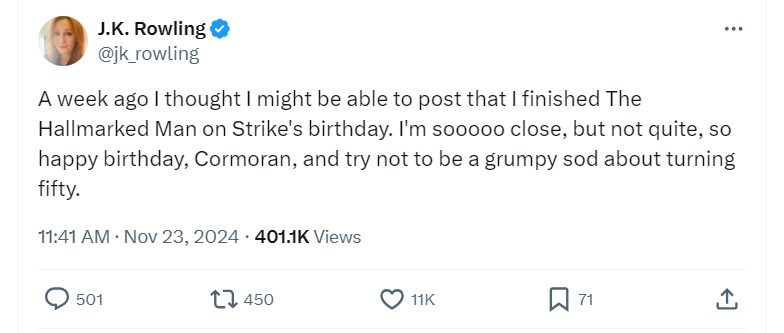
Rowling Tweets Call for Help in Finishing ‘Hallmarked Man,’ Adds Comic Tea Mug

On the down side of these messages, Rowling-Galbraith is still hard at work writing or revising Hallmarked Man.

The up side is definitely the caption to the cartoon on the mug. Beneath a picture of a puritan man with a lit torch in his hand and a woman tied to a post and standing on a pile of kindling, the cartoon has the guy about to light up a lady’s world say, “Let me start by saying that no one is a bigger feminist than me.”

Rowling ‘Writing for Grown-Ups’ (2012)

If there is one critical moment, say ‘a year,’ in Rowling’s life as a writer, a credible argument can be made that it was not 1990-1991, the so-called “year of misery” that featured the inspiration for the Hogwarts novels and the demise of her mother, but 2012 when Casual Vacancy was published and Rowling began her career in post-Potter publishing.

This interview is one of many she gave that year, every one of which has several gems of ‘Lake and Shed’ material, especially, I think, for Serious Strikers, those novels having already been plotted by this point. Enjoy!