

Read the BBC version of the Chopra’s family inspiring story, ‘It’s an Honour and a Privilege to be Educated.’
Thoughts for the Serious Reader of Harry Potter
Read the BBC version of the Chopra’s family inspiring story, ‘It’s an Honour and a Privilege to be Educated.’
Jules Feiffer died on 17 January this year at age 95 and I have to confess I was surprised to learn he lived to see 2025. The name in the obituary and the books associated with it in my deepest of my memories drew me back more than fifty years, a startling experience akin to a stray scent causing an avalanche of associations with a lost friend or a forgotten event.
Reading the obituaries online, I learned how other people remembered him. As a cartoonist for Playboy magazine, as a satirist of the English Punch tradition whose ‘strips’ in The Village Voice, even The New York Times, were biting and pointed simultaneously, as the screenwriter for films such as Carnal Knowledge: he had a full life of notable achievements, in other words, besides working on two books that shaped my life so intimately.
 The first was the illustrations he did for Norton Juster’s The Phantom Tollbooth in 1961, the year I was born. It is the first book I can remember reading, though it’s safe to say I had read all the Dr Seuss classics, the Beginner Books series, and maybe even a few Hardy Boys serials before I met Milo, Tock, and the Humbug. I can’t even guess how many times I read it as a boy or as a dad excited to share it with my children. More recently I bought my daughter Sarah the annotated edition of Tollbooth to read to her three children and she was as thrilled and excited about that present as I can remember her being when we finally spent money we didn’t have to get her a flute equal to her zeal for the instrument.
The Phantom Tollbooth, in brief, was my doorway to thinking about words, stories, and books, and it was for my children as well, perhaps the entrance for several generations of readers — and Feiffer’s sketchy illustrations, the barest of line drawings really, are indelibly linked to that never-ending adventure in imagination. I only learned this morning that Feiffer was Juster’s roommate at the time he wrote the book and played a larger part in its writing than an illustrator might otherwise have. It makes sense that all the word play in Tollbooth might have sprung from puns shared by two friends in a months long conversation, one that bent my brain to thinking about words-about-words in a story about the story experience.
 The second was Feiffer’s collation and annotation of The Great Comic Book Heroes, a book that came out in 1965 and I received as a Christmas gift sometime in the early 1970s. Its subtitle is one of the best ever: “, that almost made up for the camp television series of that time.
Feiffer’s over-sized book, a collection and reprinting of the earliest comic books of my favorite heroes with his helpful commentary and introductions, made me think for the first time about comics as a genre of story, one that had historical beginnings and a rainbow variety of possible meanings in the hands of different writers and artists, no where more obvious than in the Batman series. The Great Comic Book Heroes is also where I learned that my given name, ‘Alan Scott,’ was from the golden age or original Green Lantern, a revelation that astonished me because of my father’s disinterest in any kind of fiction or reading, really, beyond news magazines (it turns out, he picked the name up from a comic book he looked at while waiting for a haircut).
Feiffer’s Comic Book Heroes in “Glorious Color” was a beautiful book that my mother was happy to include on the living room glass-topped coffee-table with other over-sized photo collections that were popular at the time. It was always at hand, consequently, which led to repeated revisits and re-readings. I have to think now that it was an invisible influence on my thinking about stories, writers, and that this was a field to be interpreted and understood better, at a depth different than the delightful unconscious imaginative experience.
I doubt I would have liked Jules Feiffer, just as I’m pretty sure I would have been very uncomfortable talking with Ted Geisel (‘Dr Seuss’). I am saddened by his death, nonetheless, because I never expressed to the man, one I assumed had died ages ago, my gratitude for Tollbooth and The Great Comic Book Heroes. He changed my life, or, better, he helped shape it at its beginnings, and all the friendships I have had inside books and with other readers talking about those stories since to some degree I owe to him. Memory eternal!
In an Inauguration Day rally, Elon Musk spoke to a crowd of Trump supporters at DC’s Capitol One arena. During his brief talk, he twice bumped his chest and threw out his right arm to the crowd, once to the group in front of him and immediately after to the crowd behind him. He said just before this talk that he was giving thanks from his heart to all those who had worked and prayed and contributed to Trump’s electoral college and popular vote triumph last November.
The American Public Broadcast Service (PBS), a news organization funded by tax payers as well as private donors and corporations, tweeted that Musk’s gesture was a “Nazi” salute, a la Hitler’s Sieg Heil arm motion and the Italian fascist ‘Roman’ gesture. The Anti-Defamation League (ADL), a watch-dog for Neo-Nazi behaviors and anti-Semitism, immediately responded that Musk’s gesture had been misinterpreted by PBS and that, stressful as the transfer of power was for many in the US, a little grace was in order. It was not, from their view, a “Nazi salute.”
I share all that because Joanne Rowling Murray (‘JKR’) teamed up with Gender Critical feminists to mock on Twixter those Progressive gate-keepers who make risible historical analogies. These “TERFS” as a rule who have spent the last five years being branded by leftists as “Nazis,” “fascists,” even “Holocaust deniers” because of their resistance to “transgenderism.” JKR’s preferred partner in these staged satirical conversations, as we’ve seen earlier this month, is Julie Bindel, who wrote Rowling with a true confession about her struggle with Nazi salutes:


Dr Beatrice Groves, Research Fellow and Lecturer at Trinity College, Oxford, and author of Literary Allusion in Harry Potter, has discovered clues that strongly suggest that Rowling (as well as her friend Sean Harris) had John Keats on her A-Level reading list as the featured poet.
In a Bathilda’s Notebook post, ‘Keats, “The Eve of St. Agnes,” and “Harry Potter”,’ Groves shares, in addition to a host of fascinating possible allusions to Keats in Rowling’s work, visible evidence that Rowling is a serious reader of John Keats, namely, a 2017 tweet from the Keats-Shelley House of their July 2015 Visitor’s Log page:

Groves deciphers in her post what Rowling, Neil Murray, and Sean Harris wrote and explains its significance of this discovery, a gem, as she notes, that “has not previously been noticed by anyone in the Harry Potter fandom.” She ends her exegesis with a pointed plea to readers that I wish to amplify here for readers who might not see it on Groves’ Notebook page at MuggleNet:
Rowling has never made an explicit reference to Keats in either her writing or interviews (nothing like the hat-tip to Jane Austen in the naming of Mrs. Norris, for example). This has made it more difficult to argue for Keats allusions than those of her acknowledged influences such as Shakespeare, Collette, or Dickens. But Keats is an absolute stalwart of the English literature curriculum in the UK: I have long suspected that Rowling studied him as part of her English A-level course – and, recently, I finally found the proof [in the 2017 tweet above]! Rowling has indeed long read and loved Keats; she studied him at A-Level, and hence he has been part of her literary consciousness for all her writing life….
I suspect that if we were to track down Rowling’s A-level syllabus, we’d find that “La Belle Dame sans Merci,” Lamia, and The Eve of St. Agnes were all part of the course. (Tracking this down, incidentally, is one of my long-term aims – and it is proving surprisingly difficult! If you or someone you know took English A-level in the 1980s and studied The Winter’s Tale, King Lear, and Keats – the three texts we now know she studied – I’d be very interested to hear from you – especially if you remember what your exam board was or the rest of the syllabus you studied!).
Do read the whole St Agnes post for Groves’ explanation of the importance of this discovery — and, if you have the information about Rowling-era A-Lists in the UK she asks for, please contact her via the email address at her Oxford University home page.
Congratulations to Dr Groves on this important find and an oversized thank you to her for sharing the allusions to Keats embedded in Rowling’s work that only a true Keat-ophile could have spotted! I love the suggestion in the 2017 tweet from the Keats-Shelley house that Rowling chose the phantom ‘K’ initial in her first pseudonym, ‘J. K. Rowling’ (she has no given middle name) as a tribute to the original J. K., John Keats.
Links to all of Dr Groves’ online writings can be found at this HogwartsProfessor.com ‘Beatrice Groves Pillar Post‘ page.
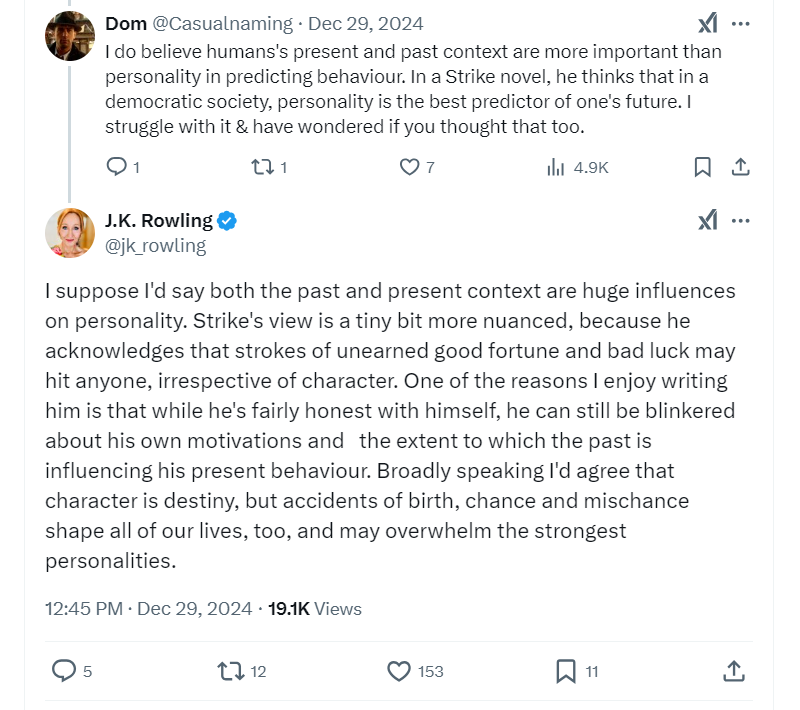
This too brief but fascinating look at Strike’s psychological make-up by Robert Galbraith herself came at the end of an equally intriguing thread about Hannah Arendt, Eichmann, and the banality of evil “transgender” fellow-travelers. That longer effort of Rowling’s deserves its own post; today let’s look at the one-off response to someone who engaged Mrs Murray about Arendt. Three thoughts?
(1) Strike Laid Bare: Rowling-Galbraith tells us point blank Strike’s strengths and weaknesses, and, in that exposure suggests strongly the direction of his transformation. “One of the reasons I enjoy writing him is that while he’s fairly honest with himself, he can still be blinkered about his own motivations and the extent to which the past is influencing his present behaviour.” Strike is about to be confronted in inescapable fashion, I think it safe to say, with “his own motivations” which will reveal to him the “extent to which the past is influencing his present behavior.” His ability to change in that crucible will be critical to his relationship with Robin.
(2) Strike and Rowling Agree: “Character is destiny” but… (Strike) “strokes of unearned good fortune and bad luck may hit anyone, irrespective of character” and (Rowling) “accidents of birth, chance and mischance shape all of our lives, too, and may overwhelm the strongest personalities.” Rowling’s artistry is depicting the morality of archetypal characters when challenged by “past and present context,” depictions of behavior for our reflection, empathetic identification, and cathartic experience. Again, Strike is about to be hit betwen the eyes with all that he has neglected in the “accidents of birth,” Strike’s being a supposedly ‘accidental birth,’ and perhaps by the “chance and mischance” of losing Robin to another man. I for one can’t wait.
(3) A Lake Point? Joanne Rowling was not born with a silver spoon for her porridge but “character” and writing genius as well as “chance and mischance” have brought her to the heights of fame, fortune, and notoriety coupled with adulation, albeit in different spheres. I think it is credible, as a reflective woman experienced in Cognitive Behavior Therapy and one who has studied psychology as an amateur, that Rowling thinks about her life, its twists and turns and tumbles and triumphs, more than most. And that this reflection on the tension between “character” and the “context” of “past and present” circumstances informs her Strike novels as something like an axis.
Hence the importance of this seeming off the cuff or throw-away look at Strike’s psychological perspective. Footnote it for reading before and after Hallmarked Man!
Recent Conversation