J. K. Rowling’s ‘G-Spot’ and ‘Triple Play:’ The Lake & Shed Secret of Her Success

I want to try tonight to explain as succinctly — and as provocatively — as possible why I think Rowling’s ‘Lake and Shed’ metaphorical explanation of how she writes offers a compelling reason for both why she writes and why readers around the world love her novels the way they do. I call this her ‘G-Spot’ and ‘Triple Play’ because it is her point of singular genius, the defining quality that separates her from contemporary story-tellers, which involves ‘Shed’ artistry of three particular literary tools, all subliminal, which work together to achieve her aims.

First, then, a brief review of Rowling’s ‘Lake and Shed’ description of how she writes, her method, inspiration to publication, then my hypothesis of why this method reflects why she writes, and finally, a very brief discussion of Rowling’s three ‘Shed’ power-tools that all have a shared aim and effect on readers. All after the jump! [Read more…]
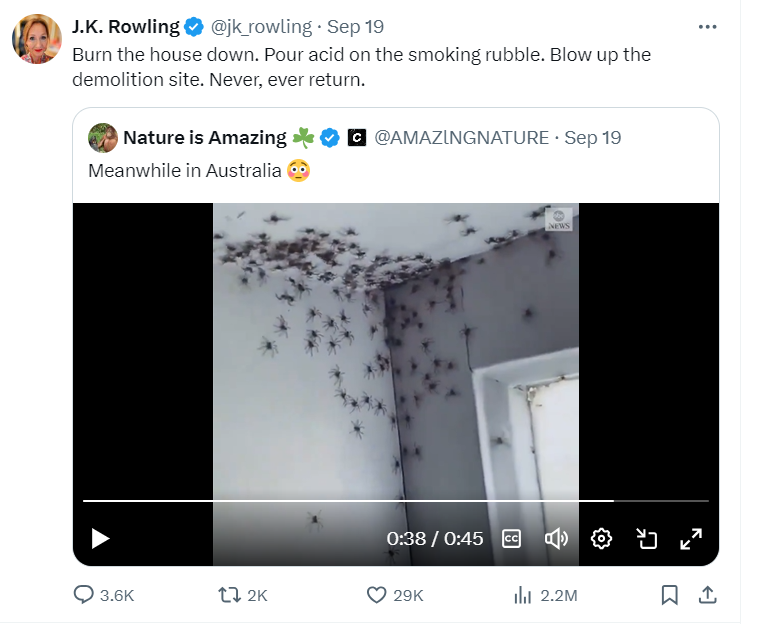
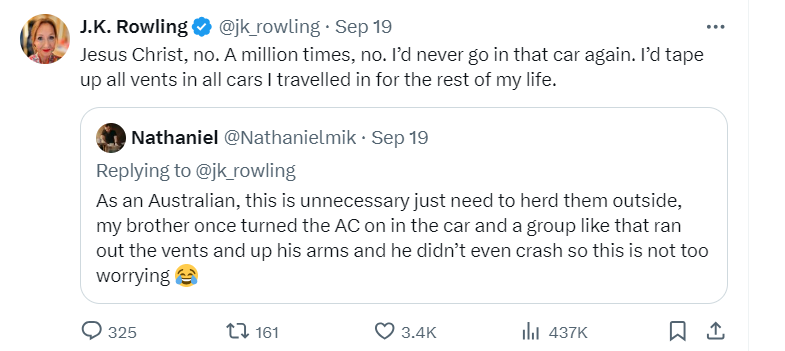
Rowling Slightly Arachnophobic?

J. K. Rowling put out two tweets yesterday that seemed to channel her inner Ron Weasley. She’s not transphobic, Islamophobic, or homophobic but it seems she has a healthy fear of a flood of spiders:

Watching that video, I confess to be a member of Team Jo if the entrance exam is alarm even while knowing it is just a film of large spiders on the wall.

Some of Rowling’s 14 million + followers on Twixter shared their stories of life with insects, especially a surprise flood of spiders:

The threads beneath these tweets are worth reading — lots of Great Australian memes and Rowling jokes.

Which is, I think, to say “Mission Accomplished.” Rowling went on offense in the transgender conflict earlier in the week and it seems probable that her PR team told her to lighten it up a bit, “You’ve got a book coming out soon, right, Jo, and a Bronte Studios adaptation? How about a silly tweet for a change-up, something with creepy crawly animals for a laugh?”

More on that switching of gears in the Gender-Sex is Real War in coming days and on Rowling’s very idiosyncratic feminism. Cheers!

Rowling’s July 1998 ITN Interview at Nicholson’s Cafe in Edinburgh

“The purest stroke of inspiration I’d ever had in my life.”

But where did it come from? What crisis in her unconscious mind or ‘Lake’ spoke to her so clearly?

More anon! Transcript available here.


Hunger Games: A New Shared Text?

It’s been sixteen years since the publication of the first Hunger Games novel.

Today, The Epoch Times published an editorial, ‘Hunger Games is Fiction No More.’

See here, here, and here for similar pieces that were posted at the premiere of the prequel The Ballad of Songbirds and Snakes.

The BookRiot article noted that Suzanne Collins’ YA dystopian novels started a trend:

The Hunger Games, in particular, catapulted YA dystopian novels into the spotlight. Future bestselling series like Divergent by Veronica Roth, The Selection by Kiera Cass, The Fifth Wave by Rick Yancy, Legend by Marie Lu, Matched by Ally Condie, and Shatter Me by Tahereh Mafi built some of their readership from fans of The Hunger Games. Dystopian and YA books had, of course, been matched up before in books like The Giver by Lois Lowry, Feed by M.T. Anderson, and Uglies by Scott Westerfeld. But none of them had the same monumental sales of The Hunger Games to truly create such a publishing phenomenon.

None of those series have continued to be part of the working vernacular when discussing the nature of 21st Century life in general and politics in particular, either.

We’ve written a lot here about the Hunger Games novels, especially the third book in the original trilogy, Mockingjay.  I wrote at the time and still think it is a legitimate point that Collins’ achievement is at least as great as what Rowling attempted and pulled off in the Hogwarts Saga, if only because of the political allegory and embedded romance in her soul triptych, literary alchemy, and structural artistry. Check out that library of posts here.

Even having said all that, I was startled by The Epoch Times article because I never expected Hunger Games to achieve anything like Shared Text status or that people would be talking about it after the better part of two decades. (I was not positively impressed by the film adaptations and they seem to be what most people remember of them, an impression I suspected would not be a lasting one because movies do not shape the imagination as reading codex does.)

And yet here we are, with popular media assuming we know who Katniss Everdeen is and why her leading a populist revolt against the Capitol elite is a relevant metaphor for the world today and its dystopian qualities.

Three questions for those Hunger Games readers out there:

(1) Why do you think Hunger Games is (or is not) a ‘Shared Text’ of our times while the other popular YA dystopian series before and after its publication have largely been forgotten?

(2) Is the series’ staying power and continued relevance down to the timeless brilliance of Collins’ conception of the story and execution of the trilogy, the fit with its popular revolt against the leftist and right wings of corporate-government oligarchy and fascism and daily news reports, or is it just the Jennifer Lawrence’ effect?

(3) Do you want us to discuss the new Collins’ Hunger Games prequel, Sunrise on the Reaping, due in March 2025, the way we would a new Strike novel or other work by Rowling-Galbraith? (I know Elizabeth and I are up to that, if there is interest here.)

Have at it in the comments thread below!


Rowling’s Soul Triptych Psychomachia: Is It From Shakespeare’s ‘Macbeth’?

I began writing about Rowling’s psychomachia, the allegory of the soul’s journey to perfection, in 2002 with the publication of The Hidden Key to Harry Potter, the book that eventually became How Harry Cast His Spell. In brief, I explained then that the three principal student characters in the Hogwarts books, Harry, Hermione, and Ron, were Rowling’s version of the allegory of the soul in Plato’s Phaedrus, a conceit that stretched across imaginative fiction to include among many others The Brothers Karamazov, the three hobbits on Mount Doom, and Kirk, Spock, and Bones.

The characters were the respective authors’ depiction of the spiritual heart, the mind or will, and the body with its desires and passions, usually reduced to the formulaic “body, mind, and spirit.” Hermione was the brains of the Hogwarts set, Ron was the body stand-in, and Harry, the scion of sacrificial love and doing the hard, right thing, was the heart or spirit to which the others deferred, at least when things were going well. Together, the three faculties of soul mature through seven alchemical cycles until they vanquish their respective failings and defeat the Dark Lord.

Rowling has worked in other types of psychomachian allegory in different books, most notably the Shakespearean romance model in the Strike series and the transference love of a child and its toy in Christmas Pig. Depicting the perfection of the soul in spirit is what she does, whichever tools she chooses to create the cathartic imaginative effect within her readers. I have argued, again since 2002, that this is what makes Rowling’s work singularly popular; readers come to fiction, per the Eliade thesis, for the oxygen it provides their transpersonal faculty — and Rowling’s allegories of the soul meet that need much more successfully than the other fare on offer in bookstores, the cinema, or in online games.

But where did she first encounter this idea in a book or play? Did she come up with it on her own or did she read about soul triptychs and the like in critical literature about a favorite story? And what inspired her to make the leap from Dostoevsky’s or Tolkien’s triptychs to making the genre formula trio of schoolboy novels with hero, egghead, and swarthy best mate, into a psychomachian drama set piece?

There’s no way of knowing the answers to that question short of Rowling agreeing to answer questions while under the power of a high octane Veritaserum draft. As that has never happened, I think it safe to assume it never will. I have a decent guess, though, namely, that she got the idea while reading about her favorite Shakespeare play, Macbeth, and then recognized it in other favorite works, especially The Lord of the Rings and even Star Wars. When inspired to write a schoolboy series of books, she elected to make the formula trio of students into her soul triptych vehicles.

A stretch? Of course it is! After the jump, I’ll share Rowling’s public statements about Macbeth, the widely available critical work on Shakespeare’s plays that discussed the soul triptych within it, and some preliminary thoughts about the likelihood that this was Rowling’s ur source for her Potter soul triptych. [Read more…]