Rowling’s Rings Within Rings: The First?

I was invited in February to contribute an article to a Rowling Library essay anthology about the structure of her work. I was not surprised that I was invited, frankly, because I was the first to chart the ring structure of her novels and series way back in 2010 and because of my enthusiasm and admiration for just everything The Rowling Library does. My excitement about this project, though, was really about my taking a position contrary to the thesis of the anthology and the opportunity it opened to explore something I had suspected for a long time but never nailed down.

I have given I don’t know how many public talks about Rowling’s ring writing, written many more posts, and spoken on at least as many podcasts; in that history, I do not know when I first mentioned (or how often consequently I referred to the idea) that I thought the Order of the Phoenix chapters about Harry’s adventures in the Ministry’s Department of Mysteries was a ring-within-the-ring of the longest book of that series. My contribution to The Rowling Library anthology is a relatively detailed exploration of that ring and its importance to the series. I’ll be writing more about this anthology of course as TRL makes its public announcements.
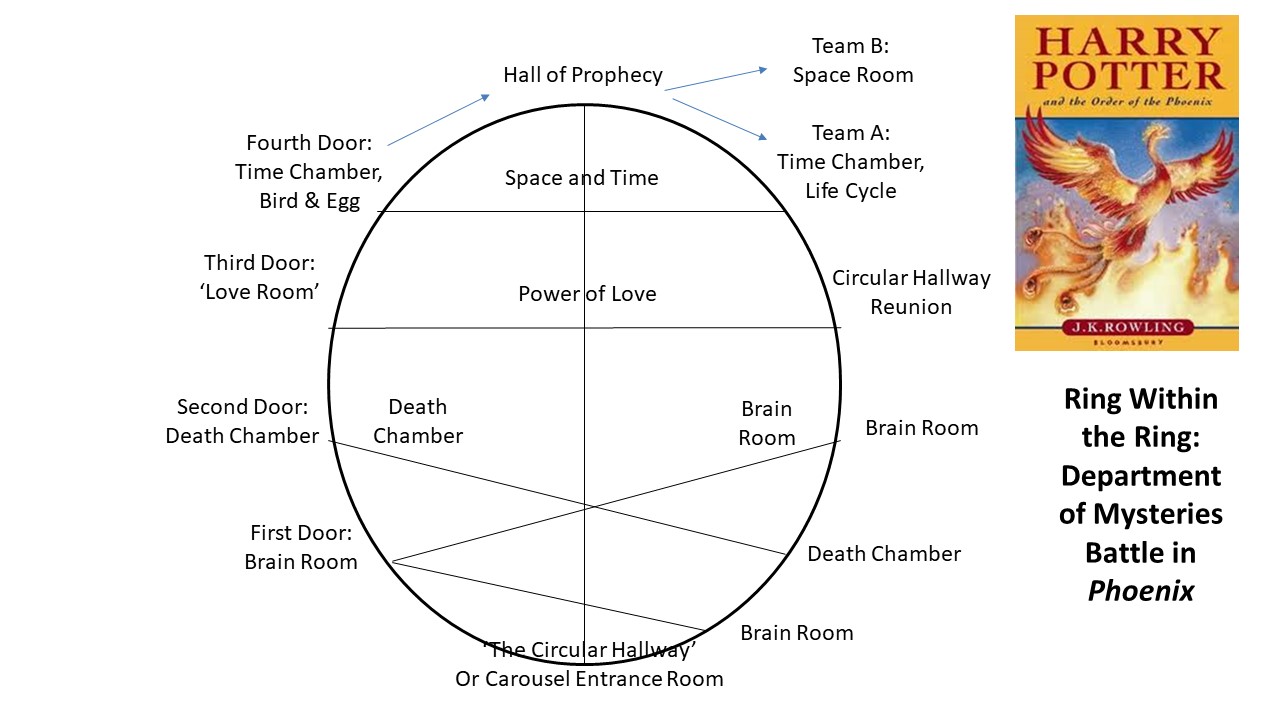
What I can say here is something I don’t say explicitly in that essay. The structure and remarkable symbolism of the Department of Mysteries misadventure make it among the most meaningful single passages in the Hogwarts Saga. The only ones that come to mind as being as important for grasping what Rowling believes and was trying to communicate via her story alembic are the three parallel gauntlet runs in Stone, Goblet, and Hallows, the Chamber of Secrets confrontation with Riddle and the Basilisk, the trip to the Lake beneath the mountain with Dumbledore in Half Blood Prince, the conversation at the other-worldly King’s Cross station in Hallows, and the burial of Alastair Moody’s ‘Mad Eye’ earlier in the finale. And, writing about it today, I think the Phoenix trip into the depths of the Ministry of Magic is probably the forty page piece that should be put in future representative collections of 21st century literature to capture the essence of Rowling’s writing.

What made it interesting to me, though, when I first charted the seven books in 2010 was the possibility that this capsule of writing was a ‘for instance’ of the chiastic structure signature element Mary Douglas in her Thinking in Circles called “rings within the ring.” In brief, real chiastic writing per the great anthropologist has as a defining characteristic not only a latch, turn, and turtle-back lines, but parts that have all those elements inside the whole. It was this Douglas premise that made me chart the individual books in the series after I had confirmed Brett Kendall’s 2003 (!) theory that the septology would be chiastic in structure.

The question that came up naturally was “Are there rings inside of the book rings the way the individual novels are rings within the series ring?” My answer to that was “I don’t know — but if I were to look, I’d chart the Order of the Phoenix passage inside the Department of Mysteries.” It has so many circular elements and obvious parallelisms that I thought it was the best place to look for an embedded ring; Rowling had seemingly lit ichneutic flares around it to highlight that possibility.

Rowling’s rings-within-rings has become something of a commonplace in her Cormoran Strike novels. Though I have not charted all of the seven books in the series with an eye for this, the two I have — Troubled Blood and Running Grave — feature Parts or chapter sets that have all the ring structure elements Douglas lays out inside the ring structure of that novel which, incredibly, fits within the seven book ring of that series thus far. See my breakdown of Running Grave’s Part Eight for an example of that intricate structural artistry.

My question today for serious Rowling Readers is, “When did she start this ring-within-the-ring-within-the-ring structural work that is invisible to the conscious mind but so important to the story’s subliminal effect?” The Phoenix trip into the Department of Mysteries is on my mind and it makes a certain sense that this would be the place she started; Order of the Phoenix  was the longest book of the Potter series, it came out after a three year pause in publication, and Rowling had clearly raised her game in several regards. A jump in the dimensions of her structural artistry seems likely there.

The Sunday Times of London published a Q&A exchange with Rowling this morning to mark the publication of Running Grave in paperback (about which, more tomorrow). That exchange closed with this:

How much had you planned all seven books when you started The Philosopher’s Stone?
By the end of the first book I knew how the seventh would end and had worked out a lot of the details of the world, but I left enough leeway to enjoy creating things as I went. Although they’re such different genres, I’ve applied a lot of what I learnt about world-building on Potter to the Strike series. In my work, I like to know exactly where I’m going. In my life, not so much.

There’s quite a bit to unpack there, of course, but I don’t think she’s being honest really about the extent of her planning. The remarkable parallels with the plot points and themes of Philosopher’s Stone in Goblet of Fire and Deathly Hallows make it clear there was less “leeway” than she lets on and that she “knew exactly where she was going” from the gate.

Having noted that, might her rings-within-the-novel-ring have started as early as Philosopher’s Stone? My haunting ring-charting project has been Ink Black Heart, the Rowling novel I have written the least about due to my PhD thesis deadlines post viva voce exams (which were on the day Strike6 was published…). I think I’ll put off that project again and, as I re-read the seven parts of the Hogwarts Saga, I’ll be focusing on the there-and-home-again story parts that may be rings. The four in the books before Phoenix would be the trip to the Mirror of Erised in Stone, the descent to the Chamber of Secrets in Potter2, the time-turning trial that leads to the Shrieking Shack in Prisoner of Azkaban, and Goblet of Fire‘s Portkey powered trip to and from the Little Hangleton graveyard after arriving at the center of the Triwizard Tournament maze.

Tomorrow I’ll be writing about the Rowling Times Q&A, next week about a new Rowling biography due early next year, and in the coming months, deo volente, more about the exciting Rowling Library anthology and the hunt for Rowling’s first ring-within-the-novel-ring. Not to mention the advent of Hallmarked Man… Thank you for joining me on these adventures in Rowling Studies!

Is Rowling Silent Because of Lawsuit?

Yesterday Newsweek magazine posted a piece with the title, ‘JK Rowling Falls Silent as She Could Be Prosecuted in Imane Khelif Lawsuit.’ The lede was that Rowling’s absence from Twixter for ten days means she has been intimidated by a frivolous lawsuit with exactly zero chances of going anywhere into a cautious retreat lest she be punished for her feminist zeal.

As I pointed out earlier this week, it is much more likely that Rowling went on the tweeting tear that she has been on since late July in order to provoke this kind of counter-attack; as Julia Hartley-Brewer noted in The Mirror (UK), it cannot be cyber-bullying if Rowling was simply telling the truth — and a lawsuit, a serious one, would expose Khelif as a man and his women’s gold medal as fraud if it came to trial. The pictures of a man beating up a woman are so much more to the point than a man beating women in a bicycle race, swim meet, or weight-lifting contest that it is easy to see the world’s most successful story-teller grasping the potential of a court case to flip the narrative here.

But that’s not why Rowling has “fallen silent.”

A friend who tracks Rowling’s yacht via its plotting signal (no, I don’t know what that is) reported this morning that the yacht has gone so far north up the eastern coast of Greenland that it has achieved unplottable status. I’m going to assume that, if the internet cannot track the Murray family boat as they sail toward the North Pole — end of Frankenstein, anyone? — then they do not have internet connections either as they approach a magnetic pole. The odds are good, if that is true, that she hasn’t heard anything about the kerfuffle her twixting blitz about Khelif has caused, whether those thirty-plus tweets were intentionally provocative or not.

Tomorrow, some thoughts on Rowling’s shed artistry, namely, when did she begin writing ‘rings-within-the-rings’ of her novels? My first guess is Order of the Phoenix but I think a closer look at specific chapters in early Harry Potter novels will reveal much tighter rings. See you then!

Rowling to Turn 60 on 31 July 2025; Where was She at 10, 20, 30, 40, 50?

If you number years of age as some traditional people do — considering the first year not as “zero years old” but as “one,” turning “two” at the beginning of the second year of life on what we celebrate as the first birthday — Joanne Rowling Murray entered her sixtieth year on 31 July, sailing on her yacht somewhere between Greenland and eastern Canada. She’ll turn 60 in conventional counting on 31 July 2025.

Turning 60 is not a very big deal in the US or UK but it is in the Far East for astrological reasons. Chinese astrology qualifies a year using both a ten year and twelve year cycle, which, taken together, mean that the quality of the birth year reappears only at the end of 60 year combined cycle:

Also named the sexagenary cycle or  the stem-branch cycle, the Chinese 60-year calendar cycle is based on the combinations of a cycle of ten heavenly stems and twelve earthly branches. Each year is named by a pair of one stem and one branch. The Year of Jia Zi (Jia from the heavenly stems and Zi from the earthly branches) is the beginning of the sexagenary cycle. The next Jia Zi Year will come 60 years later.

In Japan the 60th birthday is celebrated with special ceremonies, clothing, and food; the word for it, Kanreki, literally means “rebirth” because the celebrant is beginning again at his or her point of origin. I was living with a very successful Japanese man’s family in Massachusetts in May 1986 and the party on his birthday was something like what in the military is known as a “command call;” his students, business associates, publishers, family, and friends traveled from Japan, North and South America, and all of Europe to salute him. It’s a big deal.

Joanne Rowling was born in July 1965, a year qualified in Oriental astrology as ‘Yin Wood Si Ni Snake.’ The year beginning in February 2025 will have the same qualities. I suppose there are jokes about being a ‘wooden snake’ but as I was born in the year of the Yin Metal Ox, I’ll pass on throwing the first stone at her glass house.

I assume Rowling and the Murray clan will spend her birthday on their yacht floating off a beautiful beach or fjord as has become the family tradition. I thought today to review where Rowling was on her decade birthday celebrations to launch her Kanreki observances near the start of her sixtieth year. Thanks to the anonymous aggregator at The Rowling Library who put together their biographical timeline for The Presence; your efforts made this birthday compilation relatively easy.

Tenth Birthday — July 1975

Rowling’s family moved in 1974 to “Church Cottage, Tutshill, Gloucestershire, England. Rowling attends secondary school at Wyedean School and College” (TRL). Rowling at ten was living in an unhappy home. Casual Vacancy‘s Andrew Price and his painful relationships with his father Simon and mother Ruth is easily read as a transparency of the Rowling family as it was in Joanne’s teen years. [Read more…]

MinaLima Out as Potter Book Designers

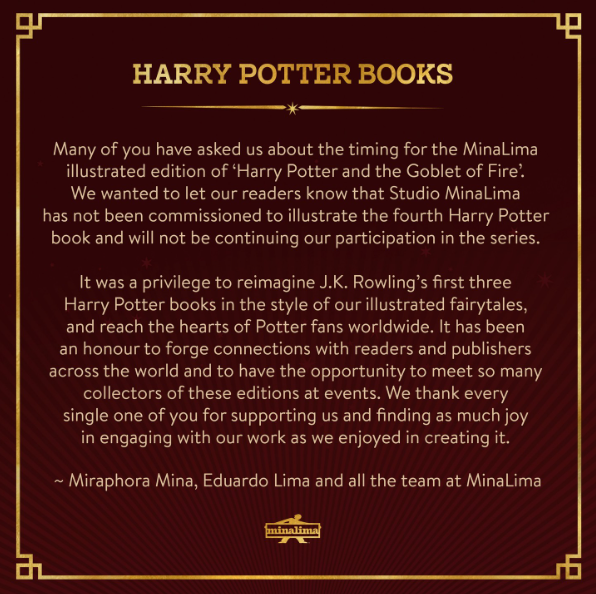
If there is a Harry Potter ‘look,’ it is the one created by MinaLima, the design and illustration team responsible for the Warner Brothers movie-adaptations’ graphic work (the Marauders’ Map!), the first two of the three Fantastic Beasts screenplays, as well as the first three volumes of the illustrated edition set of the seven Hogwarts Saga novels. Studio MinaLima announced via Instagram on 5 August that they would not be designing or illustrating the Goblet of Fire volume in this series.

Scholastic confirmed this via The Rowling Library’s Instagram platform soon thereafter:

Judging from the responses to this news on Instagram, collectors and fans of the series as well as of MinaLima’s artistry are not at all happy with this decision. I scrolled down the first responses to The Rowling Library posting of this news and the reactions were uniformly expressions of disappointment, even disgust with Scholastic.

Why the change? The answer is almost certainly “money.” Either MinaLima asked for more than Scholastic was willing to pay or the books they designed were becoming too expensive to produce, which is to say, “too close to the ceiling price point readers will pay thereby reducing the profit made on each sale” or Scholastic just decided to go with a much less costly partner in this venture. As they have already done in another series — [Read more…]

Rowling to be Sued for Cyberbullying?

Last week I posted ‘Rowling Rages Against Olympic Women’s Boxing Debacle,‘ in which piece I reported on the author’s sixteen tweets between 30 July and 3 August on the subject of men being permitted to compete against women in the 2024 Olympic Games. See that article for the facts about these karyotype XY boxers, the pushback against Rowling’s  assertion that this is being allowed by a “misogynistic sporting establishment” rather than by an IOC cowed by feminists and their genderist offspring, and my thoughts about the relative importance of this story compared to the UK riots and incipient war between Iran and Israel.

Since I wrote that post, the Algerian and Taiwanese boxers won all their matches against biological women and were awarded gold medals. Rowling has tweeted and retweeted fifteen more times on this subject since 7 August; her only other three tweets in that time frame were one to condemn the UK riots targeting Muslim groups (nothing about those targeting “non Asian” populations or the causes of anti-Labour riots as well as the attacks on immigrants in the UK), one about the Islamist state’s abuse of women in Iraq, and another about those in Iran.

[Aside: again, nothing about the history of Islamist crimes against women in the United Kingdom or the context of the UK riots contra open immigration, making the irony and hypocrisy of her rioting post’s exclusivity that much more obvious. See ‘England Burning’ for the necessary historical perspective and typology of current populist protests in the US and UK that you won’t find in Rowling’s tweets.]

Regardless, Rowling has tweeted on the subject of men being able to beat up women in the 2024 Olympics more than thirty times since the end of July; thirty one out of thirty seven tweets and retweets have been on the Olympic boxing scandal or 84%. She hasn’t tweeted on the subject or any topic since 7 August.

Today this story took a predictable turn. One of the XY boxers, Imane Khelif, the Algerian who won a gold medal against XX competition, has initiated a law suit in France claiming that he has been the subject of “cyber bullying.” Rowling is said to be named among those accused of causing Khelif this harm. From the BBC report: [Read more…]