The Rowling Library #92: ‘What Will the Wizarding Archive Contain?’

One of the best days in every moment is the one in which The Rowling Library (TRL!) e-zine arrives in my inbox. This month’s issue had, as always,  one story that I flipped to first, either because the subject was of special interest or the author was someone I know is going to challenge and inform me about something I know little about. The August issue’s cover story is one with both those qualities.

The Writer Who Goes By ‘Ibid’ for reasons not known by me (why remain anonymous when you are the global subject matter expert for a given topic?) shares his or her comprehensive knowledge about Rowling manuscript history and canon. Here it is about the Pottermore digital material and its several presentations for sale, a discussion of the re-packaging of that Hogwarts encyclopedia in ebook form later this month.

It’s first rate, as everything the Writer Who Goes by ‘Ibid’ has written that I’ve read on TRL and elsewhere has been. The review of the Pottermore materials history, the sober but still very interesting list of the possible chapters to be included in each of the new ‘Wizarding Archive’ volumes, and the Parthian shot to Rowling, Inc., that it would really be more than okay to publish codex editions of this Hogwarts Saga backstory stuffing. (I was especially grateful for that last, as I was thinking it again and again while reading this excellent summary of what is known about the new collection and what can be reasonably assumed about its two tables of content.)

To read the August issue of The Rowling Library and its cover story, ‘What Will the Wizarding Archive Contain,’ just click here. To download the whole shebang as a pdf, touch here.

Enjoy! HogPro Hats are doffed once again to the writers and editors for TRL for another wonderfully professional presented magazine and diverse set of articles.
Rowling Reveals Mental Image of What Lives in Her Lake of Inspiration

Rowling’s 2019 interview for the BBC’s Museum of Curiosity was where she chose to roll out her mental metaphor for her method of writing, namely, the Lake and the Shed. In brief, the Lake is how she visualizes her unconscious mind giving her the unshaped story stuff, something like “molten glass,” that she works into proper narrative form with her literary toll kit in the Shed. She admitted that this source of inspiration was cued to her subconscious struggling to resolve issues. You can read more about that interview and her much more recent version of this metaphor by reading The Lake and The Shed: Rowling Reveals Her Writing Process or listening to the ‘Rowling Studies’ podcast about the author’s 2024 ‘On Writing.’

Note that in the 2019 interview, Rowling says she never sees what it is that is in her Lake:

I feel as though the inspiration is the thing that lives in the lake that’s very mysterious, that I never see. But it hands me stuff. And then I have to take this unformed stuff – sometimes it can be reasonably formed, sometimes it’s very blobby like molten glass or something, and then I have to take it into the shed and there I have to work on it.

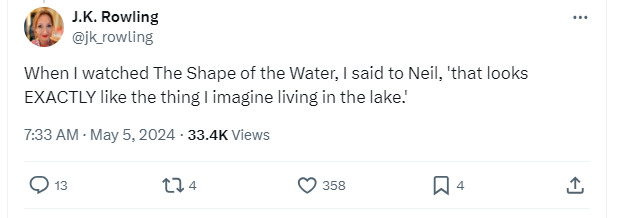
In May of this year, though, Rowling admitted that she had a very clear image in her imagination of what the story-inspiration-genie or Lady of her Lake looked like:

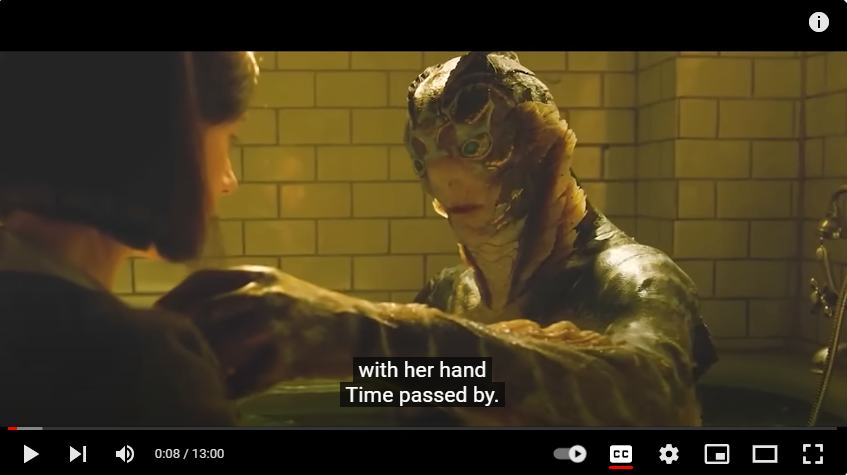
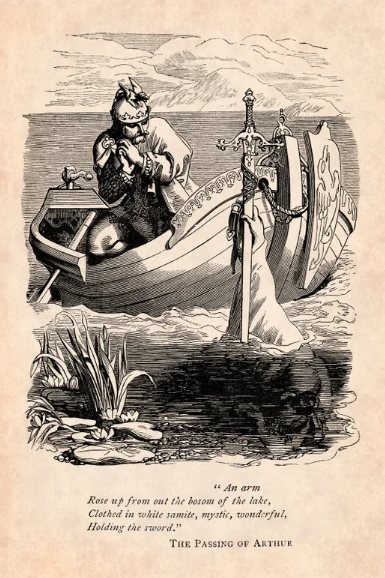
Images of that android amphibian are readily available, of course. Not an especially handsome guy, at least, not if your mental picture was something akin to illustrations of the Lady in the Lake from Tennyson’s Idylls of the King as mine was. What’s interesting to me, though, was Rowling’s description of the movie creature as looking “EXACTLY like the thing I imagine” in her metaphorical Lake and the powers of this creature in ‘The Shape of Water.’ If you’re not familiar with the movie, I attach both the trailer and a YouTube quick telling of the story below this post and the Wikipedia plot summary can be read here.


There are three dots that I think Rowling is connecting here: her core belief about imagination as such, the power and substance of the “unconscious” mind, and the Logos or Christ. I’m sure that must seem a reach, but bear with me. The title of my PhD thesis was ‘The Lake and the Shed: A Traditional Reading of the Work of J. K. Rowling,’ so I’ve given this Lake subject and Rowling’s ideas of the imagination some thought. Join me after the jump for my connections of those implausible dots. [Read more…]

Rowling Rages Against Olympic Women’s Boxing Debacle

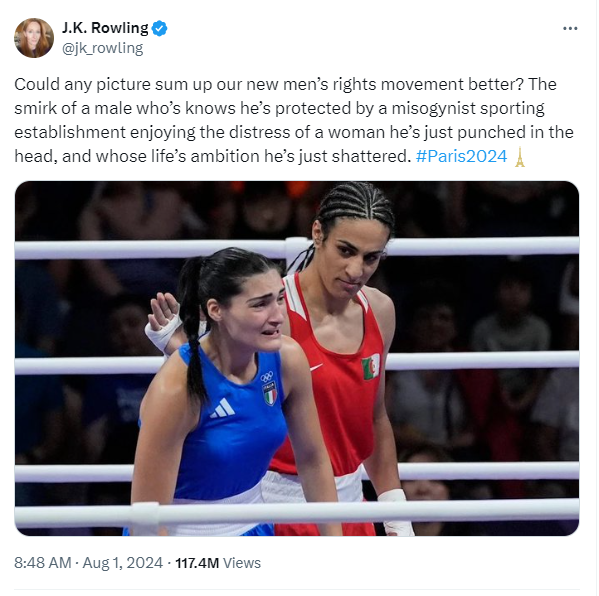
If you follow @jk_rowling, as more than 14 million twixters do, you know that she is working hard to raise the awareness of these followers to include the injustice being done to women competitors at the Paris 2024 Olympics. She has tweeted and reposted sixteen tweets on this subject between 30 July and 3 August. Here is an example that has received well over one hundred million views:

The story was broken by Reduxx Magazine, an online journal dedicated to stories that are “Pro Woman, Pro Child Safe-Guarding, Anti-Bullsh*t.” Their 27 July story, ‘TWO “Female Boxers” Set To Compete At Paris 2024 Were Previously Disqualified From Women’s World Championship For Having “XY Chromosomes”,’ spells out the madness of what is happening in Paris (for the shorter version, see this comprehensive twixter thread by one of the @Reduxx editors). In brief, the two boxers are men who were raised as women because of their DSD, a birth defect.

They are believed to be impacted by a Difference of Sexual Development, in which there is a developmental abnormality in secondary sex characteristics. This is a medical condition which can manifest with children being born with ambiguous or disfigured genitalia. Male children impacted by DSDs are often “assigned female at birth” due to these genital defects, as there is a genuine assumption they are girls.

Read the whole article or twixter thread. You’ll be astonished by how much this story has been changed in the telling. Rowling, per her feminist core beliefs, is on the side of the women boxers who are being beaten up by male boxers with DSD:

Three notes to this twixter tornado or ‘twister’ after the jump! [Read more…]

Beatrice Groves – The Golden Journey to The Hallmarked Man

With The Hallmarked Man launch coming ever closer and J. K. Rowling treating us to a new Twitter Header, Beatrice Groves, Research Fellow and tutor at Trinity College, Oxford, and author of  Literary Allusion in Harry Potter, has written a Hogwarts Professor Guest Post: The Golden Journey to The Hallmarked Man. 

[Read more…]

Popular Culture Catches up to Chiasmus in Harry Potter

Entertainment web magazine Screen Rant has discovered the chiastic form of the Harry Potter series, seemingly from first principles. Senior staff writer, Angel Shaw, noticed that the later novels reflected the earlier ones and wanted to know if they were the first to discover it. 

Once I noticed the Harry Potter series’ reflective nature, I went to the internet to see if anyone else had reached the same conclusion. Of course, they had, and I quickly dove into what has come to be called the “ring composition” or “chiastic” theory of Harry Potter, analyzed stupendously by John Granger.

Anyone who wishes to dig deeper into ring composition can see the pillar post here, or read John Granger’s book Harry Potter as Ring Composition and Ring Cycle. John’s most recent work, the stupendously epic Running Grave: Ring Reading, can be found here.