Let the JKR 60th Birthday Party Begin!

Starting tomorrow over at the HogwartsProfessor substack, Nick Jeffery and I will begin our Lake and Shed reviews of the twenty-one stories written at least in part by Joanne Rowling Murray, who writes under the pseudonyms of ‘J. K. Rowling’ and ‘Robert Galbraith.’ We have taken on this month long project to celebrate Mrs Murray’s 60th birthday which falls on the last day of the month of July.

Nick and I are both Nipponophiles and want to observe JKR’s Kanreki, or ‘calendar return,’ the second-birth celebration made by those who observe the five cycles of twelve years in Chinese astrology, each cycle of the twelve animals having the quality of one of the five archetypal elements. Rowling was born in the year of the Wood Snake or Tree Snake, 1965, and this year on her birthday she will once again enter into the cycle of the years that she did as a newborn.

We are taking this occasion to make a romping roll-through review of most everything she’s written with Nick making one point from the Lake side of the house, Rowling’s metaphorical place for her inspiration from her biological history and unconscious mind, and my making one point from her Shed, a point about her deliberate artistry, i.e., her tools, the Golden Threads, and her most pronounced themes. It promises to be something of a marathon exercise but still a lot of fun — and, I hope, an engaging introduction to the Fourth Generation of Rowling Studies in which, per Rowling’s Lake and Shed writing process metaphor and invitation, her biography and bibliography are both given their due.

If you want to be sure to catch each conversation, subscribe to the HogwartsProfessor Substack site and every one will be sent to your email address on publication. It’s free.

See you there!


J. K. Rowling: The World’s Most Important Writer, Feminist, and Philanthropist

Why I Have Read and Written about the Work of Joanne Murray for Twenty-Five Years and Why I Don’t Think I Have Been Wasting My Time

Ron Weasley rebuked Hermione Granger once with the comment, “Always the tone of surprise.” He was referring to her unconscious estimation of him as something of a bumbling idiot who rarely got things right. Not pretty.

Two weeks ago after a church service in northeastern Arkansas, a newly illumined (baptized) woman in her thirties I had met for the first time at Pascha this year in South Carolina greeted me with a hug and a smile. “John,” she said, “the Harry Potter guy.” It was said affectionately enough, a note that she remembered me — but also as if my niche celebrity as a serious reader of J. K. Rowling was something of a joke she got. There was the inevitable hint that my decades of work devoted to Rowling Studies was borderline pathetic, a life and mind spent on childish things, a pat on the head.

Gabriela’s greeting, too, wasn’t anything new or unusual or unkind, really. It’s been the rule to which exceptions are almost always from other serious readers of J. K. Rowling; academics, reporters, friends, family, and fellow Team Members at the grocery store where I work much more often than not treat my signature work as if it were a strange kind of fetish, something I should be slightly embarrassed about, a hobby about something no more interesting or important than building models or collecting beer cans, one that had taken over my life and distracted me from meaningful uses of my intelligence and time.

They show a certain deference, as you’d expect, to my advanced degrees, publications, and Walter Mitty reality but there’s usually that curious note bordering on disdain for the subject of my expertise. One of my PhD advisers, for example, a global authority on the life and work of Franz Kafka, noted at our first meeting it was a stretch for him to be supervising my thesis because his parents hadn’t let him read Enid Blyton as a child and he certainly couldn’t be bothered to read Harry Potter, today’s equivalent of the Magic Treehouse books.

I doubt very much this is specific to me. I remember James Thomas, a first tier Potter Pundit and now a retired Pepperdine professor, sharing with me the confusion of his English department peers in Malibu about his interest in Rowling as an author. James, after all, had published on Poe and Faulkner. Y’know, real authors writing at real depth and with real artistry.

As I begin a series of articles to commemorate and, in an odd way, celebrate this summer the 60th birthday of the author known to the world as ‘J. K. Rowling’ and ‘Robert Galbraith,’ both pseudonyms and one an international brand worth billions of pounds sterling, I want to push back against this prejudice in the popular mind as well as in the academy.

What follows, of course, my one-off apologia pro vita mea, will have no effect on what people think and that’s more than okay (frankly, the wonderful people I have met and perks I have enjoyed as the “Dean of Harry Potter scholars” make the dismissive ribbing and condescension I get seem like a very small price to pay). I want to set the table here, though, for ideas and possibilities I will be writing about before 31 July, posts I have reason to believe will be a re-setting of the premises of Rowling Studies, the field I have played a larger part in establishing than perhaps any other critic.

Why, after all, should anyone care about the artistry and meaning of Rowling’s work or about her life? So what?

My thesis today is that everyone has reason to care because Joanne Rowling Murray, aka J. K. Rowling and hereafter ‘Rowling,’ is not only the most important writer of our time but also the most important philanthropist and feminist as well. For the purposes of this review, I define “most important” as “most famous, most influential, and most challenging” and argue that there is plenty to write and think about those aspects of her published work, charities, and core beliefs which are edifying points of reflections for thoughtful people today with respect both to their own thinking as well as what it means to be human. [Read more…]

Golden Trio Cast for HBO+ Potter Shows

The new Harry, Ron, and Hermione have been cast for the HBO+ and Bronte Studios adaptations of J. K. Rowling’s Harry Potter novels.

From the author’s website, JKRowling.com:

The HBO Original HARRY POTTER television series has cast screen newcomers Dominic McLaughlin in the role of Harry Potter, Arabella Stanton as Hermione Granger, and Alastair Stout as Ron Weasley.

Francesca Gardiner (Showrunner, Executive Producer) and Mark Mylod (Director of multiple episodes, Executive Producer) said:

‘After an extraordinary search led by casting directors Lucy Bevan and Emily Brockmann, we are delighted to announce we have found our Harry, Hermione, and Ron. The talent of these three unique actors is wonderful to behold, and we cannot wait for the world to witness their magic together onscreen. We would like to thank all the tens of thousands of children who auditioned. It’s been a real pleasure to discover the plethora of young talent out there.’

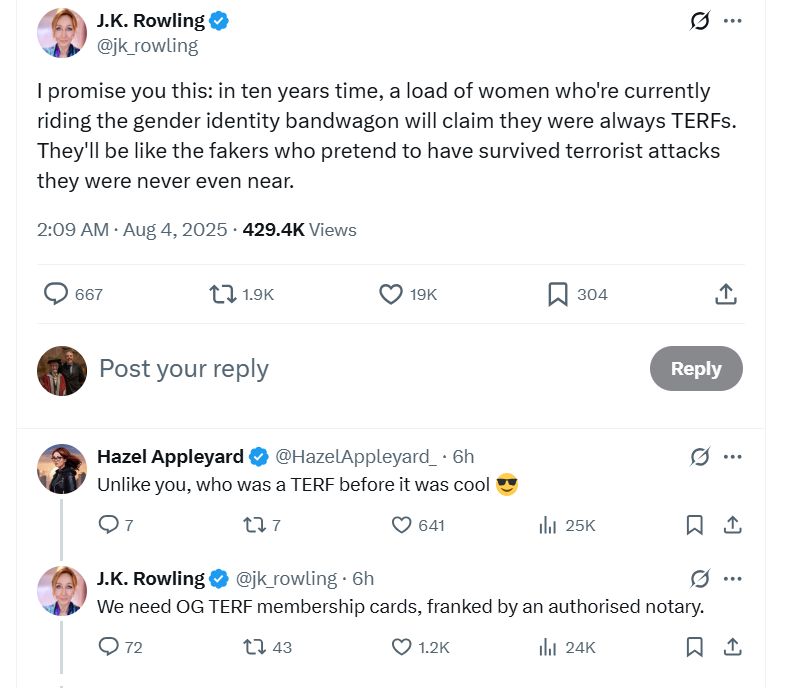
Rowling, an executive producer for the adaptation (not to mention her ownership of Bronte Studios), tweeted about the casting:

Which response generated a Daily Mail article of its own, ‘J K Rowling gives decisive four-word verdict on new Harry Potter child stars fronting TV series.’ MuggleNet, which seems to have forgotten its aversion to all things profiting Rowling, Inc., because of her supposed “bigotry” and “transphobia,” has posted a stream of articles about the teevee adaptation casting decisions as well as the Universal Epic Theme Park’s Wizarding World attractions which opened this week in Orlando.

Team Rowling invited MNet to the opening so it seems they have been brought back into the fold and their all-in condemnations of Rowling’s Gender Critical feminism have been memory-holed. Emma, Rupert, and Daniel should be so lucky…

Three quick thoughts on the casting choices:

(1) Black Hermione? Read all about it at Horse and Whip’s ‘Arabella Stanton’s Parents: What to Know About Her Ethnicity and Race.’ The Daily Mail came at the issue side-ways to dodge the racism charge in their piece, ‘Stunned Harry Potter fans claim new Hermoine star Arabella Stanton is spitting image of huge Hollywood actress – gasping ‘I can’t unsee it now!‘ (That would be Jenny Ortega.)

I’ve written what I want to say on the subject of diversity casting in ‘‘Black Severus’ versus ‘Black Hermione:’ Similarities and Differences in Casting.’ I’d only add what many others have said about the new Golden Trio; one can only hope that their parents and guardians of these children have carefully considered what their accepting these roles will mean for the rest of their lives and that they will do everything possible to protect them from the madness that will be the actors’ day-to-day life for the next decade.

(2) Rowling’s Birthday Resurrection It’s been quite the fortnight in Rowling Land.

First, the Sunday Times published a not quite hagiographic but certainly laudatory article, ‘JK Rowling: ‘Nobody who hasn’t been poor can understand what it means.’ It is a detailed review of the author’s more than generous philanthropy with respect to causes ranging from orphan children, women needing funding to seek judicial action in the Trans Wars, medical research, and a women-only shelter.

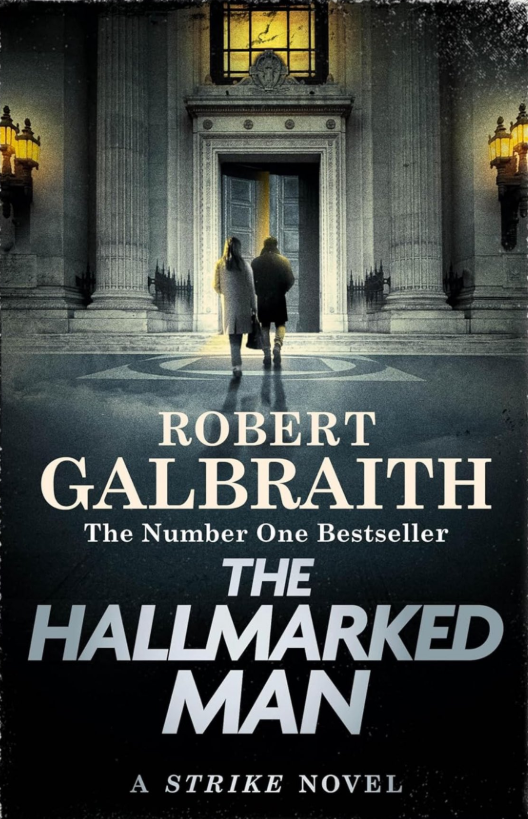
Then Hallmarked Man’s cover was released to the delight of all Cormoran Strike readers.

Then the Universal Epic theme park opened which excites that part of fandom that enjoys the 3D experience of the Wizarding World.

And then the Golden Trio casting was announced, the three players that Harry Potter screen fans are most interested in and excited about.

Rowling celebrates her 60th birthday at the end of July. I think the gods are smiling on her, the stars are coming into alignment, or the plans carefully laid out by the trio giants of Rowling’s marketing team are coming together so that this landmark celebration will see as much of a full-on rehabilitation of the author’s public image as is possible. It certainly helps that she has won the Trans Wars, with the scientific community, court decisions, and public opinion now lining up behind her with respect to the fact that sex is fixed and binary and women’s places must be protected from trans-identifying men.

I think Rowling’s more than positive press in the last two weeks on all fronts is evidence of a coordinated campaign, i.e., her marketing team’s hard work, to restore her platinum status among celebrities. Good on them. There will be naysayers in the comment threads beneath articles about Rowling on 31 July because there is no pleasing everyone but the great majority will be notes of admiration from fans of her writing, her philanthropy, or of her feminism.

The timing of this casting news announcement, in other words, probably is best viewed as part of a larger project and as one that is progressing very well indeed.

(3) So What?

I like to end posts and podcasts with an answer to the question, “So What?” I want the reader or listener to walk away from the conversation we’ve been having with the key points I’ve covered and why it matters.

I cannot think of a single reason that anyone outside the families of the young actors involved should care about this casting announcement. Given the history of child actors since the invention of moving screened images, those families should be alarmed. Given the proven hysterics and volatility, which is to say “mental instability,” of Harry Potter fandom leadership and twitterati (cf. their Trans War long knives for any and all not chanting “T-W-A-W!”), they may soon wonder why they didn’t refuse HBO+’s offer.

Which is none of my business, I know.

What is my business as the “Dean of Harry Potter Scholars” (TM) is to discuss the artistry and meaning of the work written by the world’s most famous and influential writer, J. K. Rowling. She is also, as I’ll argue in a future post, the world’s most famous and influential philanthropist and the world’s most famous and influential feminist. The “So What?” of these discussions is that, man being the story-telling animal and Rowling’s being the most popular stories globally in human history, understanding why and how they work — their structure, symbolism, allegorical and anagogical substance — reveal important ideas and information via reflection on imaginative experience about what it means to be human.

Talking about twitter headers, speculating about the covers of not-yet-published books, fan-girl-ing pre-adolescent actors, planning vacations in Orlando to ride exteriorized and packaged experiences erasing your imagination’s picture or to attend fan conferences? I’ve done all that. I’ll take a pass on those efforts in the run-up to Rowling’s birthday.

What I hope to be sharing here before the end of July are my research into and conclusions about Rowling Studies ‘Fourth Generation’ subjects:

  • What is the most persistent ‘golden thread’ that runs through everything Rowling writes?
  • What ‘Lake’ event in Rowling’s younger life inspired her to write the Harry Potter stories?
  • What are the points of intersection or places of overlap in the Venn diagram circles of Rowling’s three lives as writer, philanthropist, and feminist?
  • Are Rowling’s signature characteristics as an author — the literary alchemy, ring writing, psychomachia, traditional symbolism, and intertextual notes (among others!) — best understood in relationship to one another or independently?
  • Are the parallels between the Potter novels and their equivalent number in the Strike mysteries a playful game between author and serious reader or are they meaningful? And will there be parallels with other Rowling work in Galbraith numbers 8, 9, and 10?
  • Just what kind of feminist is Rowling beyond “biology based” and “Gender Critical”? She’s outside the usual categories of “academic” and “movement” feminism as well; does she have a role-model, living likeness, or historical equivalent?
  • Quo vadis, Joanna-Robertus? Extrapolating from Rowling’s recent experience of intentional solve et coagula transformation in the Trans Wars, what might the future hold for her?

That’s a lot, certainly, and it’s certainly a lot more interesting and important than HBO+ casting news from Rowling, Inc., marketing Headquarters. At least to me it is, but, sure, de gustibus. I’m still as interested as the next Serious Striker in ‘Who killed Leda?’ and ‘Is Robin sterile?’ but, until the Big Birthday Bash, I’m going to be focusing on the seven points above.

Stay tuned!


Shared Text: Hogwarts Baseball Uniforms (Hartford Yard Goats)

You may not have ever heard of the Colorado Rockies Double A minor league baseball franchise, the Hartford Yard Goats, but they’re for real. They have a downtown Hartford, Connecticut, stadium — Dunkin’ Field! — a full-on website (well, it’s a page at MLB.com), even a Wikipedia entry, from which:

The name “Yard Goats” was selected as part of a “Name the Team” contest which drew over 6,000 submissions. “Yard goat” is a railroad term for a switcher, a locomotive that moves rolling stock within a yard. The stadium is adjacent to Hartford Yard. The logo features a goat chomping on a baseball bat and the team makes heavy use of animal imagery and symbolism.[7] The blue and green colors are a nod to the Hartford Whalers team that played in the National Hockey League from 1979 to 1997.[8] The team stages an annual Whalers Reunion weekend, with special uniforms resembling the hockey club’s and the logo has the goat chomping a hockey stick. The logo font replicates that used by the former New York, New Haven, and Hartford Railroad.[1]

Like all minor league baseball teams, the Yard Goats specialize in special promotions for almost every game in order to boost attendance. Fireworks Night, Kids Run the Bases Day, Double-Header Discounts, you name it.

Last week the Yard Goats rolled out their Gryffindor themed uniforms for Harry Potter Day at Dunkin’ Field. Here are some snaps taken by Ryan DeSantis for the Major League Baseball Instagram page:

Apparently every team in the minor leagues had a Star Wars Night on May the Fourth (free admission to those who come in costume! Baby Yoda, anyone?) so cultural touchstone special promotions are not unique to Hartford’s Harry Potter night. But still…

How many book series are so popular that themed uniforms would be instantly recognizable and celebrated by a crowd of sports fans, even a reason that they came to Dunkin’ Field to see and celebrate?

That’s right. Only one book series is the Shared Text of generations.

Here’s hoping that the Yard Goats merchandise page isn’t the subject of Culture warrior outrage. It’s a Yard Goat head necklace, team, not a Baphomet pendant!

Gamesmakers Rejoice Over Sunrise on the Reaping: Capitol will Love Games!

Francis Lawrence, Lionsgate’s Gamesmaker-in-Chief for their movie adaptation of Sunrise on the Reaping, is thrilled to death about the second prequel. Why? Listen in to his over the top excitement about the project:

In a nutshell, he’s totally excited about the second prequel because it is so unlike the first prequel, Songbirds and Snakes.

The problems with that book were (1) that it featured a character, Coriolanus Snow, who was despicable and audiences quite rightly struggled to “get behind” him and (2) the technology of the Hunger Games death match was relatively primitive. There wasn’t a lot of pod-induced mayhem or Muttation-generated terror in the Arena killing field.

Which is to say that Lawrence is delighted that the new book brings us back to Catching Fire level technology and Gamesmaker horrors for the Tributes who are fighting for their lives as entertainment for the Capitol audience.

This is beyond satire, no? Collins is writing novels that depict the evils of the Gamesmakers and the psychopathic illness of those who enjoy watching their death festivals — and the movie makers who adapt those novels into films have exactly the same priorities as the villains (and the movie-goers as the mindless citizens?) in the novels.

This isn’t new to the series; it’s been a constant since the first Lionsgate production. See Gamesmakers Hijack Story: Capitol Wins Hunger Games Again from 2012 for proof of that. What’s groundbreaking here, I think, is the ‘saying the silent thing out loud’ quality of Lawrence’s enthusiastic comments.

It’s Holy Week here at HogwartsProfessor, which means that we’re taking some time off for travel, worship, and reflection about the future of HogwartsProfessor.com. Saturday’s post, a Haymitch clip from the original movie that has new resonance in light of Sunrise (see below for the best part of that), was the 250th of daily pieces since last August. We’re due a break and the weblog deserves a re-imagining.

More on that next week. In anticipation of the Feast, Kalo Pascha!