Mailbag: Help with Christian Harry Hater

This plea for assistance or advice was in my inbox this morning:

Dear Mr. Granger,

I am asking for some advice on how to handle fellow Christians who are disrespectful towards people who enjoy Harry Potter.

I recently conversed back and forth on Instagram with a very condescending Christian who labeled me as “dense” for disagreeing with his arguments and muggle-like attitude–lol. 

I am curious how you would respond to the following claims he made:

  • Harry Potter contains pagan practices;
  • Real occult references and symbolism are in the books;
  • Harry Potter contains information about “magick”, sigils, and spells (that sounds like some Richard Abanes propaganda);
  • The Deathly Hallows symbol is designed from Solomonic sigil magick;
  • Incantations are bad (not fantasy) and are called “magick” (he conveniently ignores the fact that incantations and spells are present in both The Lord of the Rings and The Chronicles of Narnia and yet defends both of those book series);
  • Harry Potter promotes the heresy of gnosticism;
  • Harry Potter story elements are based on real occultic legends/people, i.e.; Alastor Moody based on Aleister Crowley, Cassandra Vablatsky based on Helena Blavatsky, the Philosopher’s Stone, and the Hand of Glory;
  • J.K. Rowling’s tattoo is demonic (I thought your argument posted on Hogwarts Professor sufficiently debunked this already); and
  • J.K. Rowling has not outrightly pronounced her faith (we already know that is false).

I tried recommending your book How Harry Cast His Spell to him and asked if he would give it a chance–but he’s so stubborn and pious that he can’t be open to another viewpoint. He claims to have been studying gnosticism and magick for ten years and says that all of these things while not directly involving invocational magic are how the Devil promotes sinful storytelling and rebellion against God.

As a conservative Christian and a Potterhead, how would you counter these bold arguments?

Thank you for all the work you’re doing and God Bless 🙂

Josh

Where to begin, Josh? I am an Orthodox Christian and a Perennialist-inclined literary critic rather than “conservative” or a “Potterhead” but I see your point that I don’t see the Hogwarts Saga as does this heresy hunter and Harry Hater.

Every one of these claims made by your Instagram sparring partner, as you noted, was made by Richard Abanes in his Harry Potter and the Bible : The Menace Behind the Magick(2001). That doesn’t mean that the claim is ipso facto in error; it actually means that there is evidence that the claim is true but the argument is wrong-headed. As you point out more than once that he was not receptive to discussion or “open to another viewpoint,” I don’t think you should spend any more time than you already have trying to persuade him.

I’d ask you to think about three things to prevent you from slipping into the pious surety of this internet maven you tangled with online.

First, my books on the Christian content and structure of the Harry Potter books and series were not written as ammunition to deploy against those who have decided not to read the book or those who campaign against their supposed “corruption of the youth.” My goal when talking about Rowling’s traditional artistry has been primarily to explain to readers who love the Wizarding World adventures why they love them.

Life is short and there is no end of books to read; there is no point in wrestling verbally with those who choose either not to engage with Harry Potter and friends or to make decrying Rowling’s fantasy fiction an article and touchstone of their faith. The exercise is not edifying to the For or the Against debaters and as often as not makes the Defender of Dumbledore begin to sound and act like his or her dismissive opponent.

Second, as rich as the books are in Christian content, symbolism, even narrative structure (and I hope to be revisiting this subject soon in light of remarkable insights from a professor in Illinois Who Must Not Be Named), there are elements in the books that most Christians would consider immoral, e.g., the torture of Slytherin bullies on the Hogwarts Express at the end of Goblet of Fire. Rowling herself has recently said she has changed her mind about the morality of assisted suicide, which makes Dumbledore’s sacrificial death at a friend’s hand lamentable. These books, uplifting and challenging and meaningful as they are, are not a postmodern Pilgrim’s Progress.

And, third, the work I have been doing consequent to Rowling’s ‘Lake and Shed’ 2019 interview suggests that the Harry Potter series can be read as the author’s prolonged feminist argument in Christian symbols for pre-natal infanticide (‘induced abortion’). See this conversation I had with Nick Jeffery for why that reading is credible and this discussion of alternative explanations for the ‘Lost Child’ Golden Thread in Rowling’s work.

We’re a long way, Josh, from the black-and-white reading of Harry Potter in which those with misgivings about the books are necessarily ignorant boobs and those who love them are by definition on the side of the angels. That’s especially true when you factor in the fandom leaders who now think of Rowling as the transphobic anti-Christ when they used to idolize her every thought and tweet and the one time Harry Haters who are now Team Rowling because of her stand against the surgical mutilation and chemical castration of children and adolescents.

The books haven’t changed but their Serious Readers have, for and against, and our appreciation of the Hogwarts Saga has been deepened and challenged simultaneously by all we have learned about the author since 2007 and about her children’s books consequent to her many post Potter publications.

To conclude, then, I’d leave you first with Twain’s advice not to wrestle with a pig (“you get filthy dirty and the pig likes it”) and then with my encouragement to read the Harry Potter novels with an open mind yourself. No, Richard Abanes’ ‘arguments by association’ remain logically invalid, but there’s a world of unanswered questions about this wonderful seven book series still to explore, most notably, “What unresolved trauma in Rowling’s life inspired her to write them?”

Thank you for writing and best wishes in your serious reading!

John
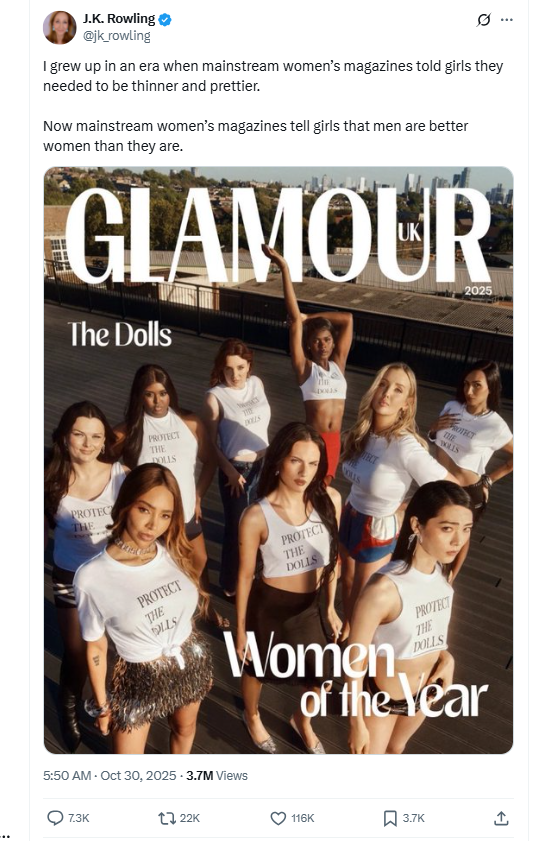
Rowling Blasts Glamour Magazine for Its ‘Men in Halloween Costumes’ Issue

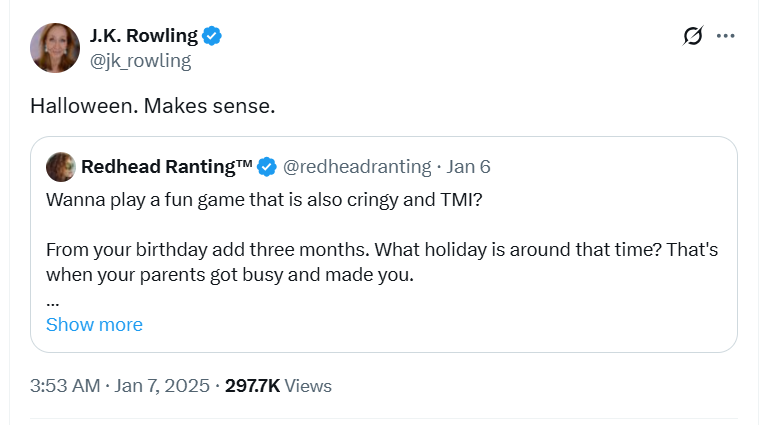
Rowling has a thing for Halloween. She noted on Twixter in January that 31 October is very likely the date of her out-of-wedlock conception (Halloween is exactly nine months before her 31 July birthday).

Having noted that, this year she decided to celebrate by having-a-go at ‘the Dolls,’ which is to say ‘men in drag’ and those who celebrate these men as if they were women.

You can read about it at ‘JK Leads Glamour Backlash: JK Rowling leads backlash against Glamour magazine after nine trans activists – including one who called the Suffragettes ‘white supremacists’ – were named ‘Women of the Year’.’

Or you can watch Megyn Kelley cover the same ground:

Happy Halloween, Everyone!

Reading Rowling the Hard, Right Way versus Enjoying the Surface Story

Last week on the Feast of the Transfiguration and a friend’s 25th wedding anniversary, I wrote a Substack post with the title above and the subtitle, ‘Images of the Transfiguration, Story as Non Liturgical Sacred Art, What We Do at Hogwarts Professor, and How We’ll Be Reading Hallmarked Man.’ In it, I shared my experience in 1981 at the University of Chicago ‘Smart Gallery’s exhibit of Raphael’s ‘Transfiguration of Christ’ and consequent conversion to a more traditional and less superficial understanding of art and story.

The post was taken in large part from my PhD thesis notes about story as a ‘non-liturgical sacred art’ and the difference between sacred art of all kinds and profane art with religious content. Believe it or not, it’s relevant not only with respect to how we read and appreciate the work of J. K. Rowling — to include of course the soon to be published Hallmarked Man— but also how we understand what it means to be human and how we properly align our lives and entertainments.

I understand that it’s hard sledding at points and not for those who are completely at home with conventional thinking (or who are predisposed to dismiss the idea that there are good, better, and best ways to do anything, to include reading, because that is somehow “exclusive”); I hope you will give it an honest reading when you have a minute and an open mind. ‘Reading Rowling the Hard, Right Way.’

Today is the Feast of the Dormition of the Mother of God, what Roman Catholic believers call the ‘Assumption.’ For an art historian and Catholic perspective on the sacred vs profane art distinction, I recommend Hilary White’s explanation of the difference between Catholic and Orthodox depictions of the Dormition of the Mother of God and especially White’s ‘Lies the Renaissance Told You,’ for her overview of when and how, in her terminology, sacred art became secular. It is an excellent overview of the gulf separating art that imitates nature, “illusionism,” versus the Creator’s “method of operation” aka Medieval “realism.”

If you want a short cut to one point of relevance to these ideas and how to read J. K. Rowling, just note that the ring around Christ in the Transfiguration and the Dormition icons, the so-called mandorla or almond, is traditionally the same shape as the Ichthys fish, the intersection of two circles, albeit on its side. The symbolism of this intersection of heaven and earth, the God-Man, plays an important part in understanding Rowling’s favorite painting, Caravaggio’s Supper at Emmaus, and Rowling’s use of it as the mother-of-pearl fish pendant in Running Grave.

Nick Jeffery and I discuss many of these ideas in our most recent conversation, also at the HogwartsProfessor Substack site, ‘Is Rowling a Romance Writer or What?‘ Rowling’s book review of Nikola Sturgeon’s memoir and the New York Times article, ‘The Wizard’s Everlasting Spell,’ about the vitality of Harry Potter fan fiction also provide a lot of food for thought germane to our plans for reading Hallmarked Man, believe it or not. Have a look or listen.

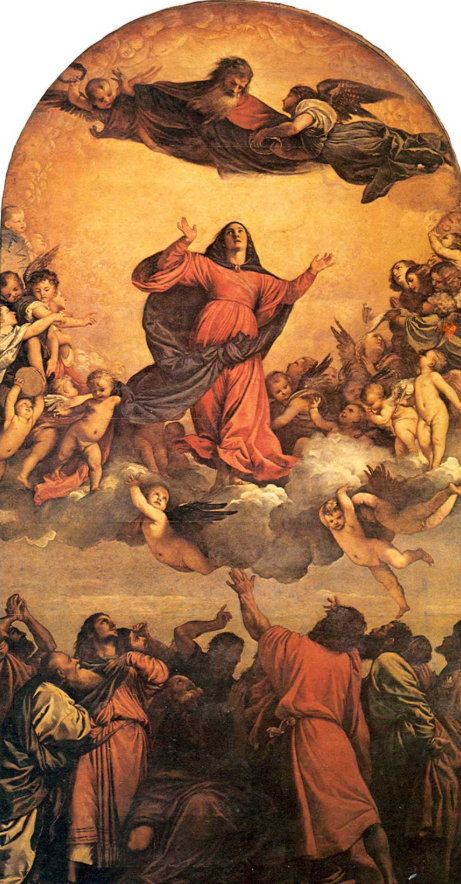
Today, though, is the Feast of the Dormition, which in addition to being one of the great Feasts of the traditional Christian Church that merits a two week fast in preparation, is my wife’s Name Day and my youngest son’s birthday. She shared with me after reading my post about Raphael’s heroic ‘Transfiguration’ her parallel experiences as an American going to high school in Italy on first seeing Titian’s ‘Assumption of the Virgin‘ while on a tour of Venice.

Please do read Hilary White’s essays (here and here) for an accessible explanation of why Titian and Raphael’s work, though beautiful, are profane art with a secular subject rather than sacred art per se. She is especially helpful, too, if you’ve ever wondered about those signature-for-the-period baby-with-wings representation of angels.

My wife’s experience of this painting as a jaded teen in the 70s with a crowd of her peers? Profane as it may be, as Raphael’s ‘Transfiguration’ had done to me, so Titian’s ‘Assumption,’ even larger than Raphael’s last painting, shocked her into reflection about her de facto atheism and vibrant skepticism about all things holy or ‘churchy.’ She marveled at and envied the faith of Christians that could produce a marvel like this. [Read more…]

Muse, Meaning, and Magic: the Teller Talk Interview with John David Mann

John David Mann, best selling author of The Go-Giver and co-author of the Chief Finn thrillers, sat down last week to discuss writing fiction from inspiration to publication, the locus of meaning in author and reader, the relationship of music and fiction (JDM is an accomplished cellist and composer), and his favorite writers, to include the best book he’s read that few of his friends have heard of.

It’s a wide-ranging conversation between a new novelist and an accomplished mentor to writers about the craft and experience of imaginative fiction. I highly recommend it.

You can get a free subscription to ‘Teller Talks’ at its Substack home site and sign up for the monthly muse-letter that Mann sends out about writing and writers (‘Mann’s Search for Meaning’ — the profiles of writers he adds as an addendum being both a challenge and a delight without fail). I’m very much looking forward to Zossima’s next interview and hope you will be part of the audience as well!


Five Minute Audio Teaser from Hallmarked Man Now Available Online

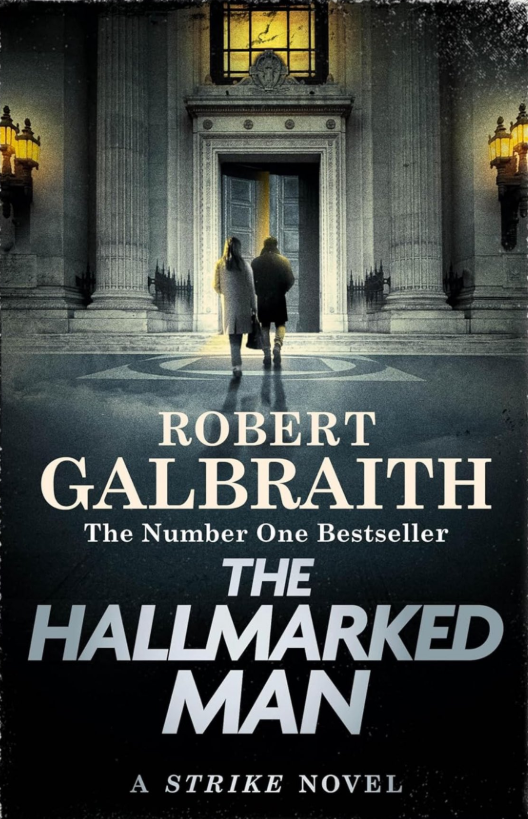
The marketing blitz for Hallmarked Man is in full swing. As it should be with only three weeks until its publication.

The author is conversing with fans on Twixter and Apple Audio Books has dropped a five minute teaser from Strike8, what I presume are the opening pages of the novel.

The epigraph was a surprise to me, the big reveal of the first pages was also the shock it was meant to be, and I was startled, too, by what this beginning suggests we’ll see in the end.

Thoughts on all of that after the jump! (I’m discussing the five minute clip, so of course there will be spoilers.) [Read more…]