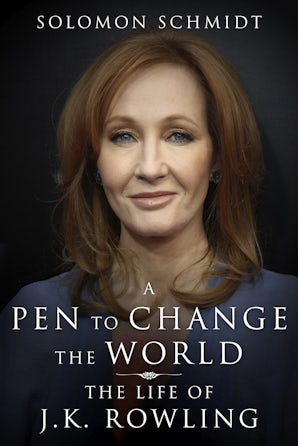
A Pen to Change the World – the Biography of J. K. Rowling by Solomon Schmidt.
 A new biography of J. K. Rowling is badly needed. J.K. Rowling: A Biography by Sean Smith provides an accessible, heavily detailed, but structurally simplistic look at the author’s meteorological rise. First published in 2001, Sean Smith’s unauthorized account focuses deeply on the trials and tribulations Rowling faced before finding global success with Harry Potter. Because his work functions as a time capsule from the very beginning of her career, it misses more than two decades of monumental shifts in her professional and personal life.
My copy of Smith’s book bears the dents and battle scars of being hurled across the room when the reference I’m looking for proves to be missing or inaccurate. There are some howlers such as the lower second class honours that Rowling gained at Exeter are translated into an incomprehensible (for British readers) 2.2 Grade Point Average, and Rowling’s parents being posted to a Commando base at Arbroath (as it is now), not the Royal Naval Air Station technical training base (as it was then).
As John Granger pointed out when the new biography by Solomon Schmidt was announced, he is very young, and his publisher seems to specialise in controversial books by, among others, Woody Allen, Robert F. Kennedy Jr., Ted Cruz and Rand Paul. This lefty socialist was not filled with confidence. Although Mr Schmidt sent me a very polite mail, I didn’t engage with him.
My reticence seemed to be confirmed when stories were placed in the gutter press to drum up publicity for the new book:
National Enquirer: J. K. Rowling’s Dad Sold Signed ‘Harry Potter’ Copy After She ‘Told Him to Go Pound Sand’
New York Post: JK Rowling’s father ‘ran illegal cannabis operation’ from secret cellar in house
In the later article Rowling’s cousin Ben is quoted as saying “When Pete was visiting me at one point in 1997, he told me that over the previous few years, he had been one of the largest growers of marijuana in South West England and Wales”. As someone who was a young man in Wales in 1997, I can confirm you would need a fair size farm to be one of the largest growers in the South West, not a few square feet of cold store designed to keep milk cool, when Church Cottage was a schoolhouse.
My worst fears seemingly confirmed, I was surprised when Solomon offered me a copy to review ahead of the publication at the end of June. The copy was electronic so I couldn’t even have the satisfaction of hurling it across the room…
In order to give A Pen to Change the World a fair review, I gave myself the following criteria, any one of which would be a valuable addition to the Rowling literature. If it fails all three tests, then save your money:
- A synthesis of all the available information we have about Rowling’s life brought up to the present date. This needs to be impartial, its okay to be sceptical and even critical, as long as the sources are presented fairly. This doesn’t need to be absolutely complete (impossible in a single volume), but should at least give a fair representation of what we know.
- Present new information, impeccably sourced, to known (not anonymous) people who’s lives have intersected with J.K. Rowling.
- Work as a piece of literature. The life of J. K. Rowling is extraordinary. If that life can be presented in an engaging way, and be a joy to read, without ‘fictionalising’ her life, this would still be a valuable book even if the above goals can’t be met.
A Synthesis of all the Available Information
A Pen to Change the World is wonderfully comprehensive, with material that has been made available after the Smith biography, woven cleverly into the narrative both pre and post Potter. All of the sources are included in an appendix of some 91 pages and referenced to each line and page of the biography. Solomon did not need to do this; most writers would have been happy with the five-page bibliography and links to extensive article and AV citations. What this does provide is an invaluable tool for researchers. A source list presented in a chronology of J. K. Rowling’s life, that will save very much time for anyone interested in looking for biographical reflections in Rowling’s works.
There are some surprising omissions. The astrological duo Starsky and Cox, that J. K. met and befriended during her year in Paris do not get a mention. But these are very few and far between, and I do bear in mind that the Hogwarts Professor interest in Rowling’s astrology might be somewhat niche.
It is Solomon’s credit that I could tell from the text what his politics biases might be. As a social minded liberal, what in the UK is called a centrist, in the later chapters there are parts of the biography I found troubling. I feel confident that would be true for everyone, no matter their political persuasion, because wherever a conflict is discussed, the author has presented both sides neutrally, and in the protagonist’s own voice.
***** Neutral, comprehensive and excellently sourced.
Present New Information
Although the biography is unauthorised by J. K. Rowling herself, Solomon Schmidt has gained access to some well-known names in Rowling’s life: Jorge Arantes, Barry Cunningham (the publisher who signed J. K. Rowling to Bloomsbury), Steve Eddy (Rowling’s English teacher), Ben Rowling and Bryony Rowling.
The revelations published in the press, at the time of writing, have come from the last two. Ben and Bryony are her American cousins, and their stories seem to be presented honestly. Where there are discrepancies with the possible (I’m wording this delicately) this could be due to the fanciful reminiscences of childhood or the hyperbole of Peter over a few drinks. I find it likely that Peter did grow marijuana, but it would only be enough for home consumption (perhaps initially to alleviate Anne’s symptoms of MS) and perhaps for a few friends in the Pub.
For students of J. K. Rowling’s lake there are a few more revelations that I have agreed not to mention prior to publication, but I eagerly look forward to discussing after that time.
**** New information has been published, and while I don’t think there is anything there to set the world on fire, Solomon is to be congratulated for finding what he has.
Work as a piece of literature.
This book is beautifully written. For the first few chapters I tried to keep track of the source material by keeping the book open to the appendix on one table while reading the text with another but abandoned this to concentrate on the story. The prose complements the shades of light and dark without being overly intrusive. A few times Solomon inserts some sentences to evoke the time and place without it appearing padded. In fact, the straightforward style can appear sparse at times but helps what is a very complex life clip along at pace. Uniquely, this biography has made it to my to-be-re-read list and not just as a reference volume.
***** A wonderfully written story, that works as a very immersive read.
Conclusion *****
I have no hesitation in recommending this book to any Rowling fans and scholars. In fact, I would recommend this book to anyone who enjoys a good story well told. The importance of A Pen to Change the World to future scholars is thanks to its voluminous citations, new references to never before documented interviews and scrupulous impartiality. The reason for it to likely enjoy widespread popularity will be down to J. K. Rowling being one of the centuries great lives. It is a life that deserves a biography of the standard of Solomon Schmidt. 5/5 Stars