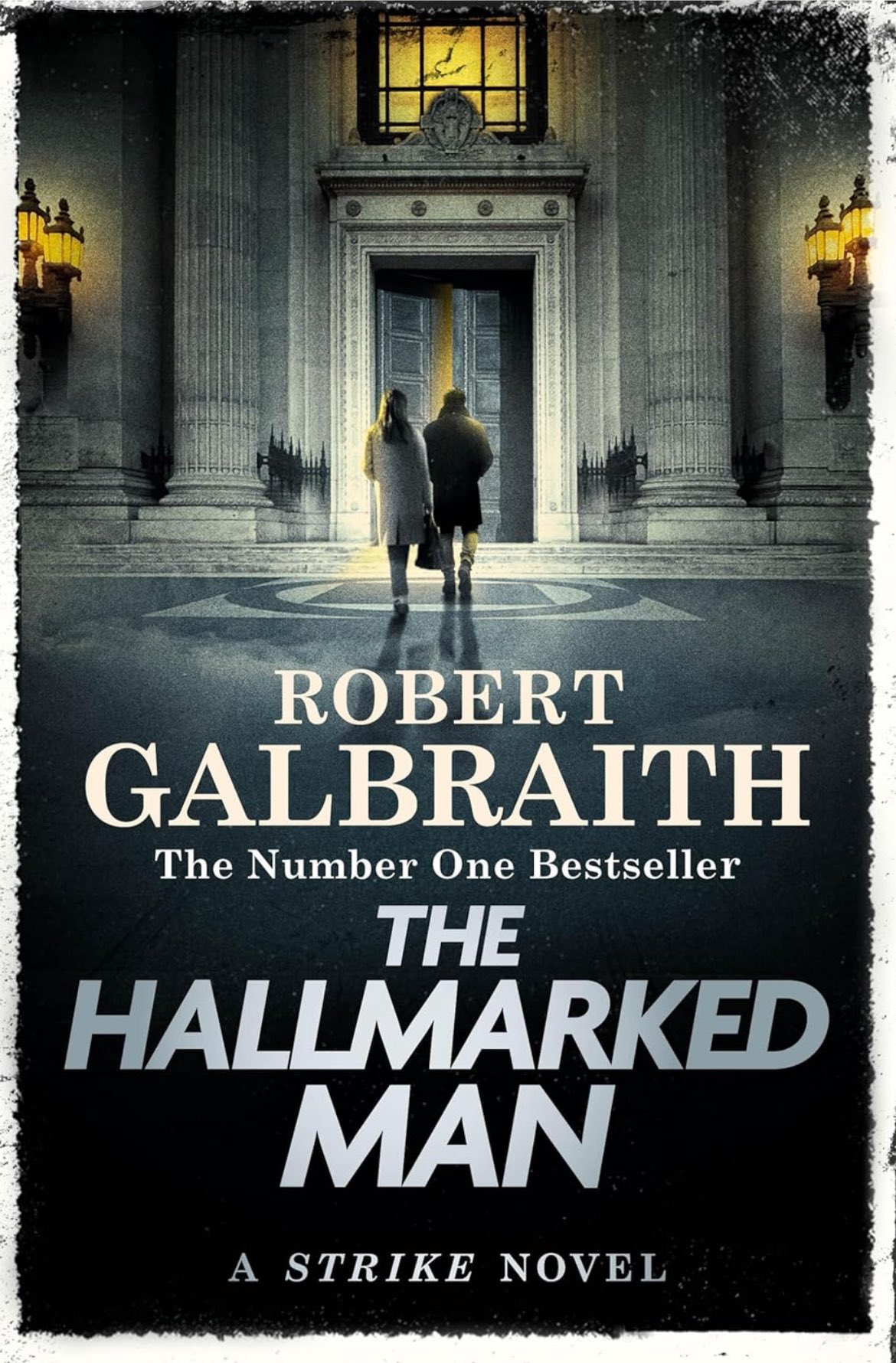
 In what looks like a case of mistaken early release (again), The Strike and Ellacott Podcast found the cover for The Hallmarked Man displayed on the Apple Books site as far back as 23rd May. A bare four hours later J. K. Rowling confirmed the cover with her own tweet, and an intriguing detail about where inside the building depicted we should be looking:

The cover is, of course, Freemasons Hall in London, previously seen in Rowling’s Twitter header. Wikipedia tells us that Temple 17:
Temple No 17 was largely funded by the Freemasons of Buckinghamshire, and has a very large carved swan (the symbol of Buckinghamshire) on one wall; it also enjoys a more than usually ornate decorative style, with extensive oak panelling, and is used in particular by the most ancient lodges in London, including the three remaining lodges (of four originals) which pre-date 1717 and the formation of the Grand Lodge itself.
We had to wait another four days for S&E Podcast to again come up trumps with a look inside Temple 17, and that Buckingham swan:

So far so good, but because of the unconventional release of the cover design, we were missing the synopsis, traditionally released at the same time. Well yesterday Robert Galbraith marketing finally caught up and released the tag line:
Time would tell whether he’d just done something foolish… or not.
And a little time later, the synopsis in full:
A dismembered corpse is discovered in the vault of a silver shop. The police initially believe it to be that of a convicted armed robber – but not everyone agrees with that theory. One of them is Decima Mullins, who calls on the help of private detective Cormoran Strike as she’s certain the body in the silver vault was that of her boyfriend – the father of her newborn baby – who suddenly and mysteriously disappeared.
The more Strike and his business partner Robin Ellacott delve into the case, the more labyrinthine it gets. The silver shop is no ordinary one: it’s located beside Freemasons’ Hall and specialises in Masonic silverware. And in addition to the armed robber and Decima’s boyfriend, it becomes clear that there are other missing men who could fit the profile of the body in the vault.
As the case becomes ever more complicated and dangerous, Strike faces another quandary. Robin seems increasingly committed to her boyfriend, policeman Ryan Murphy, but the impulse to declare his own feelings for her is becoming stronger than ever.
There is a LOT to unpack here… We are perhaps inured to police incompetence in the Strike series, but how dismembered must a body be, for a DNA match to an already convicted armed robber to be unreliable? Since 1995 the DNA records of everyone convicted of an offence has been held. If the armed robber was released before 1995, with a typical imprisonment of 18 years, he is no spring chicken. What about a DNA paternity test for the newborn baby? Or is it the baby that has mysteriously disappeared? Louise Freeman suspects possible police corruption linked to Freemasonry.
Then we have the name Decima Mullins. Decima, as well as meaning the tenth child for unimaginative parents of large families…
Decima was one of the three Parcae (known in English as the Fates) in Roman mythology. The Parcae goddess Nona was responsible for pregnancy; Decima was responsible for measuring a person’s lifespan; and Morta was charged with overseeing death. They distributed to mankind all the good and bad things in life, and according to some classical writings even Jupiter had to bend to their will. Decima measured the thread of life with her rod, like her Greek equivalent Lachesis. In some accounts, her mother was Nox the goddess of night and her father was Scotus the god of darkness; while in other accounts, her parents were Jupiter and Themis.
Professor Freeman also links Decima with her Greek equivalent’s appearance in Lethal White.
“Playing stupid, eh? Lachesis,” said Chiswell, “was one of the Fates. She measured out each man’s allotted lifespan. Knew when everyone’s number would be up. Not a fan of Plato, Mr. Mallik? Catullus more up your street, I expect. He produced some fine poetry about men of your habits. Pedicabo ego vos et irrumabo, Aurelia pathice et cinaede Furi, eh? Poem 16, look it up, you’ll enjoy it.”
Lethal White Chapter 21
“Think about the lachesis pills. You’re the one who thought they were significant. Think about all those odd things Chiswell kept doing: taunting Aamir in front of everyone, saying Lachesis ‘knew when everyone’s number would be up,’ telling you ‘one by one, they trip themselves up,’ looking for Freddie’s money clip, which turned up in his pocket.”
Lethal White Chapter 65
Intriguing as all this is, its the third paragraph that has set the fandom on fire! “Robin seems [this word is doing a lot of heavy lifting] increasingly committed to her boyfriend, policeman [and possible Freemason?] Ryan Murphy, but the impulse to declare his own feelings for her is becoming stronger than ever.” Hasn’t Strike already declared his feelings?
Strike and Robin had once before sat in this office, after dark and full of whisky, and he’d come dangerously close to crossing the line between friend and lover. He’d felt then the fatalistic daring of the trapeze artist, preparing to swing out into the spotlight with only black air beneath him, and he felt the same now.
‘—she knew I was in love with you.’
A stab of cold shock, an electric charge to the brain: Robin couldn’t quite believe what she’d just heard. The passing seconds seemed to slow. She waited for Strike to say ‘which was her spite, obviously,’ or, ‘because she never understood that a man and a woman could just be friends’, or to make a joke. Yet he said nothing to defuse the grenade he’d just thrown, but simply looked at her.
The Running Grave Epilogue
Has the romantic miscommunication been going on too long? What is meant by “Time would tell whether he’d just done something foolish… or not.”? Let me know what you think in the comments!

When either Affection or Eros is one’s theme, one finds a prepared audience. The importance and beauty of both have been stressed and almost exaggerated again and again… But very few modern people think Friendship is a love of comparable value or even a love at all. I cannot remember that any poem since In Memoriam, or any novel, has celebrated it. Tristan and Isolde, Antony and Cleopatra, Romeo and Juliet, have innumerable counterparts in modern literature: David and Jonathan, Pylades and Orestes, Roland and Oliver, Amis and Amile, have not.
