J. K. Rowling Drops All the Strike 9 Clues for Christmas!

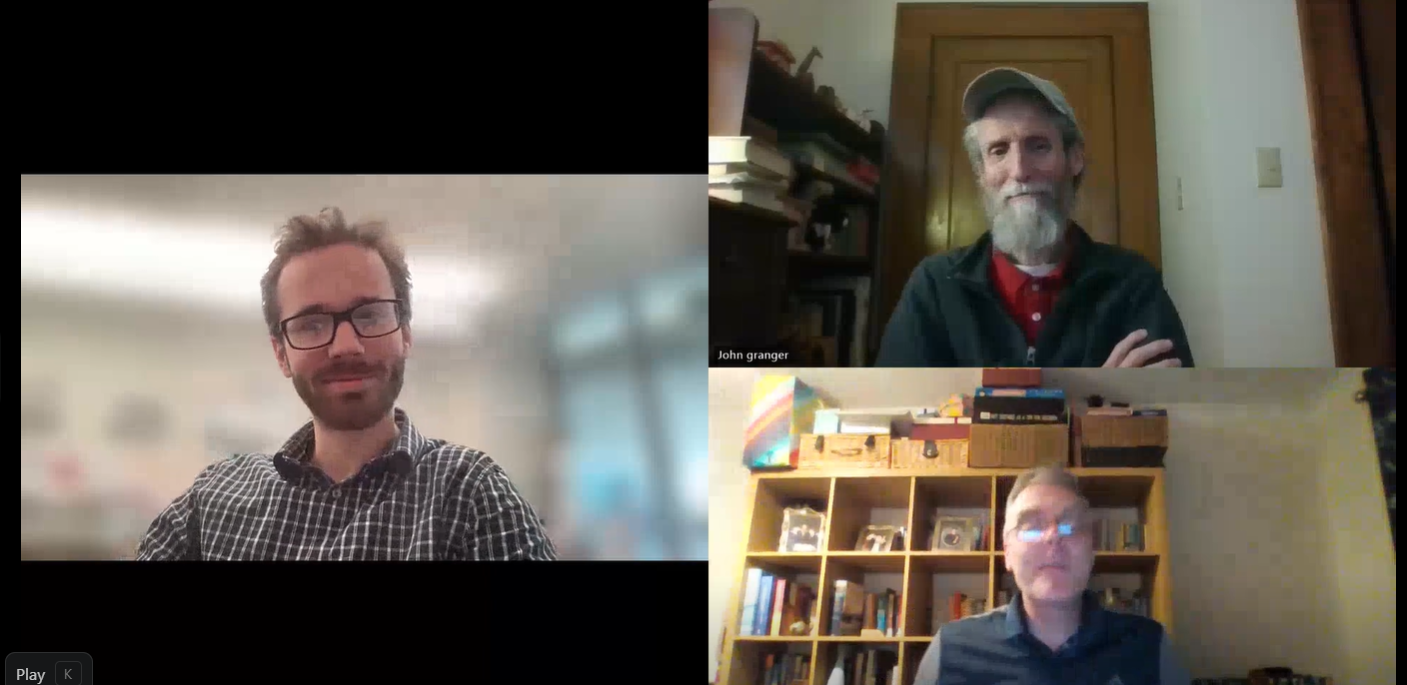
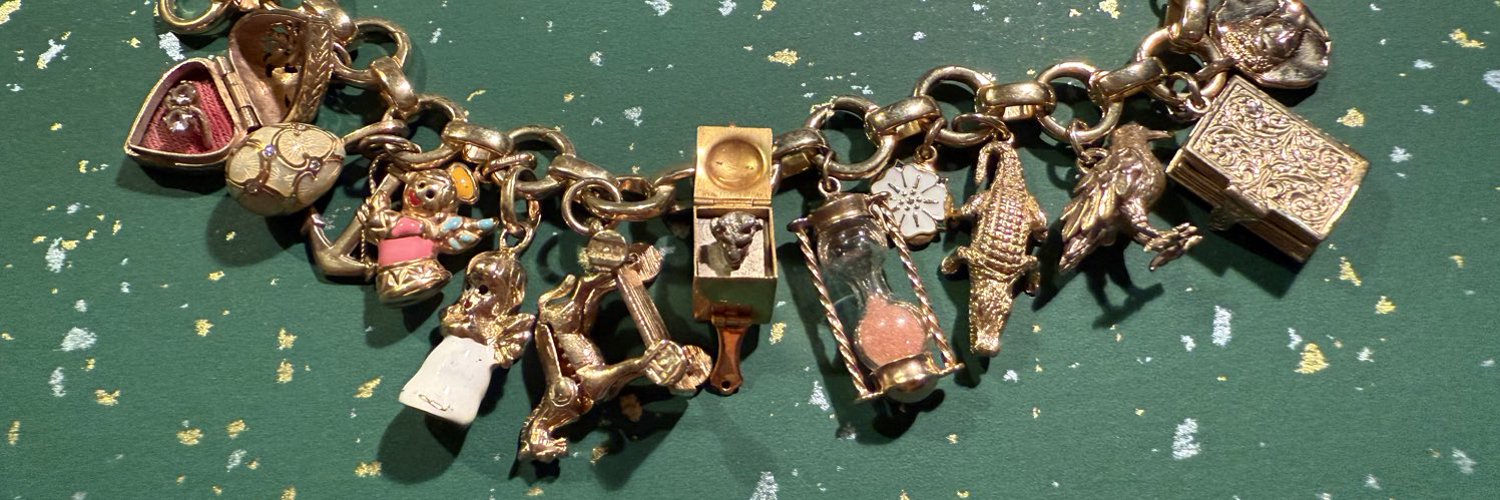
J. K. Rowling has consistently used the headers to her Twitter (X) account to drop clues to the books she has been working on. You can find all of her previous Twitter headers here. As a special  early Christmas present to Strike fans, she has changed her header to a charm bracelet filled with clues for the upcoming ninth in the Strike-Ellacott series. Each of the charms on the bracelet are discussed below:
Link 1
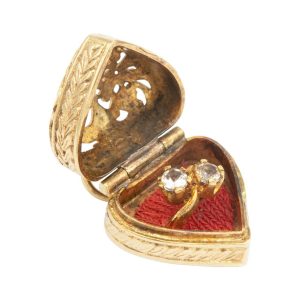
A diamond ring in a heart shaped box. Described by Robert Harris Jewellers as “An attractive vintage 9 carat gold ring box charm. This splendid little charm has a gorgeous heart shaped filigree lid, opening to display a pretty two stone ring. A lovely and interesting item dating to 1966.”

This could be “the silver-coloured band hidden in the depths of Murphy’s wardrobe: a tiny, sparkling shackle.” However this is not a solitaire and the band is gold rather than silver. Could this be a ring from another suitor?

Link 2
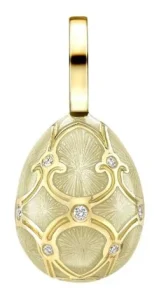
A diamond encrusted and enamelled gold egg. This egg is from Fabergé, and is by some distance the most expensive item on the bracelet, retailing at $9,770. 

The egg is a universal symbol of creation, rebirth, fertility, and potential. Its ability to contain and birth new life makes it a powerful symbol of renewal, growth, and the afterlife, found in spring rituals and Christian Easter celebrations. Robin’s ectopic pregnancy in The Hallmarked Man was a surprise to all except John Granger. This may represent her difficult decision to freeze her eggs to maintain fertility.

A golden anchor. Anchor symbolism primarily represents safety, stability, hope, strength, and steadfastness, stemming from its nautical function of holding a ship secure; it also signifies strong ties, commitment, and love, especially in relationships, and holds deep roots in Christianity as hope in Christ, often appearing in catacombs as a hidden symbol of faith during persecution. Paired with the egg, this could represent Cormoran Strike’s support for Robin.
Link 3

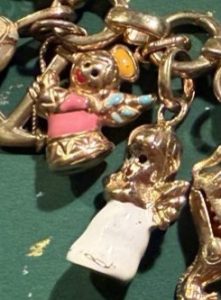
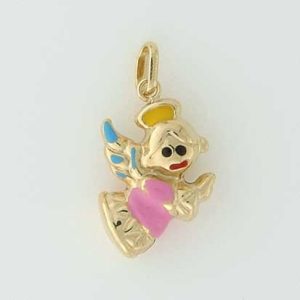
Possibly Cupid and Psyche, but these figures aren’t very distinct. Twitter user, hsmum has brilliantly identified the Hattern Garden jeweller where the pink Angel was purchased.

Link 4

A Trojan horse. This one looks to be sourced from Ogden a jeweller in Harrogate. They say: “Expertly crafted from high-quality 9ct gold, this charm is designed to open, revealing intricate details inside, adding an element of surprise and intrigue. A symbol of cunning and strategy, the Trojan Horse makes a bold statement while offering a delightful, interactive experience.” 

This reader is hoping that Strike reflects on the success of his ‘cunning and strategy’ in Hallmarked Man, and tries another tactic.

Link 5

A Jack-in-a-box. Badly-Wired-Lamp identified this on Twitter, and Worth Point describe this as “A terrific vintage English, solid 9 carat gold charm; beautifully modelled as a jack in the box type toy, with a catch-release revealing a tiny silver horned devil inside on a spring!”

A Jack-in-a-box is the archetypal surprise, and it is certain that Strike 9 will contain its share of surprises.
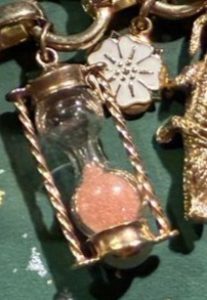
Link 6

A hourglass. Time may be running out! A similar one is available at Butter Lane Antiques who say: “The hourglass (aka sand timer), along with it’s obvious practical uses, has long been associated with death – particularly the brevity of individual human existence. Often found on grave stones from the middle ages through to the Victorian era, occasionally with the words Fugit Hora (Latin: ‘Hours are Fleeting’ or ‘Time Flies’). This miniature hourglass pendant dates from the late Victorian era, and, while it does measure out a length of time (approx. 3 seconds), it was likely intended as a symbolic Memento Mori piece more than anything else.”
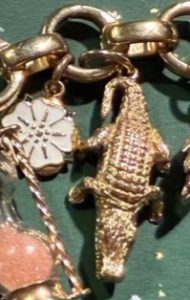
Link 7

The white rose of Yorkshire. Robin Ellacott’s home county. White roses symbolise purity, innocence, new beginnings, and reverence, making them popular for weddings (new union), funerals (remembrance, peace), and as tokens of loyalty, respect, and honour, representing a pure, untainted love or deep admiration. They signify fresh starts, quiet love, spiritual connections, and are a timeless way to express deep emotions from joy to sorrow.

A crocodile or alligator. A crocodile may symbolise power, survival, resilience, and primal energy, but also cunning, deceit, and danger.
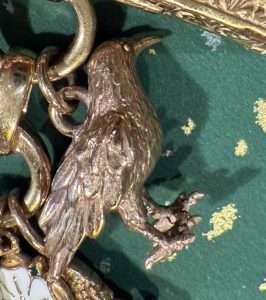
Link 8

A golden corvid. A crow or raven. I really wanted this to be a chough to symbolise Cornwall, but the beak looks too thick. As Badly-Wired-Lamp pointed out, Strike has a close encounter with a raven in The Running Grave: “A loud bang made Strike start. A bird had hit the office window. For two seconds, he and the raven blinked at each other and then, in a blur of black feathers, it had gone.”
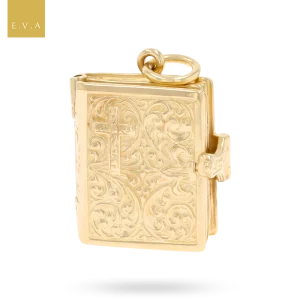
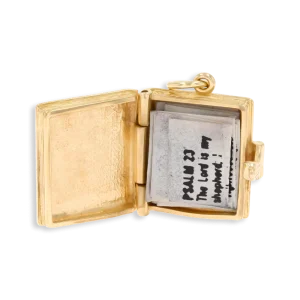
Link 9

A psalter. J. K. Rowling herself has identified this as: “The book is a psalm book and holds real, miniature psalms.” I can find three of these for sale recently. Two were empty and this one has Psalm 23. I can find other designs with the commandments and the lords prayer.

23 The Lord is my shepherd; I shall not want.

2 He maketh me to lie down in green pastures: he leadeth me beside the still waters.

3 He restoreth my soul: he leadeth me in the paths of righteousness for his name’s sake.

4 Yea, though I walk through the valley of the shadow of death, I will fear no evil: for thou art with me; thy rod and thy staff they comfort me.

5 Thou preparest a table before me in the presence of mine enemies: thou anointest my head with oil; my cup runneth over.

6 Surely goodness and mercy shall follow me all the days of my life: and I will dwell in the house of the Lord for ever.
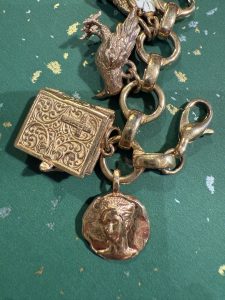
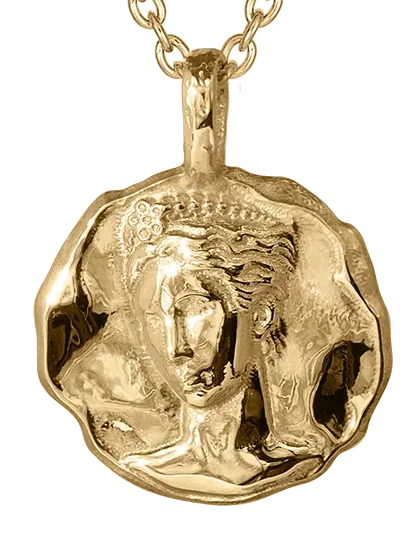
The head of Persephone. Rowling helpfully provided us another view of this charm to help us identify it. This one is sold as a necklace by Common Era. Persephone plays a crucial role in Psyche’s final trial: obtaining a box of her beauty from the underworld to appease Aphrodite. We know already that the myth of Cupid and Psyche will form the framework for the upcoming books, and Psyche in Hades will certainly need psalm 23!
J. K. Rowling and the Roy Phipps Connection

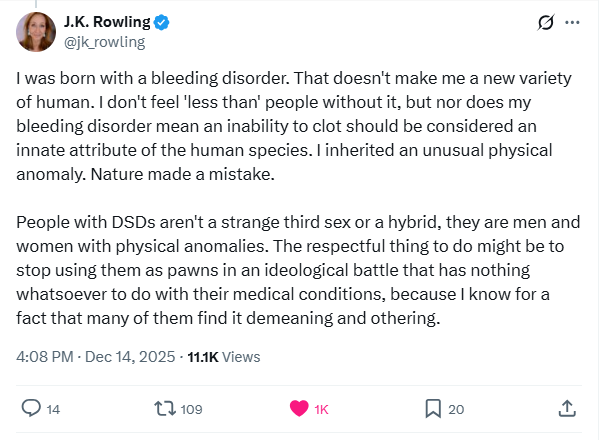
Yesterday, in one of J. K. Rowling’s regular forays in to the sex and gender debate revealed that she was born with a genetic blood disorder:

I was born with a bleeding disorder. That doesn’t make me a new variety of human. I don’t feel ‘less than’ people without it, but nor does my bleeding disorder mean an inability to clot should be considered an innate attribute of the human species. I inherited an unusual physical anomaly. Nature made a mistake.

It is tempting to remember Roy Phipps from Troubled Blood also has a genetic blood condition – von Willebrand Disease.

‘What’s von Willebrand Disease?’ asked Robin.

‘A bleeding disorder. I looked it up. You don’t clot properly. Gupta remembered that wrong; he thought Roy was a haemophiliac.

‘There are three kinds of von Willebrand Disease,’ said Strike. ‘Type One just means you’d take a bit longer than normal to clot, but it shouldn’t leave you bedbound, or unable to drive. I’m assuming Roy Phipps is Type Three, which can be as serious as haemophilia, and could lay him up for a while. But we’ll need to check that.

Troubled Blood, Chapter 14

If Rowling does have von Willebrand Disease, it isn’t that uncommon. It is the most common hereditary blood clotting disorder in humans, affecting 1% of the population. In terms of lake inspiration, perhaps it is time to take a second look at both the title of Troubled Blood and the blood malediction featuring in both Cursed Child and Fantastic Beasts.

Full Cast Audio Harry Potter: Is It Worth a Listen? Three Potter Pundits Discuss

John Granger rarely listens to audio adaptations of books unless he’s on a long drive, though he admits they have played an important part in his life as a reader.

Nick Jeffery listens to audio books everyday and often for hours at a time; he credits the medium for his mid-life rebirth as a reader (re-reader!).

Zossima Granger, writer in residence at ProtagonistBook.com (Give the gift of an unforgettable story!) and host of Teller Talk interview series at Zossima’s Story Stack Substack page, cannot remember a time when Harry Potter and audio books were not an important part of his life. He like Nick listens to one book per week or more.

So — what do these Potter Pundits and Serious Strikers think of the new Audible ‘Full Cast Audio’ (FCA) unabridged dramatization of Harry Potter and the Sorcerer’s Stone, which in the UK and Commonwealth nations is Philosopher’s Stone?

They loved it! Listen to their in-depth discussion at the HogwartsProfessor Substack page.

No, the adaptation wasn’t perfect, and, yes, there are a few jarring miscues and disappointments. As they explain in their ten point discussion of their experience listening to the Audible production, however, there’s reason to be very excited about this audio version of the first Potter novel and the six promised FCA dramatizations.

Nick lays out the audio adaptation history of the Hogwarts Saga, to include, in addition to the background of the new FCA books, the Stephen Fry and Jim Dale legacies. And then he asks the questions below!

  1. What is your relationship with audio books? Are you a frequent listener?
  2. Were the Fry/Dale Potter adaptations an important part of your experience of the Hogwarts Saga?
  3. Did you listen to the ‘full cast audio’ adaptation of Christmas Pig? Other books?
  4. What were your expectations — fears and hopes — for the Sorcerer’s Stone full cast audio adaptation?
  5. What was the biggest surprise you experienced in your first listening?
  6. Which of the voice actors brought out a different dimension of the text than you expected?
  7. What is your favorite scene in Stone and was the full cast audio depiction of it a delight or a disappointment?
  8. Fry, Dale, or Full Cast: will you listen to all three versions in the future? Do you have a strong preference?
  9. Thumbs up or down: one to five stars, please, for the Audible production and your biggest grins and gripes.
  10. What changes do you hope the producers will make before they release the next six adaptations?

Please join in the conversation by sharing your answers to these questions in the comment boxes below. What is your relationship with books you listen to rather than read? What do think of the new FCA dramatization?

And, when you’ve made your contribution to this conversation and you’d like more conversation between Nick Jeffery and Zossima Granger for dessert, check out Teller Talk #4, ‘Harry Potter and the Skill of Reading’!

Thoughts on the First Trailer for Sunrise on the Reaping

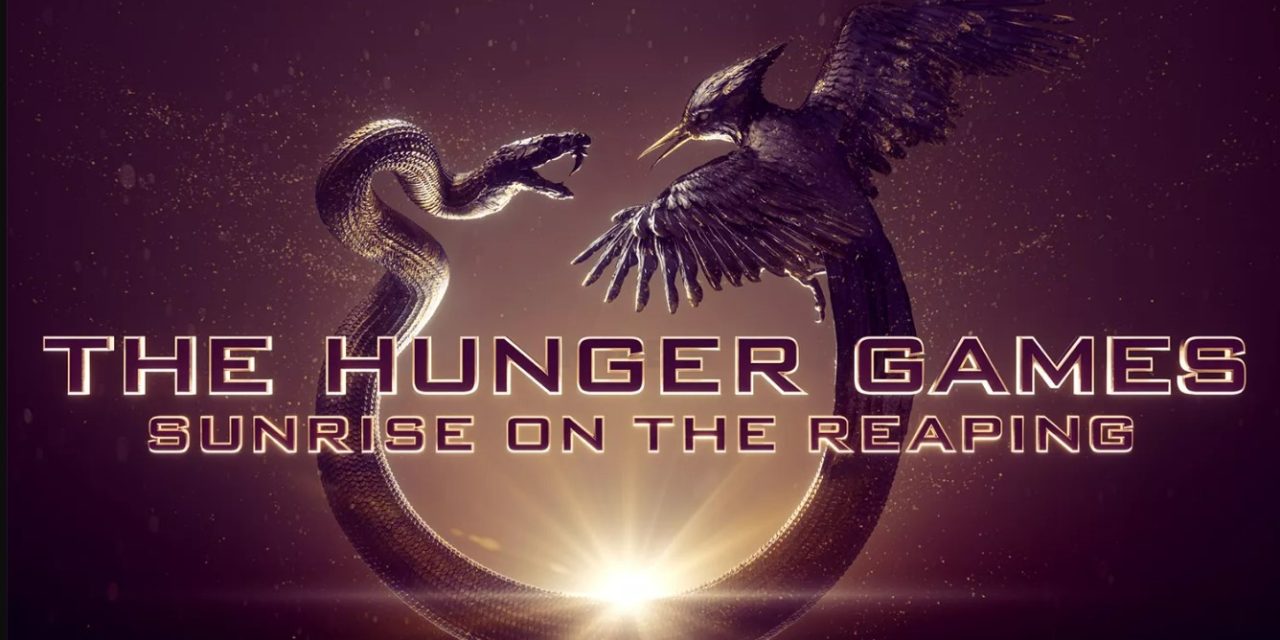
It’s nearly a year until the release of the film adaptation of Sunrise on the Reaping, the second prequel to Suzanne Collins’s Hunger Games trilogy. Of course, as we’ve already discussed here, theTHE HUNGER GAMES: SUNRISE ON THE REAPING Trailer | novel is a powerful look into the trauma that shaped Haymitch Abernathy, sleeper rebel agent and mentor to Katniss Everdeen and Peeta Mellark. The Hollywood Gamemakers, however, are not wasting any time ramping up the PR machine with plenty of the old “razzle dazzle” that Plutarch Heavensbee appreciates. Just a few days ago, Lionsgate released a brief teaser trailer calculated to drive the fans wild, but it also has some interesting points to consider. Although this film will doubtless, like the others, have some serious missteps, it will be interesting to look into the choices made by the filmmakers, people who apparently don’t know or care that their creations justify Collins’s scathing criticism of an entertainment-driven culture that mercilessly abuses and sacrifices its darlings. Join me after the jump for  three (of course) quick thoughts on the trailer and what we might expect from the film next year.


[Read more…]

Mailbag: Help with Christian Harry Hater

This plea for assistance or advice was in my inbox this morning:

Dear Mr. Granger,

I am asking for some advice on how to handle fellow Christians who are disrespectful towards people who enjoy Harry Potter.

I recently conversed back and forth on Instagram with a very condescending Christian who labeled me as “dense” for disagreeing with his arguments and muggle-like attitude–lol. 

I am curious how you would respond to the following claims he made:

  • Harry Potter contains pagan practices;
  • Real occult references and symbolism are in the books;
  • Harry Potter contains information about “magick”, sigils, and spells (that sounds like some Richard Abanes propaganda);
  • The Deathly Hallows symbol is designed from Solomonic sigil magick;
  • Incantations are bad (not fantasy) and are called “magick” (he conveniently ignores the fact that incantations and spells are present in both The Lord of the Rings and The Chronicles of Narnia and yet defends both of those book series);
  • Harry Potter promotes the heresy of gnosticism;
  • Harry Potter story elements are based on real occultic legends/people, i.e.; Alastor Moody based on Aleister Crowley, Cassandra Vablatsky based on Helena Blavatsky, the Philosopher’s Stone, and the Hand of Glory;
  • J.K. Rowling’s tattoo is demonic (I thought your argument posted on Hogwarts Professor sufficiently debunked this already); and
  • J.K. Rowling has not outrightly pronounced her faith (we already know that is false).

I tried recommending your book How Harry Cast His Spell to him and asked if he would give it a chance–but he’s so stubborn and pious that he can’t be open to another viewpoint. He claims to have been studying gnosticism and magick for ten years and says that all of these things while not directly involving invocational magic are how the Devil promotes sinful storytelling and rebellion against God.

As a conservative Christian and a Potterhead, how would you counter these bold arguments?

Thank you for all the work you’re doing and God Bless 🙂

Josh

Where to begin, Josh? I am an Orthodox Christian and a Perennialist-inclined literary critic rather than “conservative” or a “Potterhead” but I see your point that I don’t see the Hogwarts Saga as does this heresy hunter and Harry Hater.

Every one of these claims made by your Instagram sparring partner, as you noted, was made by Richard Abanes in his Harry Potter and the Bible : The Menace Behind the Magick(2001). That doesn’t mean that the claim is ipso facto in error; it actually means that there is evidence that the claim is true but the argument is wrong-headed. As you point out more than once that he was not receptive to discussion or “open to another viewpoint,” I don’t think you should spend any more time than you already have trying to persuade him.

I’d ask you to think about three things to prevent you from slipping into the pious surety of this internet maven you tangled with online.

First, my books on the Christian content and structure of the Harry Potter books and series were not written as ammunition to deploy against those who have decided not to read the book or those who campaign against their supposed “corruption of the youth.” My goal when talking about Rowling’s traditional artistry has been primarily to explain to readers who love the Wizarding World adventures why they love them.

Life is short and there is no end of books to read; there is no point in wrestling verbally with those who choose either not to engage with Harry Potter and friends or to make decrying Rowling’s fantasy fiction an article and touchstone of their faith. The exercise is not edifying to the For or the Against debaters and as often as not makes the Defender of Dumbledore begin to sound and act like his or her dismissive opponent.

Second, as rich as the books are in Christian content, symbolism, even narrative structure (and I hope to be revisiting this subject soon in light of remarkable insights from a professor in Illinois Who Must Not Be Named), there are elements in the books that most Christians would consider immoral, e.g., the torture of Slytherin bullies on the Hogwarts Express at the end of Goblet of Fire. Rowling herself has recently said she has changed her mind about the morality of assisted suicide, which makes Dumbledore’s sacrificial death at a friend’s hand lamentable. These books, uplifting and challenging and meaningful as they are, are not a postmodern Pilgrim’s Progress.

And, third, the work I have been doing consequent to Rowling’s ‘Lake and Shed’ 2019 interview suggests that the Harry Potter series can be read as the author’s prolonged feminist argument in Christian symbols for pre-natal infanticide (‘induced abortion’). See this conversation I had with Nick Jeffery for why that reading is credible and this discussion of alternative explanations for the ‘Lost Child’ Golden Thread in Rowling’s work.

We’re a long way, Josh, from the black-and-white reading of Harry Potter in which those with misgivings about the books are necessarily ignorant boobs and those who love them are by definition on the side of the angels. That’s especially true when you factor in the fandom leaders who now think of Rowling as the transphobic anti-Christ when they used to idolize her every thought and tweet and the one time Harry Haters who are now Team Rowling because of her stand against the surgical mutilation and chemical castration of children and adolescents.

The books haven’t changed but their Serious Readers have, for and against, and our appreciation of the Hogwarts Saga has been deepened and challenged simultaneously by all we have learned about the author since 2007 and about her children’s books consequent to her many post Potter publications.

To conclude, then, I’d leave you first with Twain’s advice not to wrestle with a pig (“you get filthy dirty and the pig likes it”) and then with my encouragement to read the Harry Potter novels with an open mind yourself. No, Richard Abanes’ ‘arguments by association’ remain logically invalid, but there’s a world of unanswered questions about this wonderful seven book series still to explore, most notably, “What unresolved trauma in Rowling’s life inspired her to write them?”

Thank you for writing and best wishes in your serious reading!

John